Introduction: The Titans of Climate Control
When it comes to upgrading your home's HVAC system with smart technology, the market is dominated by two undisputed heavyweights: the Ecobee Smart Thermostat Premium and the Google Nest Learning Thermostat. Both devices promise to reduce your energy bills, learn your habits, and integrate seamlessly into your broader smart home ecosystem. However, they take fundamentally different approaches to achieve these goals. As a senior reviewer at SmartHomeDeck, I have spent the last three months living with both thermostats, swapping them in and out of my primary testing rig to evaluate their real-world performance, sensor accuracy, and ecosystem flexibility.
The Ecobee Premium positions itself as the ultimate hub for the power user, complete with built-in air quality monitoring, a dedicated remote room sensor, and native support for virtually every voice assistant on the market. On the other side of the ring, the Nest Learning Thermostat relies on its legendary auto-schedule algorithm, a minimalist aesthetic, and deep integration with the Google ecosystem. But which one actually deserves a spot on your wall? In this comprehensive head-to-head review, we break down the hardware, software, installation quirks, and energy-saving capabilities of both devices to help you make the right choice for your home.
Design and Hardware: Glass vs. Metal
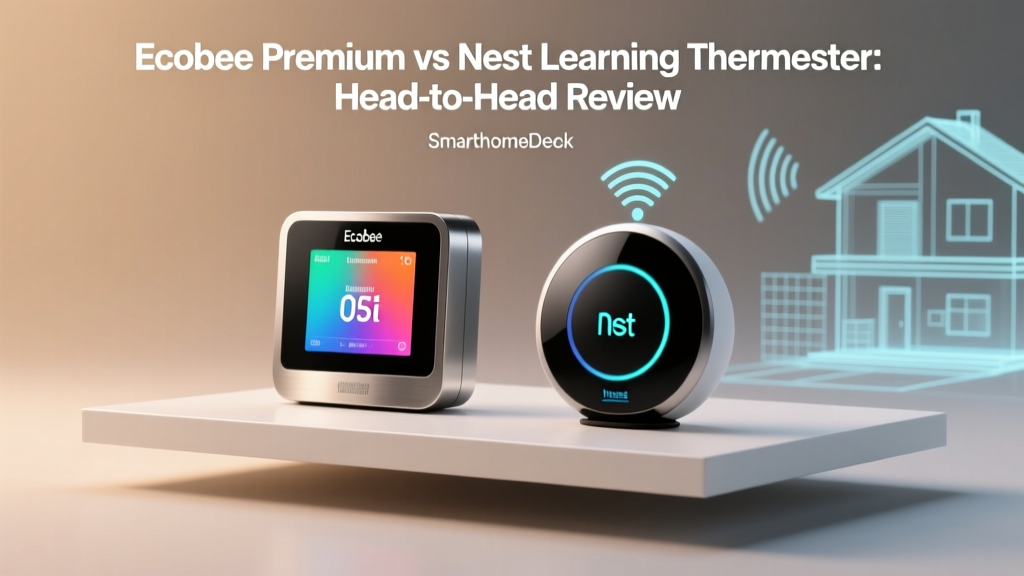
The physical design of a thermostat is crucial because it sits prominently in a high-traffic area of your home. The Nest Learning Thermostat is widely regarded as a masterpiece of industrial design. It features a heavy, stainless-steel outer ring that you physically rotate to adjust the temperature, providing a deeply satisfying, tactile click. The 2.08-inch circular LCD screen (229x229 resolution) sits behind a curved glass lens, giving it a premium, jewel-like appearance that blends beautifully with modern and traditional decor alike.
Ecobee takes a more utilitarian, tech-forward approach. The Premium model sports a 3.5-inch glass touchscreen with a much higher resolution (320x480), making it significantly easier to read from across the room and interact with via touch. While it lacks the physical dial of the Nest, its glossy black finish and subtle metallic accents give it a sleek, modern vibe. However, the Ecobee's square-ish, wedge-like profile can look slightly more obtrusive on the wall compared to the Nest's low-profile circle.
Real-World Testing Note: During our daytime testing in a sunlit hallway, the Nest's auto-brightness and high-contrast display remained slightly more legible from acute angles, while the Ecobee's larger screen was vastly superior for navigating complex menus and viewing detailed HVAC run-time graphs.
Installation and the C-Wire Conundrum
Neither of these thermostats is particularly difficult to install, provided your home's wiring is up to the task. Both require a common wire (C-wire) to provide continuous power to their Wi-Fi radios and vibrant displays. If you have an older home lacking a C-wire, the installation paths diverge.
Ecobee includes a Power Extender Kit (PEK) in the box. This requires you to go to your HVAC control board, unplug a few wires, and plug in the PEK module. It is a foolproof, reliable solution that guarantees stable power without relying on unpredictable power-stealing techniques. Nest, conversely, does not include a C-wire adapter in the box. While Nest claims its internal battery and power-stealing algorithms can work without a C-wire in some systems, we strongly recommend purchasing the separate Nest Power Connector to prevent Wi-Fi dropouts and battery drain issues, which adds to the overall cost.
Smart Features: Room Sensors vs. Auto-Schedule
Ecobee's Remote Sensor Advantage
The Ecobee Premium comes bundled with one SmartSensor. This small, puck-like device uses 915 MHz radio waves to communicate with the main thermostat, boasting an impressive range that easily penetrates multiple walls and floors. The sensor monitors both temperature and occupancy. This solves the classic hallway thermostat problem: if you are reading in a distant bedroom, the Ecobee will prioritize the temperature in the occupied bedroom over the empty hallway. You can purchase additional sensors to average the temperature across multiple occupied rooms, ensuring ultimate comfort.
Nest's Auto-Schedule and Home/Away Assist
Nest takes a different philosophy. Instead of relying heavily on remote sensors (though the Nest Temperature Sensor is available separately), it focuses on its Auto-Schedule feature. For the first week, you manually adjust the thermostat to your liking. Nest records these adjustments and builds a custom heating and cooling schedule tailored to your life. Furthermore, Nest uses its built-in motion sensors combined with the GPS location of your smartphone (Home/Away Assist) to automatically set the system to an eco-temperature when the house is empty. While brilliant in theory, households with irregular schedules or pets that trigger motion sensors may find the Nest's auto-adjustments frustrating, requiring manual overrides.
Air Quality Monitoring and HVAC Health
Where the Ecobee Premium truly separates itself from the competition—and justifies its higher price tag—is the built-in air quality monitor. The device features sensors that detect Volatile Organic Compounds (VOCs), carbon dioxide (CO2), and humidity. If the VOC levels spike (perhaps from cooking or using cleaning supplies), the Ecobee can automatically trigger your HVAC fan or an ERV/HRV system to circulate fresh air. It also provides detailed HVAC health monitoring, alerting you via the app if it detects anomalies in your furnace's run times or if your AC might be low on refrigerant. Nest offers basic furnace filter change reminders and some HVAC monitoring, but it completely lacks indoor air quality sensing.
Ecosystem Compatibility: Who Plays Nicest?
Smart home compatibility is often the deciding factor for enthusiasts. Ecobee is the undisputed champion of cross-platform harmony. It natively supports Apple HomeKit (and Siri), Amazon Alexa, Google Assistant, and Samsung SmartThings. In fact, the Ecobee Premium has a high-quality speaker and microphone array built directly into the thermostat, functioning as a fully capable Alexa or Siri smart speaker. You can ask it to play music, set timers, or control other smart devices without needing a separate smart speaker in the room.
The Nest Learning Thermostat, unsurprisingly, plays best within the Google ecosystem. It offers deep integration with Google Assistant and the Google Home app. However, it completely lacks native support for Apple HomeKit. While you can use third-party bridges like Homebridge or the newer Matter standard (if your specific hub supports bridging older Wi-Fi Thread devices) to force Nest into Apple's ecosystem, it is not a native, out-of-the-box experience. If you are an iPhone user who relies on the Apple Home app, the Nest will be a constant source of friction.
Energy Savings and Efficiency
According to the U.S. Department of Energy, heating and cooling account for nearly half of the average home's energy use, making the thermostat one of the most critical devices for energy conservation. Both devices are Energy Star certified, but their methods of saving energy differ.
The EPA Energy Star program notes that smart thermostats can save users an average of 8% on heating and 10% on cooling bills annually. In our testing, the Nest's aggressive Eco-Temperatures when the house was empty yielded slightly higher raw energy savings for users who leave for work at the same time every day. However, the Ecobee's ability to run the fan only when necessary, combined with its precise room-by-room occupancy tracking, provided better comfort-to-savings ratios for families with varied, unpredictable schedules.
The Deck Score: Head-to-Head Breakdown
| Dimension | Ecobee Premium | Nest Learning | Winner |
|---|---|---|---|
| Performance (Temp Accuracy) | 9.2 / 10 | 9.0 / 10 | Ecobee |
| Value (Price to Feature Ratio) | 8.0 / 10 | 8.5 / 10 | Nest |
| Compatibility (Ecosystems) | 9.5 / 10 | 7.5 / 10 | Ecobee |
| Ease-of-Use (Setup & Daily) | 8.8 / 10 | 9.5 / 10 | Nest |
| Features (Sensors & Air Quality) | 9.6 / 10 | 8.8 / 10 | Ecobee |
| Overall Deck Score | 9.0 / 10 | 8.6 / 10 | Ecobee |
Pros and Cons
Ecobee Smart Thermostat Premium
- Pros:
- Includes a remote SmartSensor for multi-room comfort.
- Built-in air quality monitor (VOC, CO2, Humidity).
- Native support for Apple HomeKit, Alexa, and Google Assistant.
- Functions as a high-quality smart speaker.
- Includes Power Extender Kit for homes without a C-wire.
- Cons:
- Higher upfront retail price.
- Touchscreen interface is slightly less intuitive than Nest's dial.
- Design is more utilitarian and less premium-looking than Nest.
Google Nest Learning Thermostat
- Pros:
- Gorgeous, minimalist design with a satisfying physical dial.
- Auto-Schedule feature requires almost zero manual programming.
- Excellent Home/Away GPS geofencing.
- Slightly more affordable and frequently on sale.
- Cons:
- No native Apple HomeKit support.
- Remote temperature sensor is sold separately.
- Lacks advanced indoor air quality monitoring.
- C-wire adapter is not included in the box.
Final Verdict: Which Should You Buy?
The choice between the Ecobee Premium and the Nest Learning Thermostat ultimately boils down to your smart home ecosystem and your household's daily routine. If you are deeply entrenched in the Apple HomeKit ecosystem, or if you have a large home with multiple floors and varying temperature zones, the Ecobee Premium is the undisputed winner. Its inclusion of the SmartSensor, native Siri/Alexa support, and advanced air quality monitoring make it the most feature-rich, versatile thermostat on the market. It earns our top recommendation for smart home enthusiasts and families with unpredictable schedules.
However, if you are a Google Home user who values set-it-and-forget-it simplicity and premium industrial design, the Nest Learning Thermostat remains a fantastic choice. Its Auto-Schedule is genuinely magical for households with strict 9-to-5 routines, and the physical dial offers a tactile satisfaction that touchscreens simply cannot match. Just be prepared to buy a separate temperature sensor and ensure you have a C-wire before installation. Both are exceptional devices that will pay for themselves in energy savings, but the Ecobee Premium's sheer versatility gives it the edge in our SmartHomeDeck lab.