The Hidden Cost of Electricity and the Need for Visibility
As the transition to electric vehicles, heat pumps, and smart home appliances accelerates, residential electricity consumption is becoming more complex and expensive. According to the U.S. Energy Information Administration (EIA), the average retail price of electricity has seen steady year-over-year increases, making energy efficiency no longer just an environmental concern, but a critical financial one. Yet, most homeowners only discover how much energy they are using when the monthly utility bill arrives. By then, it is too late to change behavior.
Enter the smart home energy monitor. Unlike smart plugs that track individual devices, a whole-home energy monitor sits inside your electrical panel and provides a bird's-eye view of your entire property's power consumption. Today, we are putting the Emporia Vue Smart Home Energy Monitor through its paces. Priced aggressively against competitors like Sense and Eyedro, the Emporia Vue promises granular, circuit-level tracking without relying on AI guesswork. But does it deliver on its promises? In this comprehensive SmartHomeDeck review, we break down the installation, accuracy, app experience, and ecosystem compatibility to help you decide if it is the right upgrade for your home.
Unboxing the Emporia Vue: Hardware and Specifications
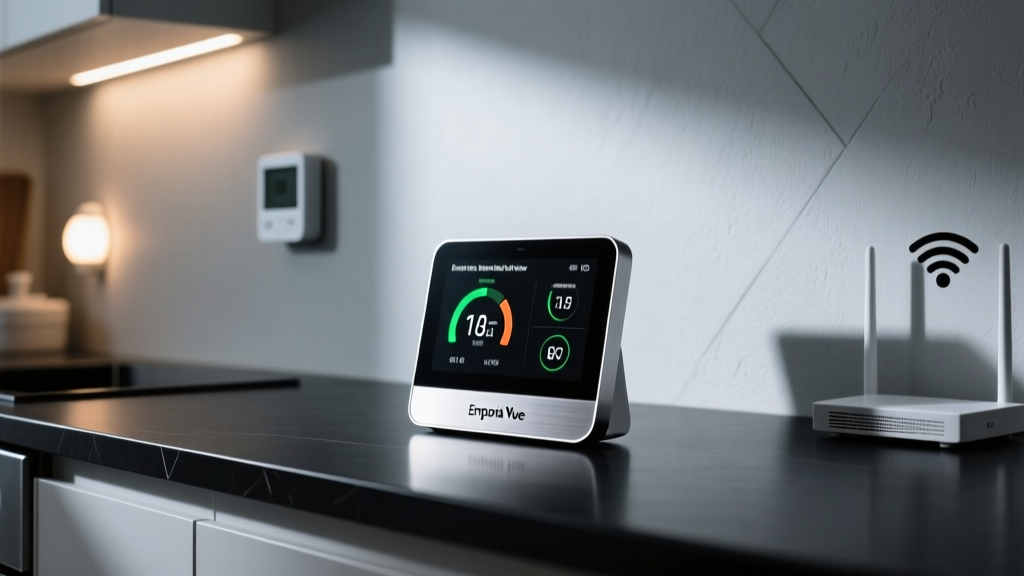
The Emporia Vue (often referred to as Vue 2 in its current mainstream iteration) is a hardware hub that connects directly to your home's main electrical panel via Current Transformer (CT) clamps. The base kit typically includes the main monitoring hub, two 200A CT clamps for your main service lines, and eight 50A CT clamps for individual branch circuits. This is a massive differentiator from competitors that only monitor the main lines and use machine learning to guess which appliance is turning on.
The hub itself is compact, measuring roughly 4.5 x 4.5 inches, and requires a standard 120V connection to a breaker for power. It communicates with your home network via 2.4GHz Wi-Fi. The CT clamps are wired directly into the hub via proprietary RJ45-style connectors. The hardware feels robust, and the clamps feature clear labeling, which is crucial when you are navigating a crowded breaker panel.
Installation: A Job for Professionals
Let us be unequivocally clear: installing the Emporia Vue requires opening your main electrical panel, which contains lethal voltage. While Emporia provides detailed DIY instructions and video tutorials, SmartHomeDeck strongly recommends hiring a licensed electrician for the installation. Working near the main service lugs, which remain live even if the main breaker is turned off, poses a severe risk of arc flash or electrocution.
From a practical standpoint, the biggest installation hurdle is physical space. The eight 50A CT clamps are somewhat bulky. If your electrical panel is already packed with wiring, or if you have a double-row breaker setup where breakers are tightly stacked, fitting all eight clamps can be a puzzle. An electrician will need to route the low-voltage wires from the clamps to the hub, which is usually mounted just outside or adjacent to the panel. Expect to pay between $150 and $300 for professional installation, depending on your local rates and the complexity of your panel.
Real-World Performance: Circuit-Level Accuracy
The core philosophy of the Emporia Vue is physical measurement over algorithmic estimation. Devices like the Sense monitor rely on AI to detect the unique electrical "signatures" of devices turning on and off. While Sense is magical when it works, it frequently struggles with variable-speed motors, LED drivers, and multi-function appliances. The Emporia Vue bypasses this entirely. If you clamp the 50A sensor around the wire feeding your oven breaker, the app will tell you exactly how much power the oven is using, with zero ambiguity.
During our testing, the Vue sampled data at an impressive one-second interval. This high-frequency sampling is vital for capturing short bursts of power, such as a microwave turning on for 30 seconds or a well pump kicking in. The accuracy of the CT clamps was exceptional, reading within 1-2% of our calibrated multimeter tests.
However, the "Other" category is where the Vue's limitation lies. Because it only comes with eight individual clamps, any breaker you do not physically clamp gets lumped into an "Other" or "Unmonitored" category. If you have a 40-breaker panel, you will need to prioritize which circuits to monitor (e.g., HVAC, EV charger, water heater, oven) and accept that your lighting and standard outlet receptacles will be grouped together.
Phantom Loads and Time-of-Use Optimization
One of the most actionable ways to use the Emporia Vue is to hunt down phantom loads and optimize for Time-of-Use (TOU) rate plans. The U.S. Department of Energy (DOE) notes that standby power and inefficient older appliances can account for a significant portion of a home's electrical draw. Using the Vue's historical graphs, we identified a 15-year-old garage refrigerator that was drawing a continuous 140 watts due to degrading compressor coils and poor insulation—a silent budget drain that we immediately replaced.
Furthermore, the Emporia app allows you to input your specific utility rate plan, including complex TOU tiers. If your utility charges $0.35 per kWh during peak evening hours but only $0.09 per kWh overnight, the Vue will calculate your actual financial cost in real-time. This is an invaluable tool for EV owners, allowing them to verify that their vehicle's scheduled charging is strictly occurring during off-peak super-off-peak windows.
Solar Production and Net Metering
For homes with solar panels, the Emporia Vue is a powerhouse. By clamping the main service lines and the solar production breaker, the system accurately calculates your net energy consumption. It separates what you are pulling from the grid versus what you are consuming directly from your roof. The app provides beautiful, easy-to-read pie charts showing your solar self-consumption versus grid reliance. While it does not replace the granular panel-level monitoring of a SolarEdge or Enphase system, it provides a highly accurate, cost-effective secondary verification of your solar array's overall production and your home's net metering status.
App Experience and Data Export
The Emporia app (available on iOS and Android) is functional, data-rich, and completely free of subscription fees—a major win in an era of paywalled smart home features. The dashboard offers real-time wattage, historical bar charts (hourly, daily, monthly), and cost estimations.
For the data nerds, Emporia allows you to export your energy data to CSV files. This means you can pull your raw data into Excel, Python, or integrate it with local home automation servers like Home Assistant via community-built APIs. The ability to own and export your data is a massive pro for privacy-conscious users and advanced tinkerers.
Smart Home Ecosystem Compatibility
While the Vue is primarily a monitoring tool, it does integrate into the broader smart home ecosystem. It supports Amazon Alexa and Google Assistant, allowing you to ask, "How much power is my house using right now?" Furthermore, Emporia offers a line of smart plugs and smart switches that integrate directly into the same app, creating a unified dashboard of whole-home and individual device monitoring. Through IFTTT and Home Assistant, advanced users can create automations, such as receiving a push notification if the sump pump runs for more than 10 continuous minutes, indicating a potential flooding issue.
Pros and Cons
Pros:
- True Circuit-Level Tracking: Eliminates the AI guesswork found in competing products.
- No Subscription Fees: Full access to historical data and features for a one-time hardware cost.
- High Sampling Rate: 1-second intervals capture micro-loads accurately.
- Solar and TOU Support: Excellent tools for net-metering and complex utility rate plans.
- Data Export: CSV exports and API access for advanced users.
Cons:
- Limited Clamps: Only eight 50A clamps included; large panels will leave many circuits grouped as "Other."
- Bulky Hardware: CT clamps can be difficult to fit in tightly packed breaker panels.
- App UI: Functional but slightly cluttered; lacks the polished, consumer-friendly gloss of some competitors.
- Professional Installation Recommended: Adds $150-$300 to the total cost of ownership.
Competitor Comparison
| Feature | Emporia Vue | Sense Energy Monitor | Eyedro Gen 2 |
|---|---|---|---|
| Tracking Method | Physical CT Clamps (Circuit-level) | AI / Machine Learning Disaggregation | Physical CT Clamps (Circuit-level) |
| Individual Circuits | 8 included (expandable) | None (AI guesses) | 6 to 12 (depending on kit) |
| Subscription Fee | None | None (but Sense Solar requires sub) | None |
| Sampling Rate | 1 Second | 1 Second (Main), Variable (AI) | 1 Second |
| Solar Support | Yes (Native) | Yes (Requires Sense Solar add-on) | Yes (Native) |
| Approx. Base Price | $100 - $130 | $299 | $250 - $300 |
SmartHomeDeck Score and Final Verdict
The Emporia Vue represents a paradigm shift in home energy monitoring. By prioritizing physical, circuit-level measurement over AI estimation, it provides reliable, undeniable data. While the installation requires professional help and the physical footprint in your panel can be tight, the lack of subscription fees and the sheer depth of the data make it an outstanding value.
SmartHomeDeck Score Breakdown for Emporia Vue
Deck Score Dimensions Explained:
- Performance (9.2/10): Flawless 1-second sampling and highly accurate CT clamps.
- Value (9.5/10): Unbeatable price-to-feature ratio, especially with zero monthly fees.
- Compatibility (7.8/10): Good Alexa/Google support, but lacks native Apple HomeKit integration.
- Ease-of-Use (7.0/10): Installation is complex, and the app has a slight learning curve for new users.
- Features (9.0/10): TOU rate tracking, solar net-metering, and CSV exports are top-tier.
The Bottom Line: If you are a homeowner looking to take control of your energy footprint, optimize solar production, or manage EV charging costs on a Time-of-Use plan, the Emporia Vue is the best smart home energy monitor on the market for the price. It trades a bit of consumer-friendly polish for raw, unfiltered data—and for the smart home enthusiast, that is exactly the right trade-off.