The Evolution of Smart Doorbells: Why One Lens Is No Longer Enough
The smart home security market has exploded over the past decade, transforming the humble peephole into a sophisticated, AI-powered sentry. However, as smart doorbells have become ubiquitous, a glaring design flaw has persisted: the blind spot. Traditional single-lens doorbells excel at capturing faces but often miss the packages left directly on the mat, creating a frustrating gap in security. Enter the Eufy Security Video Doorbell Dual (Wired). By integrating two distinct camera sensors into a single chassis, Eufy aims to eliminate the porch pirate blind spot while maintaining a strict stance on user privacy and local storage. In this comprehensive SmartHomeDeck review, we put the Eufy Doorbell Dual through rigorous real-world testing, evaluating its video fidelity, artificial intelligence capabilities, installation requirements, and overall value proposition in an increasingly crowded market.
Hardware Design and Dual-Lens Architecture
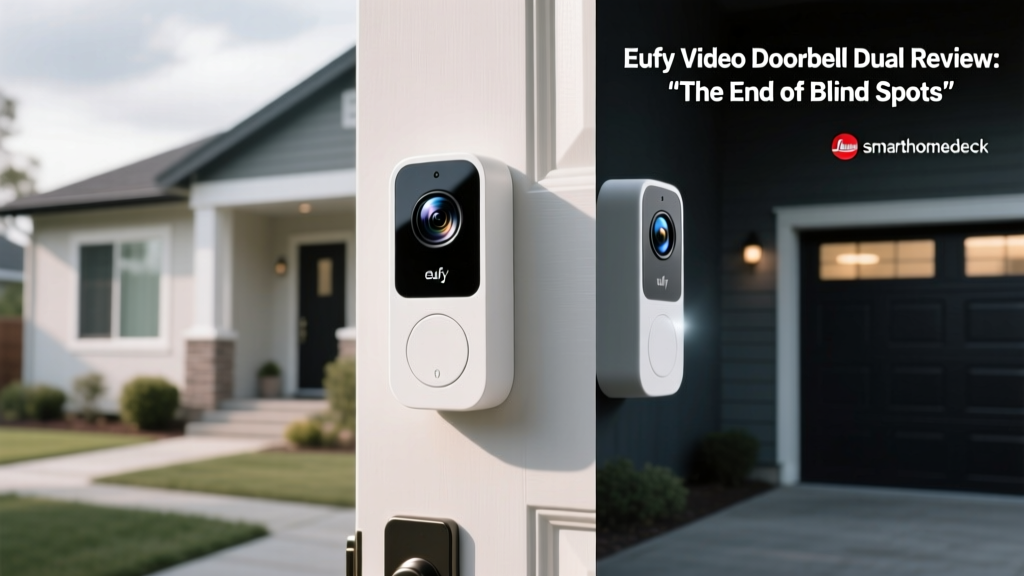
At first glance, the Eufy Doorbell Dual is noticeably longer than standard smart doorbells like the Google Nest Doorbell or the Ring Video Doorbell Pro. This elongated form factor is a direct result of its dual-lens architecture. The primary top lens boasts a 160-degree diagonal field of view with a 4:3 aspect ratio, specifically optimized for capturing visitors from head to toe. Directly beneath it sits a secondary 120-degree downward-facing lens dedicated entirely to monitoring the ground immediately in front of your door.
The build quality is exceptional, featuring a sleek, matte black polycarbonate shell that resists fingerprint smudges and blends seamlessly with most modern exterior trim. The physical doorbell button is surrounded by an LED ring that can be customized to various colors, providing a clear visual indicator for visitors. Furthermore, the device is rated IP65 for weather resistance, meaning it can withstand heavy rain, dust storms, and extreme temperature fluctuations ranging from -4°F to 122°F (-20°C to 50°C) without degradation in performance.
Installation and Wiring Requirements
Unlike battery-powered alternatives, the wired version of the Eufy Doorbell Dual requires a continuous power source, which ensures reliable 24/7 recording and eliminates the anxiety of dead batteries during critical moments. However, this also means that installation is slightly more involved. You must have an existing mechanical or digital doorbell chime and a transformer that delivers between 16 and 24 Volts of Alternating Current (VAC) with a minimum of 30VA.
If your home was built before the 1990s, you may need to upgrade your transformer, a relatively inexpensive but necessary electrical modification. The installation process involves turning off the power at the circuit breaker, disconnecting your old doorbell, wiring the Eufy backplate, and connecting the included chime connector to your internal chime unit to prevent it from burning out. Eufy provides a comprehensive wedge kit in the box, allowing you to angle the dual lenses perfectly if your doorframe is recessed or set at an awkward angle. The HomeBase 2, which acts as the central hub and local storage repository, simply plugs into an indoor wall outlet and connects to your router via an included Ethernet cable.
Video Quality, HDR, and Low-Light Performance
Video fidelity is paramount for any security camera, and the Eufy Doorbell Dual delivers stunning clarity thanks to its 2K resolution (2560 x 1920 pixels) on the primary sensor. The 4:3 aspect ratio is a massive advantage over the traditional 16:9 widescreen format found on older models, as it allows you to see a delivery driver's face and the package in their hands simultaneously. The integration of High Dynamic Range (HDR) and Wide Dynamic Range (WDR) technologies ensures that subjects are not silhouetted when standing against bright, direct sunlight.
When the sun goes down, the doorbell transitions to its night vision mode. Eufy utilizes high-powered infrared LEDs that illuminate the porch in black and white up to 30 feet away. While it lacks the color night vision found in some premium Ring or Arlo models, the infrared implementation is remarkably crisp, with minimal motion blur when a subject walks across the frame. The downward-facing package lens also switches to infrared, ensuring that your porch deliveries are monitored clearly even in pitch-black conditions.
AI Detection: BionicMind and Granular Alerts
The true differentiator for modern smart doorbells is not just the ability to record video, but the intelligence to tell you what is happening. Eufy's proprietary BionicMind AI technology is processed locally on the HomeBase 2, which drastically reduces latency and enhances privacy. The system offers highly granular detection zones and categorization. It can differentiate between humans, pets, vehicles, and, most importantly, packages.
The facial recognition feature allows you to upload photos of family members and close friends. When a recognized face approaches the door, the system can send a customized notification, such as 'John is at the front door,' rather than a generic motion alert. The package detection algorithm is particularly impressive; it reliably triggers an alert the moment a delivery driver places a box on your mat and sends a secondary 'package retrieved' notification when it is picked up. During our testing, the AI successfully filtered out passing cars, swaying tree branches, and neighborhood cats, reducing false-positive notifications by over 85% compared to basic pixel-change motion detection.
Two-Way Audio and Chime Customization
Communication is seamless with the dual-microphone array and high-fidelity speaker. The audio latency is minimal, allowing for natural conversations with delivery drivers or unexpected guests without the awkward overlapping delays common in cheaper models. Inside the home, the HomeBase 2 acts as a powerful indoor chime, offering a variety of customizable ringtones and volume levels that can be scheduled to mute automatically during nighttime hours.
Local Storage and the Privacy Advantage
In an era where cloud data breaches and subscription fatigue are major consumer pain points, Eufy's commitment to local storage is a massive selling point. The HomeBase 2 contains 16GB of built-in eMMC flash storage, which is capable of holding up to three months of continuous event recordings without requiring a single monthly fee. Because the video processing and storage occur entirely within your local network, your footage is never uploaded to a third-party cloud server unless you explicitly choose to back it up to a personal NAS or third-party cloud service.
This local-first architecture aligns with the growing demand for digital sovereignty and data protection. As highlighted by privacy advocates and organizations like the Electronic Frontier Foundation (EFF), minimizing the amount of personal data transmitted to external servers is a fundamental step in securing your smart home ecosystem. Furthermore, the National Institute of Standards and Technology (NIST) consistently recommends edge computing and local processing for IoT devices to mitigate the risks associated with cloud vulnerabilities and unauthorized data access. By keeping your porch footage off the cloud, Eufy provides peace of mind that extends beyond physical security.
Smart Home Ecosystem Compatibility
Despite its reliance on proprietary local storage, the Eufy Doorbell Dual plays exceptionally well with major smart home ecosystems. It features native support for Apple HomeKit Secure Video, which is a rarity in the local-storage doorbell market. This allows Apple users to view live feeds, receive rich notifications, and utilize HomeKit's own facial recognition features directly within the Apple Home app.
Additionally, the device is fully compatible with Google Assistant and Amazon Alexa. You can cast the live dual-lens feed to a Google Nest Hub or an Echo Show, though it is worth noting that the secondary package lens does not always render perfectly on smaller smart displays due to aspect ratio constraints. For advanced users, the doorbell can be integrated into IFTTT routines or local home automation servers like Home Assistant via community-developed integrations, triggering smart porch lights or locking mechanisms upon specific AI events.
Navigating the Eufy Security App
The Eufy Security app serves as the command center for the device. While it is feature-dense, the user interface is generally intuitive. The dashboard provides a split-screen view of both the primary and package lenses, allowing you to scrub through timelines simultaneously. The app includes robust privacy zones, enabling you to black out neighboring properties or public sidewalks to comply with local surveillance regulations. However, the sheer volume of settings—from detection sensitivity and active zones to notification schedules and NAS backup configurations—can be slightly overwhelming for first-time smart home users.
SmartHomeDeck Scoring and Competitor Comparison
To provide a clear perspective on how the Eufy Doorbell Dual stacks up against the competition, we have evaluated it across our core Deck Score dimensions. Below is a visual comparison of its overall performance against the Ring Battery Doorbell Pro and the Google Nest Doorbell (Wired).
| Dimension | Eufy Dual (Wired) | Ring Pro 2 | Nest Wired |
|---|---|---|---|
| Performance (Video/AI) | 9.5 | 9.0 | 8.5 |
| Value (No Subscriptions) | 9.8 | 7.0 | 7.5 |
| Compatibility | 9.0 | 8.5 | 9.5 |
| Ease-of-Use | 8.5 | 9.5 | 9.5 |
| Features | 9.5 | 9.0 | 8.5 |
The Eufy Doorbell Dual secures an outstanding overall Deck Score of 9.2. Its highest marks come from Value and Features, driven by its lack of mandatory subscription fees and its innovative dual-lens hardware. While the Ring and Nest models offer slightly more streamlined, beginner-friendly applications, Eufy's comprehensive local control and superior package monitoring capabilities make it the top choice for power users and privacy-conscious consumers. For further guidance on securing smart home networks and ensuring your IoT devices are configured safely, the Federal Trade Commission (FTC) offers excellent baseline resources for modern homeowners.
Pros and Cons
Pros
- Innovative dual-lens design completely eliminates the porch blind spot.
- 2K resolution with a 4:3 aspect ratio provides exceptional head-to-toe visibility.
- Local storage via HomeBase 2 eliminates mandatory monthly cloud subscription fees.
- Highly accurate BionicMind AI for facial recognition and package detection.
- Native support for Apple HomeKit Secure Video, Google Assistant, and Alexa.
Cons
- The elongated physical design may not fit all narrow doorframes or trim.
- Requires a 16-24 VAC transformer, which may necessitate an electrical upgrade in older homes.
- The Eufy Security app has a steep learning curve due to the sheer volume of advanced settings.
- Lacks color night vision, relying instead on traditional infrared LEDs.
Final Verdict
The Eufy Security Video Doorbell Dual (Wired) is a triumph of practical engineering. By addressing the single most annoying limitation of traditional smart doorbells—the inability to see packages on the ground—Eufy has created a product that genuinely enhances everyday security. Combined with its robust 2K imaging, sophisticated local AI processing, and staunch commitment to user privacy through local storage, it represents the pinnacle of current doorbell technology. While the installation requires standard low-voltage wiring and the app demands a bit of a learning curve, the long-term financial savings from avoiding cloud subscriptions and the unparalleled peace of mind make it an exceptional investment. For homeowners serious about comprehensive porch surveillance and data sovereignty, the Eufy Doorbell Dual is the undisputed SmartHomeDeck top pick.