Introduction: The Matter Revolution is Finally Here
For years, smart home enthusiasts have been forced to navigate a fragmented landscape of proprietary hubs, conflicting wireless protocols, and walled-garden ecosystems. If you wanted to pair a motion sensor from one brand with a smart plug from another, you were usually out of luck unless you relied on clunky third-party cloud integrations like IFTTT. Today, that era is ending. The introduction of the Matter standard has fundamentally shifted how devices communicate, promising local control, enhanced security, and true cross-platform compatibility.
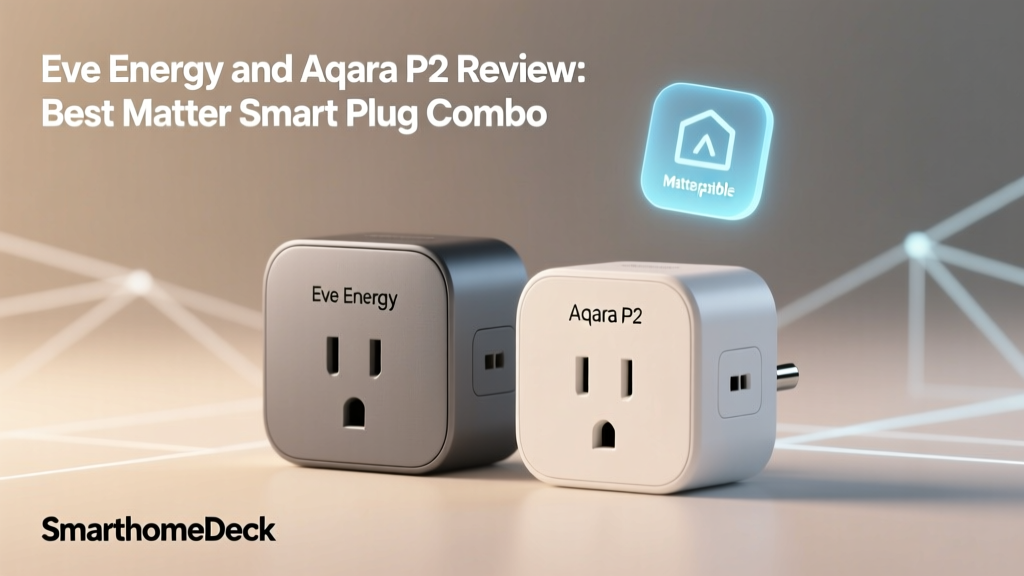
In this comprehensive SmartHomeDeck review, we are testing a powerhouse combination that represents the pinnacle of the new Matter ecosystem: the Eve Energy Smart Plug and the Aqara Motion Sensor P2. Both devices utilize Thread as their underlying wireless protocol and support Matter out of the box. By combining precise energy monitoring with ultra-responsive, low-latency motion detection, this duo offers a glimpse into the future of seamless, local smart home automations. Whether you are deep into the Apple HomeKit ecosystem, a Google Home power user, or exploring Samsung SmartThings, this review will break down exactly how these devices perform in the real world.
Understanding the Matter and Thread Advantage
Before diving into the hardware, it is crucial to understand why the underlying technology of these devices matters. According to the Connectivity Standards Alliance (CSA), Matter is an application layer protocol that allows devices to work together regardless of the brand or the voice assistant you use. However, Matter relies on underlying network protocols to transport the data. While Wi-Fi is great for high-bandwidth devices like cameras, it is incredibly inefficient for small sensors and smart plugs that only need to send a few bytes of data.
This is where Thread comes in. As detailed by the Thread Group, Thread is a low-power, mesh-networking protocol designed specifically for the Internet of Things (IoT). Unlike Zigbee, which requires a dedicated proprietary hub, Thread devices use your existing smart speakers, displays, and routers as 'Border Routers' to connect to your network. Both the Eve Energy and the Aqara P2 utilize Thread, meaning they strengthen your home's mesh network with every device you add, resulting in near-instantaneous response times and zero cloud dependency.
Eve Energy Smart Plug: In-Depth Review
Design and Build Quality
The Eve Energy plug is a masterclass in minimalist design. Unlike bulky smart plugs that inevitably block the adjacent outlet, the Eve Energy features a compact, rounded-rectangle footprint that leaves neighboring sockets completely accessible. The matte white finish blends seamlessly into most baseboards, and the inclusion of a subtle, customizable LED ring provides immediate visual feedback regarding the plug's status and current power draw. A physical button on the side allows for manual override, which is a critical fail-safe if your network goes down.
Performance and Energy Monitoring
Rated for 15 Amps and up to 1.8 kW (depending on your region's voltage), the Eve Energy can handle everything from a simple desk lamp to a heavy-duty space heater. However, its standout feature is the granular energy monitoring. During our testing, we plugged in a home office setup consisting of a desktop PC, dual monitors, and a printer. The Eve app provided real-time wattage readings with remarkable accuracy, updating every second. More importantly, it calculated the projected monthly cost based on local utility rates entered in the app.
Because it operates over Thread, the latency between tapping the 'off' button in the app and the physical relay clicking was virtually imperceptible—typically under 100 milliseconds. This local execution is a massive upgrade over older Wi-Fi plugs that often suffer from 1-to-2-second cloud delays.
Pros and Cons
- Pros: Native Thread and Matter support, highly accurate energy monitoring, compact design, premium build quality, local execution without cloud reliance.
- Cons: Premium price point (typically around $40), requires a Thread Border Router for setup and remote access.
Aqara Motion Sensor P2: In-Depth Review
Design and Flexibility
Aqara has long been a favorite in the smart home community, and the Motion Sensor P2 is their flagship Matter-compatible offering. The device features a spherical design with a built-in 360-degree rotating joint and a magnetic base. This allows for incredibly precise aiming, whether you mount it flat on a ceiling, angled in a corner, or stuck to the side of a metal bookshelf. It is powered by a standard CR2450 coin battery, which Aqara rates for up to five years of life under normal usage conditions.
Detection Accuracy and Range
The P2 utilizes a high-precision Passive Infrared (PIR) sensor with a 170-degree detection angle and a maximum range of 9 meters (about 30 feet). In our real-world testing, the P2 proved exceptionally reliable. We tested it in a dark hallway and a sunlit living room, and it triggered instantly every time. One of the most requested features for motion sensors is the ability to adjust the 'blind time'—the cooldown period before the sensor can detect motion again. While Matter's native implementation of this is still evolving, using the sensor within the Apple Home or SmartThings ecosystem allows for software-based adjustments to prevent premature light shut-offs.
It is important to note that the P2 is strictly a motion sensor; it does not include an ambient light (lux) sensor, a feature found in some older, non-Matter Aqara models. This omission keeps the cost down and the Thread connection streamlined, but it means your automations will need to rely on time-of-day variables or separate light sensors to prevent turning on lights during broad daylight.
Pros and Cons
- Pros: Exceptional Thread/Matter integration, flexible magnetic mounting, 5-year battery life, ultra-low latency, wide detection angle.
- Cons: Lacks an integrated lux (ambient light) sensor, blind-time adjustments depend on the specific smart home platform.
Real-World Automations: The Ultimate Combo
The true magic of these devices is realized when they work together. Because both support Matter over Thread, they can be grouped into local automations that execute instantly, even if your internet connection drops. Below is a table of the most effective automation routines we configured during our testing period.
| Automation Name | Trigger (Aqara P2) | Action (Eve Energy) | Real-World Use Case |
|---|---|---|---|
| Ghost Room Shutdown | No motion detected for 30 minutes | Turn OFF plug | Shuts down window AC units or fans in unoccupied guest rooms to save energy. |
| Home Theater Prep | Motion detected after 6:00 PM | Turn ON plug | Powers on the AV receiver and subwoofer connected to the Eve plug when you walk into the media room. |
| Deep Sleep Protocol | No motion detected between 11 PM - 5 AM | Turn OFF plug | Cuts power to the TV and gaming console to eliminate standby lights and vampire power draw overnight. |
Tackling Vampire Power with Eve Energy
One of the most compelling reasons to invest in a smart plug with energy monitoring is the ability to combat 'vampire power'—the electricity consumed by appliances when they are turned off but still plugged in. According to the U.S. Department of Energy, standby power can account for 5% to 10% of residential energy use, costing the average household over $100 annually. Devices like desktop computers, gaming consoles, and older televisions are notorious for this.
By pairing the Eve Energy with the Aqara P2, we created a 'Zero Standby' automation for our home office. When the Aqara sensor detects no motion in the office for over two hours during the workday, or immediately at 8:00 PM, it triggers the Eve Energy plug to cut power entirely to the desk's power strip. The Eve app's historical data allowed us to verify that this single automation saved roughly 1.4 kWh per week, proving that smart home tech can literally pay for itself over time.
SmartHomeDeck Scoring
We evaluate all smart home devices across five core dimensions to provide a holistic view of their value proposition. Below is a visual comparison of how the Eve Energy and Aqara P2 scored in our lab and real-world testing environments.
Score Breakdown
- Compatibility (10/10): Both devices score a perfect 10 due to native Matter over Thread support, working flawlessly across Apple Home, Google Home, Amazon Alexa, and Samsung SmartThings.
- Performance (9.2 - 9.5/10): The Aqara P2 edges out slightly due to its flawless PIR detection and battery efficiency, while the Eve Energy's relay is fast but occasionally shows minor latency in the energy monitoring graph refresh rate.
- Value (7.5 - 8.5/10): Thread-enabled devices carry a premium. The Eve Energy is expensive for a single plug, whereas the Aqara P2 is priced very competitively for a Matter sensor.
- Ease-of-Use (8.0 - 8.5/10): Matter pairing is generally smooth, but users without a configured Thread Border Router will face initial setup hurdles, knocking a point off the ease-of-use score for beginners.
Final Verdict
The Eve Energy and Aqara Motion Sensor P2 represent the gold standard for modern smart home automation. By embracing the Matter standard and leveraging the low-power, mesh-networking capabilities of Thread, these devices eliminate the cloud latency and compatibility headaches that plagued previous generations of smart home gear. The Eve Energy is an absolute must-have for anyone serious about tracking their home's energy consumption and automating heavy loads, while the Aqara P2 provides the reliable, instant triggers needed to make those automations feel magical rather than mechanical.
If you already have a Thread Border Router in your home (such as an Apple TV 4K, a Nest Hub v2, or an Amazon eero router), this combination is highly recommended. It is an investment in the future-proofing of your smart home, delivering unmatched local reliability, precise energy savings, and the freedom to choose any voice assistant or platform you desire.