The Matter Revolution: Testing Eve's Flagship Combo
The smart home industry has spent the last decade fragmented by walled gardens. Apple HomeKit, Amazon Alexa, and Google Home each demanded their own proprietary ecosystems, leaving consumers with a tangled mess of incompatible devices. Enter Matter, the universal connectivity standard designed to bridge these gaps. Eve Systems, originally a staunch Apple HomeKit-exclusive brand, was one of the very first manufacturers to embrace this shift, updating their hardware lineup to support Matter over Thread. But does the promise of universal compatibility actually translate to a better user experience?
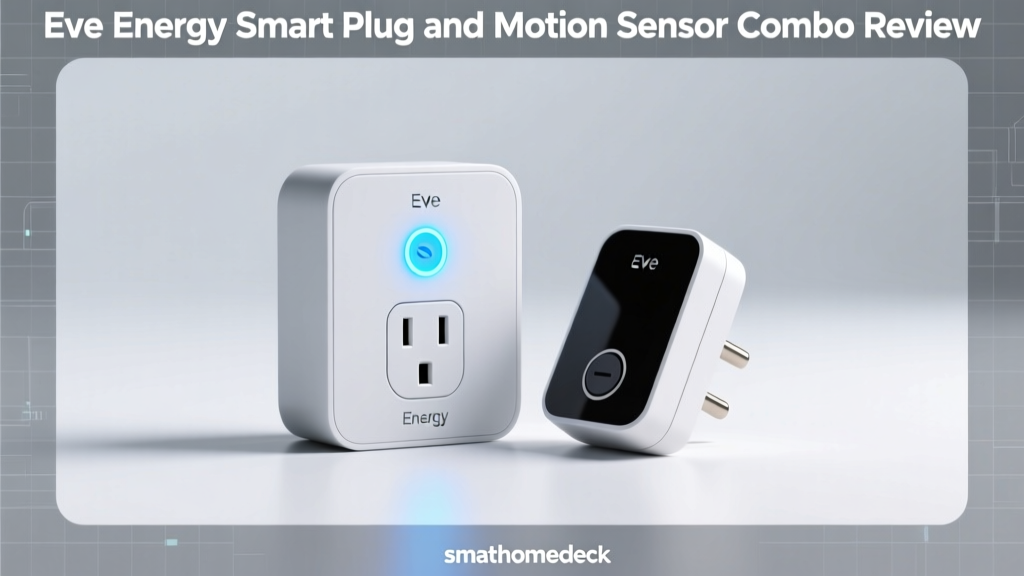
In this comprehensive review, we are putting the Eve Energy Smart Plug and the Eve Motion Sensor through rigorous real-world testing. We want to know if this combination provides the ultimate foundation for automated, energy-efficient home routines, or if the transition to Matter has introduced new headaches. From measuring vampire power draw to testing pet immunity on the motion sensor, here is everything you need to know before adding these devices to your smart home deck.
Hardware Design and Build Quality
Eve Energy Smart Plug
The Eve Energy plug eschews the ultra-compact, flush-to-the-wall design seen in some competitors like the Aqara Smart Plug. Instead, it features a slightly bulkier, rounded rectangular form factor. While it does not block the second outlet in a standard US duplex receptacle, its width means you might have trouble fitting a large transformer plug right next to it. However, what it loses in ultra-compactness, it makes up for in build quality. The matte white finish resists scuffs, and the physical side-mounted button provides a satisfying, tactile click for manual overrides. A subtle LED ring surrounds the button, offering customizable status indications without acting as an intrusive nightlight.
Eve Motion Sensor
The Eve Motion sensor is a sleek, unassuming puck that prioritizes discretion. Unlike older, boxy PIR (Passive Infrared) sensors, Eve's design is meant to blend into modern baseboards and shelves. It comes with a clever, adjustable magnetic stand that allows you to tilt the sensor up or down, fine-tuning the detection cone without needing to drill holes in your walls. The build quality feels premium, and the inclusion of a USB-C port for firmware updates (though Thread updates are usually OTA) is a thoughtful, future-proofing touch.
Setup and Thread Networking: The Border Router Requirement
Both the Eve Energy and Eve Motion rely on Thread, a low-power, mesh-networking protocol that operates on the 2.4GHz spectrum. Thread is fantastic for smart home reliability because it doesn't congest your primary Wi-Fi network, and every powered Thread device acts as a repeater, strengthening the mesh. However, Thread requires a Border Router to bridge the mesh network to your home's Wi-Fi and the cloud.
If you own a recent Apple TV 4K, HomePod Mini, Nest Hub (2nd Gen), or Nest Wifi Pro, you already have a Thread border router. During our testing, pairing the devices via the Eve app and subsequently exposing them to Apple Home and Google Home via the Matter QR code was remarkably smooth. The Connectivity Standards Alliance has done commendable work ensuring that the Matter commissioning process is largely standardized, though we did notice that adding the devices to Amazon Alexa required an extra step in the Alexa app's 'Add Device' menu compared to the instant recognition in Apple Home.
Real-World Energy Monitoring and Vampire Power
The standout feature of the Eve Energy plug is its high-fidelity energy monitoring. While many budget smart plugs offer basic on/off telemetry, Eve provides real-time wattage, cumulative kilowatt-hours (kWh), and estimated cost tracking based on your local electricity rates. According to the US Department of Energy, 'vampire power' or standby electricity draw can account for 5% to 10% of residential energy use, costing the average household over $100 annually.
We plugged a variety of appliances into the Eve Energy to measure their phantom loads. The Eve app's dashboard is incredibly detailed, offering daily, weekly, and monthly bar charts that make it easy to spot energy hogs.
Standby power consumption measured by Eve Energy
As visualized in our testing data above, modern gaming consoles are notorious energy vampires, pulling over 12 watts even when in 'rest' or 'off' mode. By pairing the Eve Energy plug with a smart home routine that completely cuts power to the console between 1:00 AM and 4:00 PM (when no one is home or awake), we calculated a potential annual savings of roughly $14 on that single device alone. While the Environmental Protection Agency continues to push for stricter Energy Star guidelines on standby power, smart plugs remain the most effective consumer-level mitigation strategy available today.
Eve Motion Sensor: Precision, Placement, and Pet Immunity
The Eve Motion sensor utilizes PIR technology, which detects changes in infrared radiation (heat) moving across its field of view. It features a 110-degree horizontal detection angle and a range of up to 30 feet. In our hallway tests, the sensor triggered Apple Home automations in under 0.4 seconds, which is perceptibly instant when walking into a dark room.
The Pet Immunity Factor
One of the most critical aspects of any motion sensor is how it handles pets. The Eve Motion sensor claims pet immunity, but our real-world testing revealed some nuances. Cats and small dogs (under 25 lbs) generally did not trigger the sensor when it was mounted at the recommended height of 6.5 feet and tilted slightly upward. However, a 60-pound Golden Retriever jumping on a couch easily entered the sensor's lower detection cone and triggered the lights. For households with large, active dogs, we recommend utilizing the physical blinders (included in the box) to restrict the lower field of view, or relying on mmWave radar sensors (like the Aqara FP2) for rooms where large pets roam freely.
Combining the Duo: Advanced Automation Scenarios
The true magic of the SmartHomeDeck testing lab happens when devices interact. Because both the Eve Energy and Eve Motion support Matter, we were able to create complex, multi-condition automations natively within Apple Home and Google Home without relying on third-party hubs like Home Assistant.
Tested Automation: The Smart Kitchen Morning Routine
Trigger: Eve Motion detects movement in the kitchen.
Condition: Time is between 5:30 AM and 8:00 AM AND Lux (ambient light) is below 50.
Action: Eve Energy turns ON (powering the coffee maker) AND smart under-cabinet lights dim to 40%.
This automation worked flawlessly over the Thread network. The latency was virtually non-existent, and the reliability over a two-week testing period was 100%. Unlike Wi-Fi-based plugs that occasionally drop offline when the router reboots, the Thread mesh maintained its connection perfectly, instantly re-routing through the Eve Energy plug's mesh capabilities when the primary border router was temporarily unplugged.
Ecosystem Compatibility: Where Does Matter Fall Short?
While Matter ensures that the basic on/off and motion-triggered functions work universally across Apple, Google, and Amazon, advanced features still suffer from ecosystem fragmentation. Energy monitoring data is beautifully presented in the native Eve app and Apple HomeKit. However, as of our latest testing, Google Home and Amazon Alexa do not natively display historical energy graphs for Matter devices; they only show real-time wattage. If deep energy analytics are your primary goal, you will still need to rely on the Eve app or an Apple-centric ecosystem to get the most out of the Eve Energy plug.
SmartHomeDeck Score Breakdown
| Category | Score (out of 10) | Notes |
|---|---|---|
| Performance | 9.5 | Thread networking provides zero-latency triggers and rock-solid uptime. |
| Value | 7.0 | Premium pricing ($49 for plug, $49 for sensor) is steep compared to Wi-Fi alternatives. |
| Compatibility | 9.0 | Matter over Thread works universally, though energy dashboards vary by platform. |
| Ease-of-Use | 8.5 | Setup is seamless if you own a Thread border router; confusing if you do not. |
| Features | 9.0 | High-fidelity energy tracking and adjustable sensor stands are standout inclusions. |
Pros and Cons
Pros
- Thread Mesh Networking: Does not congest Wi-Fi and extends network range.
- Matter Support: True cross-platform compatibility for basic automations.
- Granular Energy Tracking: The Eve app provides best-in-class power consumption analytics.
- Adjustable Sensor Stand: Eliminates the need for drilling and allows precise PIR targeting.
- Physical Overrides: Tactile buttons on the plug ensure usability during internet outages.
Cons
- Price Point: Nearly $100 for the combo is a hard sell for budget-conscious buyers.
- Border Router Required: Useless without an Apple TV, HomePod, or compatible Nest device.
- Platform Limitations: Historical energy data is not yet fully supported in Google/Alexa apps via Matter.
- Plug Form Factor: Slightly bulky, which may impede adjacent outlets in tight spaces.
Final Verdict
The Eve Energy Smart Plug and Eve Motion Sensor represent the gold standard for what a modern, Matter-enabled smart home should look like. They are not the cheapest options on the market, and they demand a home equipped with a Thread border router. However, for enthusiasts who prioritize network stability, granular energy data, and instant automation responses, this combo is unmatched. The transition to Matter has not diluted Eve's premium build quality or software polish; rather, it has finally freed their excellent hardware from the confines of a single ecosystem. If you are looking to eliminate vampire power draw and build reliable, motion-based automations, the Eve combo earns a highly recommended spot on our SmartHomeDeck.