The Smart Home Fragmentation Problem
If you have spent any time building a smart home over the last few years, you are likely intimately familiar with the "walled garden" problem. You purchase a Ring security camera, an Ecobee thermostat, Philips Hue lights, and an Aqara door sensor. Suddenly, your smartphone is cluttered with half a dozen different apps, your network is choked with cloud-dependent Wi-Fi devices, and creating a single, cohesive automation routine feels like trying to negotiate a peace treaty between rival nations. The smart home was supposed to make our lives easier, but ecosystem fragmentation has turned it into a part-time IT job.
This is the exact problem the Homey Pro was engineered to solve. Unlike traditional smart speakers that double as basic hubs, or proprietary bridges that only speak one wireless language, the Homey Pro is a dedicated, multi-protocol smart home brain. It promises to unify your devices, process automations locally, and bridge the gap between the major voice assistants. But does it actually deliver on this ambitious promise? In this comprehensive ecosystem integration experience review, we put the Homey Pro through its paces to see if it is the ultimate smart home hub for power users.
Hardware Design and the Shift to Local Processing
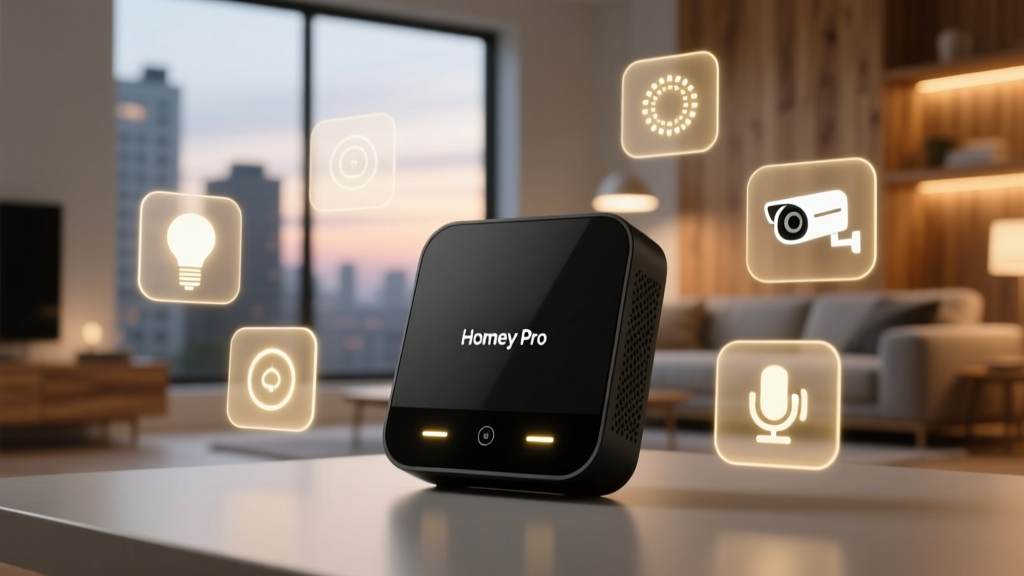
Visually, the Homey Pro is a striking piece of hardware. It abandons the traditional utilitarian router aesthetic for a sleek, dark, spherical design that looks more like a high-end smart speaker than a networking hub. The front features a subtle, customizable LED ring that provides visual feedback for system status, alarms, and automation triggers. However, the real magic lies beneath the surface.
Inside the sphere is a robust array of antennas supporting an impressive list of wireless protocols: Wi-Fi, Bluetooth, Zigbee, Z-Wave, 433MHz, Infrared, and the newer Thread and Matter standards. More importantly, the latest iteration of the Homey Pro represents a massive architectural shift for the company: 100% local processing. Previous generations of Homey relied heavily on cloud servers to execute logic. The new Homey Pro processes all automations locally on its internal processor. This means that if your internet connection drops, your smart home keeps functioning. Lights will still turn on, security routines will still execute, and latency is reduced to mere milliseconds.
Bridging the Walled Gardens: The Core Integration Experience
The primary reason enthusiasts invest in a premium hub like the Homey Pro is ecosystem bridging. Apple, Google, and Amazon all want you locked into their respective ecosystems, which inherently limits the hardware you can purchase. Homey Pro acts as the ultimate neutral diplomat.
Apple HomeKit Exposure
For users entrenched in the Apple ecosystem, Homey Pro is a revelation. Apple HomeKit is notoriously strict about which devices it supports, completely ignoring legacy protocols like Z-Wave or 433MHz. Through the Homey app, you can "expose" any connected device to Apple Home. This means you can take a Z-Wave deadbolt, a 433MHz weather station, or a niche Wi-Fi appliance connected to Homey, and make it appear natively inside the Apple Home app. You can then use Siri to control devices that Apple never officially certified, complete with room assignments and native Apple automations.
Google Home and Amazon Alexa
The integration experience with Google Home and Amazon Alexa is equally seamless. Homey links to these services via secure OAuth cloud skills. Once linked, every device connected to your Homey Pro is instantly pushed to Google and Alexa. The beauty of this setup is that Homey handles the complex protocol translation. You can tell Alexa to turn off the living room lights, and Alexa sends the command to Homey, which then translates it into a Zigbee signal for your Philips Hue bulbs and a Z-Wave signal for your GE smart switches simultaneously.
Matter, Thread, and Future-Proofing
No modern smart hub review is complete without discussing Matter. Developed under the guidance of the Connectivity Standards Alliance (CSA), Matter is the industry's attempt to create a universal, interoperable smart home language. The Homey Pro is fully Matter-compliant and acts as a Thread Border Router.
In our testing, we paired several Matter-over-Thread devices directly to the Homey Pro. The onboarding process, utilizing Thread's mesh networking capabilities, was remarkably fast and stable. Because Homey supports Matter natively, it can not only control Matter devices but also expose its legacy Zigbee and Z-Wave devices to other Matter-compatible ecosystems. This two-way Matter bridging ensures that your investment in older, proprietary hardware remains relevant as the industry transitions to the new standard.
Real-World Integration Testing and Automations
To truly evaluate the ecosystem integration experience, we moved beyond simple voice commands and tested complex, multi-protocol automations using Homey's proprietary logic engine, known as "Homey Flow." Homey Flow uses a visual, card-based programming interface (When, And, Then) that is vastly superior to the basic conditional logic found in native Apple or Google apps.
Test Scenario 1: The Morning Wake-Up Routine
We created a routine triggered by an Aqara Zigbee motion sensor detecting movement in the hallway (When). The conditions (And) checked if the local time was between 6:00 AM and 9:00 AM, and if the Ecobee thermostat was set to "Sleep" mode. If true, the actions (Then) adjusted the Ecobee via Wi-Fi to "Home" mode, faded in LIFX Wi-Fi bulbs to 40% warm white, and triggered a 433MHz smart plug to turn on the coffee maker. Because of the local processing, the entire sequence executed in under 200 milliseconds, with zero reliance on external cloud servers.
Test Scenario 2: Security and Notifications
We integrated a Z-Wave door sensor and a generic IP camera. When the door opened while the Homey Pro was in "Away" mode, Homey triggered the camera to record a local clip, flashed the Philips Hue lights red, and sent a rich push notification with a snapshot to the Homey smartphone app. The reliability of this local execution was flawless over a two-week testing period, completely eliminating the missed notifications and delayed triggers we frequently experience with cloud-dependent hubs.
Deck Score Dimensions
At SmartHomeDeck, we evaluate every product across five core dimensions to generate our proprietary Deck Score. Here is how the Homey Pro performed in our ecosystem integration testing.
Homey Pro Deck Score Breakdown
Performance (9.5/10): Local processing is a game-changer. Latency is virtually non-existent, and the hub handles dozens of simultaneous Zigbee and Z-Wave mesh messages without dropping packets.
Value (7.0/10): At a premium price point (typically around $399), it is an investment. It scores lower here simply because casual users won't utilize the features that justify the cost.
Compatibility (10.0/10): With support for Zigbee, Z-Wave, Wi-Fi, BLE, 433MHz, IR, Matter, and Thread, it is the most compatible hub on the market, bar none.
Ease-of-Use (8.0/10): The mobile app is beautiful and intuitive, but the sheer depth of Homey Flow and advanced settings can be overwhelming for smart home beginners.
Features (9.5/10): From local processing to energy monitoring dashboards and cross-ecosystem bridging, the feature set is incredibly robust.
Ecosystem Compatibility and Protocol Matrix
The table below illustrates how the Homey Pro handles various wireless protocols and bridges them to the major voice assistants and smart home platforms.
| Protocol | Native Hub Support | Bridged to Apple HomeKit | Bridged to Google / Alexa | Matter Exposed |
|---|---|---|---|---|
| Zigbee | Yes | Yes | Yes | Yes |
| Z-Wave | Yes | Yes | Yes | Yes |
| Wi-Fi | Yes (via Cloud Apps) | Yes | Yes | Yes |
| Bluetooth (BLE) | Yes | Yes | Yes | Yes |
| 433MHz / IR | Yes | Yes | Yes | Yes |
| Thread / Matter | Yes | Yes | Yes | Native |
Pros and Cons
Pros
- Unmatched Protocol Support: The inclusion of eight different wireless radios eliminates the need for multiple dongles and proprietary bridges.
- True Local Processing: Automations run instantly and reliably, even during internet outages.
- Ecosystem Agnostic: Seamlessly exposes niche devices to Apple HomeKit, Google Home, and Amazon Alexa.
- Advanced Logic Engine: Homey Flow allows for complex, multi-condition automations that native apps simply cannot handle.
- Energy Insights: Built-in dashboard tracks energy consumption of connected smart plugs and devices.
Cons
- Premium Pricing: At roughly $399, it is significantly more expensive than an Apple TV or a standard SmartThings hub.
- Wi-Fi Device Limitations: While it integrates with Wi-Fi devices via cloud APIs, it cannot control them locally if the manufacturer's cloud goes down.
- Learning Curve: The depth of the Homey Flow automation engine requires a time investment to master.
Pricing and Final Verdict
The Homey Pro sits at the premium end of the smart home hub market, retailing for approximately $399. When compared to a $129 Apple TV 4K or a $99 SmartThings Hub, the price tag can cause sticker shock for casual users. However, evaluating the Homey Pro purely on price misses the point of its existence. This is not a basic bridge; it is a localized, enterprise-grade smart home server designed for enthusiasts.
If you are heavily invested in a single ecosystem—say, you only buy Apple HomeKit-certified devices and use Siri exclusively—you do not need the Homey Pro. But if your home is a mosaic of different brands, protocols, and eras of smart home tech, the Homey Pro is arguably the best integration experience available today. It successfully tears down the walls between Apple, Google, and Amazon, giving you the freedom to buy the best hardware for the job regardless of the logo on the box. For its unmatched compatibility, lightning-fast local processing, and brilliant automation engine, the Homey Pro earns our highest recommendation for advanced smart home integrators.