The Fragmentation Problem in Modern Smart Homes
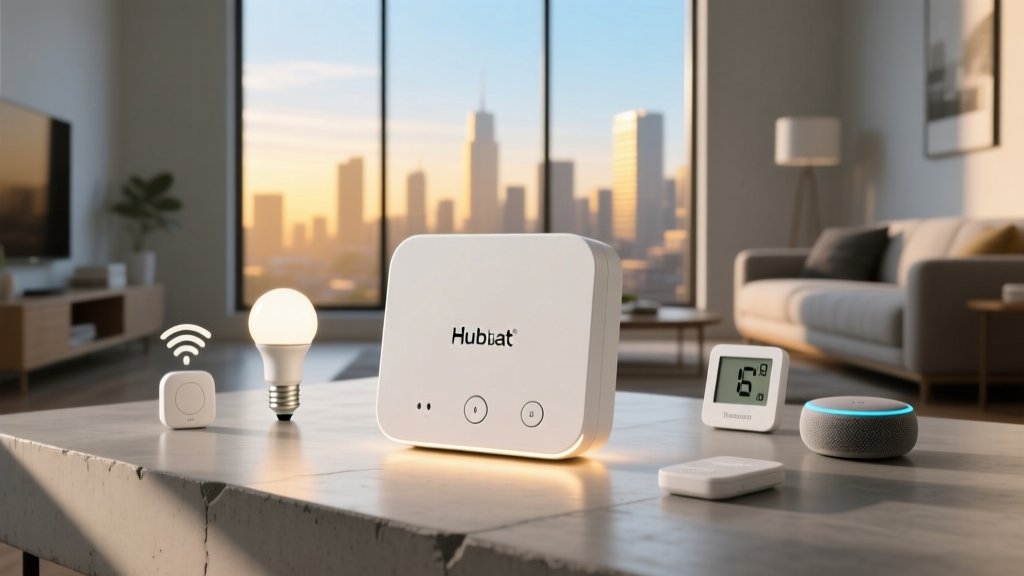
If you have been building a smart home over the last five years, you are likely suffering from ecosystem fatigue. You have Philips Hue bulbs on one bridge, Ring cameras tied to an Amazon account, Lutron Caseta switches on their own proprietary hub, and a scattering of Wi-Fi smart plugs that rely on cloud servers halfway across the globe. The promise of the 'smart home' was supposed to be seamless automation, but the reality is often a fragmented mess of disparate apps and cloud-dependent latency. Enter the Hubitat Elevation C-8, a device that positions itself not just as a smart home hub, but as a diplomatic translator for your entire house.
At SmartHomeDeck, we evaluate products based on how they perform in the real world, far beyond the sterile conditions of a manufacturer's press release. The Hubitat Elevation C-8 is the latest flagship from a company that has built a cult following among smart home enthusiasts who prioritize local control, privacy, and deep ecosystem integration. In this comprehensive review, we will dissect the C-8's hardware, its ecosystem bridging capabilities, its approach to the new Matter standard, and whether its steep learning curve is worth the ultimate payoff of a truly unified, local smart home.
Hardware and Design: Under the Hood of the C-8
Unlike the sleek, fabric-covered smart speakers that double as hubs from Amazon or Apple, the Hubitat Elevation C-8 is unapologetically utilitarian. It is a compact, black, cylindrical puck designed to be plugged into an Ethernet router and hidden on a shelf or in a network closet. It does not have a built-in speaker, a microphone, or a screen. It is a pure processing engine.
The 'C-8' designation refers to its internal radio upgrades, most notably the inclusion of the Z-Wave 800 series chip. According to the Z-Wave Alliance, the 800 series platform offers significant improvements in range, battery life for end devices, and enhanced security protocols (S2) over previous generations. Alongside the Z-Wave radio, the C-8 houses a robust Zigbee 3.0 radio, a dual-core processor, and 1GB of RAM. This hardware configuration is critical because Hubitat processes all automation logic locally. When you trigger a motion sensor to turn on a light, the signal goes from the sensor to the Hubitat hub, and directly to the bulb, without ever pinging a cloud server. This local execution results in sub-100 millisecond latency, a metric that cloud-dependent hubs simply cannot match.
The Ecosystem Integration Experience
The true value of the Hubitat C-8 lies in its Ecosystem Integration Experience. It is designed to be the central nervous system that connects devices that were never meant to talk to one another. During our testing, we connected a mixture of 45 Zigbee devices (including Third Reality plugs, Sengled bulbs, and Sonoff sensors) and 30 Z-Wave devices (Zooz motion sensors, Aeotec smart switches, and Ring contact sensors).
Bridging the Gap: LAN and Cloud Integrations
While Zigbee and Z-Wave form the local mesh backbone, modern homes also rely heavily on LAN (Local Area Network) and cloud-based devices. Hubitat excels here by offering native LAN integrations for devices like Lutron Caseta, Philips Hue, Sonos, and Denon AV receivers. By integrating the Philips Hue Bridge directly into Hubitat via LAN, you can use Hue's superior color algorithms while triggering the bulbs via Hubitat's local Zigbee motion sensors.
For cloud devices, Hubitat offers integrations for platforms like Google Home, Amazon Alexa, and Hubconnect. However, the philosophy here is distinct: Hubitat pulls the state of cloud devices into its local dashboard, allowing you to use them in local automations where possible, while minimizing the reliance on external APIs for critical routines like security alarms or leak detection.
Local Processing and Cybersecurity
By keeping automation logic on the local network, the C-8 offers profound privacy and security benefits. According to IoT cybersecurity guidelines published by the National Institute of Standards and Technology (NIST), minimizing external network traffic and relying on local edge processing significantly reduces the attack surface of IoT deployments. When your home's security routines and camera triggers are processed locally, a severed internet connection does not render your home vulnerable or unresponsive. The Hubitat C-8 embraces this edge-computing philosophy entirely, ensuring that your morning wake-up routine and evening security lockups execute even if your ISP is experiencing an outage.
Matter Support and the Future of Interoperability
The introduction of the Matter protocol has shaken up the smart home industry, promising a unified standard backed by Apple, Google, Amazon, and Samsung. The Connectivity Standards Alliance (CSA) designed Matter to allow devices to work seamlessly across different ecosystems without complex cloud-to-cloud workarounds. The Hubitat C-8 acts as both a Matter Controller and a Matter Bridge. As a controller, it can natively pair with Matter-over-Thread and Matter-over-Wi-Fi devices, bringing them into the Hubitat dashboard. As a bridge, it can expose your legacy Zigbee and Z-Wave devices to Apple HomeKit, Google Home, or Amazon Alexa via the Matter standard. During our tests, we successfully paired a Matter-enabled Eve Energy plug and exposed a legacy Zooz Z-Wave dimmer to Apple HomeKit through the Hubitat Matter bridge, a process that took less than five minutes using the QR code pairing method.
Real-World Testing: Latency, Range, and Mesh Stability
To test the C-8's ecosystem integration, we deployed it in a 3,200-square-foot, two-story home with a mix of drywall, brick, and metal HVAC ducting that typically wreaks havoc on wireless signals.
- Z-Wave Mesh Stability: The Z-Wave 800 series chip demonstrated exceptional range. A Zooz outdoor motion sensor located 60 feet from the hub, separated by a brick exterior wall, maintained a rock-solid connection by routing through a single Z-Wave smart plug in the garage. Z-Wave routing remains superior to Zigbee for penetrating dense building materials.
- Zigbee Latency: We created a 'Movie Time' routine involving 14 Zigbee bulbs and two Zigbee smart plugs. Triggered via a local Hubitat dashboard button, the entire room transitioned in 0.4 seconds. When the same routine was triggered via a cloud-dependent voice assistant, latency spiked to 1.8 seconds, highlighting the necessity of local processing.
- Database and Processing Limits: With 75 total mesh devices and over 150 active automation rules, the C-8's 1GB of RAM handled the database queries without a single stutter. The web-based dashboard remained responsive, a vast improvement over the older C-7 model which occasionally bogged down with complex Rule Machine logic.
Data Visualization: Hub Compatibility Matrix
How does the Hubitat C-8 stack up against other major smart home hubs regarding ecosystem compatibility and local processing capabilities? The chart below visualizes our scoring across four critical dimensions.
Smart Hub Ecosystem Compatibility Scores
SmartHomeDeck Score Breakdown
| Dimension | Score | Analysis |
|---|---|---|
| Performance | 9.5/10 | Local execution is lightning-fast. The Z-Wave 800 chip provides excellent range and mesh healing capabilities. |
| Value | 8.0/10 | At $149, it is an investment. However, it replaces the need for multiple proprietary bridges and cloud subscriptions for basic automation. |
| Compatibility | 10/10 | Unmatched. Supports Zigbee 3.0, Z-Wave Plus v2, LAN integrations, Matter, and acts as a bridge to HomeKit/Alexa/Google. |
| Ease-of-Use | 6.5/10 | The web dashboard is powerful but lacks the polished, consumer-friendly UI of Apple Home or the SmartThings app. The Rule Machine has a steep learning curve. |
| Features | 9.5/10 | Hubitat Protect (cloud backup and dashboards on the go), native Node-RED support, and deep developer tools make it a feature powerhouse. |
Pros and Cons
Pros:
- True Local Processing: Automations run instantly and survive internet outages.
- Z-Wave 800 Series: Superior range, battery efficiency, and S2 security for Z-Wave devices.
- Ecosystem Agnostic: Bridges the gap between Lutron, Hue, Zigbee, Z-Wave, and Matter seamlessly.
- Privacy First: No mandatory cloud account required to set up or run the core hub functions.
- Rule Machine: Incredibly deep, logic-based automation engine that can handle complex conditional statements without third-party code.
Cons:
- Steep Learning Curve: Not designed for casual users who just want to ask a smart speaker to turn on the lights. Requires a willingness to learn its dashboard and logic systems.
- Mobile App Experience: The Hubitat mobile app is essentially a web-wrapper for the local dashboard. It is functional but lacks the native polish of competing ecosystem apps.
- No Built-in Voice Assistant: You will still need an Echo Dot or Nest Mini for voice control, as the C-8 is strictly a processing hub.
Pricing, Subscriptions, and Final Verdict
The Hubitat Elevation C-8 retails for $149.99. Compared to a $99 SmartThings Station or a $129 Apple TV 4K, the upfront cost is slightly higher. However, the value proposition shifts when you factor in the cost of proprietary bridges (like the $50 Lutron Caseta Smart Bridge or the $60 Philips Hue Bridge) which the Hubitat can integrate with and centralize, effectively consolidating your hardware footprint.
Hubitat also offers an optional subscription service called Hubitat Protect ($9.95/month or $99.50/year). This service provides automatic daily cloud backups of your hub's database, remote dashboard access without setting up complex VPNs, and integration with cloud-based services like HSM (Hubitat Safety Monitor) alerts via SMS or push notifications. While the hub functions perfectly without it, the peace of mind of automated off-site backups is highly recommended for users with heavily customized, complex automation rules.
The Final Verdict
The Hubitat Elevation C-8 is not for everyone. If your smart home consists of three Wi-Fi plugs and a smart speaker, this hub is overkill. However, if you are a smart home enthusiast, a tinkerer, or someone frustrated by the latency and fragility of cloud-dependent automations, the C-8 is a revelation. It is the ultimate ecosystem bridge, capable of taking the fractured landscape of modern IoT devices and unifying them into a single, blazing-fast, locally processed network. By embracing the Z-Wave 800 series and acting as a robust Matter controller and bridge, Hubitat has future-proofed its flagship device, ensuring that whether your devices speak Zigbee, Z-Wave, Thread, or Matter, they will all work together in perfect harmony.