The Shift to Local: Why Hubitat Elevation Matters
The smart home industry has spent the last decade heavily reliant on cloud processing. While cloud-based hubs offer easy setup and remote access, they introduce significant drawbacks: latency, privacy concerns, and a total loss of functionality when your internet connection drops. Enter the Hubitat Elevation (Model C-8), a dedicated smart home controller designed from the ground up to process automations locally. By keeping your data inside your home and executing commands in milliseconds, Hubitat has carved out a fiercely loyal following among smart home enthusiasts, tinkerers, and privacy advocates.
In this comprehensive SmartHomeDeck review, we put the Hubitat Elevation through rigorous real-world testing. We evaluate its hardware design, protocol support (including the highly anticipated Z-Wave Long Range and Matter), the infamous Rule Machine automation engine, and how it stacks up against competitors like Samsung SmartThings and Home Assistant. Whether you are building a new smart home from scratch or migrating away from a cloud-dependent ecosystem, this review will help you decide if the Hubitat Elevation is the brain your home needs.
Hardware and Design: Built for the Network Rack
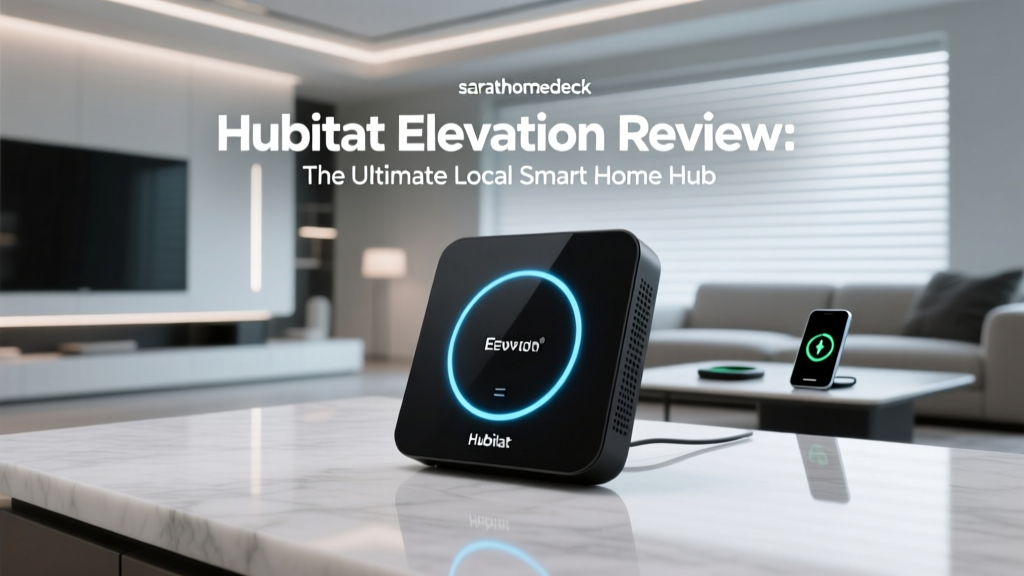
Unlike the sleek, consumer-friendly pods designed to sit on a living room bookshelf, the Hubitat Elevation C-8 embraces a utilitarian, industrial aesthetic. It is a flat, square device measuring roughly 5.5 x 5.5 x 1.1 inches, finished in a matte black plastic that blends easily into a network closet or media rack. The design prioritizes function over form, which is exactly what advanced users want.
The rear I/O panel is sparse but purposeful. It features a Gigabit Ethernet port, a USB-C port for power, and a USB-A port that can be used for external storage or legacy Zigbee/Z-Wave dongles if you choose to bypass the internal radios. The C-8 model includes upgraded internal antennas for both Zigbee and Z-Wave, significantly improving the baseline range compared to the older C-7 model. A multi-color LED indicator on the front provides basic status updates, though most users will rely on the web interface for system monitoring.
Real-World Setup: Setup is entirely browser-based. You plug the hub into your router via Ethernet, power it on, and navigate to the local IP address or use the Hubitat discovery tool. There is no mandatory mobile app required for the initial configuration, reinforcing the 'local-first' philosophy. The onboarding wizard guides you through setting up your admin password, configuring local time zones, and initializing the radios.
Protocol Support: The Holy Trinity of Smart Home
The true power of a dedicated hub lies in its radio array. The Hubitat Elevation C-8 is a multi-protocol powerhouse, natively supporting Zigbee 3.0, Z-Wave 800 (with Long Range), and acting as a Matter controller and Thread border router.
Z-Wave 800 and Z-Wave Long Range (LR)
The inclusion of the Z-Wave 800 series chip is a massive leap forward. According to the Z-Wave Alliance, Z-Wave Long Range extends the wireless range up to one mile line-of-sight and supports up to 4,000 nodes on a single network. In our testing across a 4,500-square-foot multi-story home, the Z-Wave LR mesh proved incredibly resilient. Devices that previously required repeaters in the garage and detached workshop connected directly to the C-8 without dropping packets. The 800 series chip also processes commands faster and uses less power, extending the battery life of sensors and locks.
Zigbee 3.0 Mesh
Hubitat's Zigbee 3.0 implementation is robust, officially supporting major brands like Philips Hue, Sengled, and Sonoff. However, advanced users should note that Zigbee is a highly fragmented standard. While standard Philips Hue bulbs and Aqara temperature sensors paired instantly, some older, non-standard Zigbee devices (like certain first-generation IKEA Trådfri remotes) required manual driver tweaking or community-created drivers to function perfectly. The internal antenna on the C-8 provides excellent coverage, easily penetrating two layers of standard drywall before requiring a mains-powered Zigbee repeater.
Matter and Thread Integration
The Connectivity Standards Alliance (CSA) has pushed Matter as the unifying standard for smart homes, and Hubitat has embraced it. The C-8 acts as a Matter controller, allowing you to pair Matter-over-Thread and Matter-over-Wi-Fi devices directly to the hub. More importantly, it acts as a Matter Bridge. This means you can expose your legacy Zigbee and Z-Wave devices to Apple HomeKit, Google Home, or Amazon Alexa via the Matter standard, effectively modernizing your entire older ecosystem without replacing a single device.
The Rule Machine: Unmatched Automation Power
If Z-Wave Long Range is the muscle of the Hubitat Elevation, Rule Machine is its brain. Rule Machine is a highly advanced, logic-based automation engine built directly into the hub's web interface. It is not designed for casual users who just want to turn on a light at sunset; it is built for power users who want to script complex, conditional logic.
Consider a scenario where you want your living room blinds to close, the thermostat to adjust to an eco-mode, and the porch lights to simulate occupancy when you leave the house, but only if it is after sunset, the home security system is armed, and the local weather forecast predicts rain. In a cloud-based system, this requires multiple third-party services, fragile webhooks, and high latency. In Hubitat's Rule Machine, this is a single, cohesive rule executed locally in milliseconds.
Rule Machine supports variables, arrays, conditional IF/THEN/ELSE statements, delays, cancellations, and custom triggers. While the user interface resembles a database form rather than a modern drag-and-drop canvas, the sheer depth of control is unparalleled. For those intimidated by Rule Machine, Hubitat also includes 'Simple Automation Rules' and 'Motion Lighting' apps that cover 80% of standard household needs with a much gentler learning curve.
Dashboards and User Interface
The built-in Hubitat Dashboard is functional but visually dated. It allows you to create custom layouts, add device tiles, and organize rooms. However, it lacks the polished, modern aesthetics of Apple Home or Home Assistant. Fortunately, Hubitat integrates seamlessly with third-party dashboard solutions like SharpTools and Homebridge. Most power users leverage Hubitat strictly as the backend automation engine and database, while using SharpTools for a beautiful, customizable wall-mounted tablet interface or mobile app experience.
Competitor Comparison: How Does It Stack Up?
To understand where the Hubitat Elevation fits in the current market, we must compare it to its primary rivals. Below is a structured breakdown of the top local and hybrid hubs available today.
| Feature | Hubitat Elevation C-8 | Samsung SmartThings V3 | Home Assistant Green |
|---|---|---|---|
| Processing | 100% Local | Hybrid (Cloud-dependent) | 100% Local |
| Z-Wave Support | 800 Series + Long Range | 700 Series | Requires USB Dongle |
| Zigbee Support d> | Native 3.0 | Native 3.0 | Requires USB Dongle |
| Matter/Thread | Native Controller & Bridge | Native Controller | Native Controller |
| Automation Engine | Rule Machine (Advanced) | Routines (Basic) | YAML / Visual Editor |
| Retail Price | ~$159 | ~$129 | ~$99 |
As noted in general home automation literature, the trend is moving heavily toward local processing to ensure reliability and privacy. While SmartThings wins on out-of-the-box simplicity and Home Assistant wins on open-source flexibility, Hubitat strikes a unique middle ground: local reliability without requiring a computer science degree to configure.
SmartHomeDeck Scoring
We evaluate every smart home hub across five core dimensions to generate our proprietary Deck Score. Below is a visual comparison of how the Hubitat Elevation scores against its closest competitors.
- Performance (9.5/10): Local execution means automations trigger in under 50 milliseconds. Z-Wave LR is a game-changer for large properties.
- Value (8.0/10): At $159, it is more expensive than basic cloud hubs, but the elimination of subscription fees and the inclusion of premium radios justify the cost.
- Compatibility (9.0/10): Incredible native support, plus a massive community library of user-written drivers for obscure devices.
- Ease-of-Use (6.5/10): The web interface is dense and utilitarian. Rule Machine has a steep learning curve that will frustrate casual users.
- Features (9.5/10): Hub Protect, local dashboards, Maker API, and Matter bridging make it a feature-dense powerhouse.
Pros and Cons
Pros:
- True local processing ensures automations run even if the internet is down.
- Z-Wave Long Range (800 series) provides massive coverage and node capacity.
- Rule Machine offers unparalleled logic and conditional automation capabilities.
- Acts as a Matter Bridge, exposing legacy devices to Apple HomeKit and Google Home.
- Active, highly knowledgeable community forum with thousands of custom drivers.
- No mandatory cloud account or monthly subscription fees required for core features.
Cons:
- User interface feels dated and lacks modern, polished aesthetics.
- Steep learning curve for Rule Machine and advanced configurations.
- No native Apple HomeKit support (requires Matter bridging or Homebridge).
- Built-in dashboard is basic; most users will need a third-party app like SharpTools.
- Mobile app is primarily for remote access and notifications, not for deep configuration.
Final Verdict: Who is the Hubitat Elevation For?
The Hubitat Elevation C-8 is not designed for the casual user who simply wants to ask a smart speaker to turn on the living room lights. If you prioritize a beautiful, plug-and-play mobile app experience above all else, Samsung SmartThings or the Apple HomePod ecosystem will serve you better.
However, if you are a smart home enthusiast, a tinkerer, or someone who values privacy, speed, and reliability, the Hubitat Elevation is arguably the best dedicated hub on the market. The addition of Z-Wave Long Range solves the mesh-reliability issues that have plagued large homes for years, and the Matter bridging capabilities future-proof your existing investments. The Rule Machine, while intimidating at first glance, rewards patience with a level of automation logic that cloud-based systems simply cannot match. For those willing to invest an afternoon into learning the interface, the Hubitat Elevation transforms from a simple piece of hardware into the undisputed, lightning-fast brain of your smart home.