The Paradigm Shift to Local Smart Home Processing
For years, the smart home industry relied heavily on cloud-based processing. While convenient, this approach introduced significant drawbacks: latency, privacy concerns, and the dreaded "internet outage" scenario where your lights refuse to turn on because a server halfway across the globe is unreachable. Enter the Hubitat Elevation Model C-8, a dedicated smart home controller designed from the ground up to prioritize local execution, unparalleled protocol support, and granular automation capabilities. In this comprehensive SmartHomeDeck review, we put the Hubitat C-8 through rigorous real-world testing to determine if it truly is the ultimate local smart hub for enthusiasts and everyday users alike.
As the smart home ecosystem matures, the demand for local processing has surged. Consumers want their homes to react instantly to motion sensors and button presses, regardless of their internet connection status. The Hubitat Elevation C-8 addresses these pain points by housing a robust local processor that handles all automation logic on-device. But with the rise of Matter and new hardware contenders like Home Assistant Green and SmartThings Station, does the Hubitat C-8 still hold the crown? Let us dive deep into its hardware, software, and ecosystem compatibility.
Design and Hardware Specifications
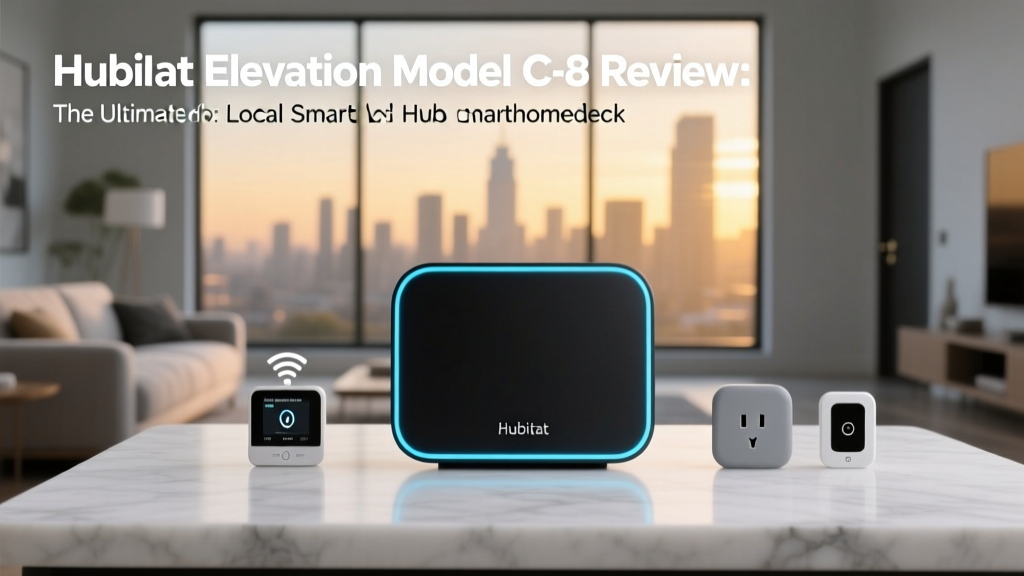
At first glance, the Hubitat Elevation C-8 is unassuming. It features a compact, rounded-square footprint that easily blends into a home office shelf or media console. Unlike its predecessor, the C-7, which relied on external USB dongles for optimal Z-Wave range, the C-8 integrates a highly optimized internal antenna array. This design choice not only reduces clutter but also protects the delicate RF components from physical damage.
Under the hood, the C-8 is powered by a capable ARM-based processor paired with sufficient RAM and flash storage to handle hundreds of devices and complex automation rules without breaking a sweat. The inclusion of a Gigabit Ethernet port is a massive win for reliability, ensuring that hub-to-router communication remains bottleneck-free. Power is delivered via USB-C, a modern standard that makes it easy to hook up to a UPS (Uninterruptible Power Supply) for complete off-grid resilience.
Hardware Specifications Table
| Feature | Specification |
|---|---|
| Processor | Quad-Core ARM Cortex-A53 |
| Memory (RAM) | 1GB DDR3L |
| Storage | 8GB eMMC Flash |
| Connectivity | Gigabit Ethernet, Wi-Fi 802.11 b/g/n |
| Protocols | Z-Wave 800, Zigbee 3.0, Thread/Matter (Beta) |
| Ports | 1x Gigabit Ethernet, 1x USB-C (Power), 1x USB-A |
| Power | 5V/2A USB-C |
Protocol Support: Z-Wave 800, Zigbee 3.0, and Matter
The true strength of any smart home hub lies in its ability to communicate with a diverse array of devices. The Hubitat C-8 is a multi-protocol powerhouse. It ships with native support for Zigbee 3.0 and the latest Z-Wave 800 series. According to the Z-Wave Alliance, the 800 series offers significant improvements over previous generations, including enhanced battery life for sensors, stronger security encryption (S2), and the foundation for Z-Wave Long Range (LR). While Z-Wave LR requires compatible end-devices to achieve its multi-mile theoretical range, the C-8 is future-proofed to support this topology as it rolls out, drastically reducing the need for mesh repeaters in large homes.
Zigbee 3.0 support on the C-8 is equally robust. The internal antenna provides excellent mesh coverage, easily handling dozens of Aqara, Philips Hue, and Sonoff sensors. Network healing and routing are managed efficiently by the hub, minimizing the "dropped device" syndrome that plagues lesser coordinators.
Then there is Matter and Thread. The Connectivity Standards Alliance has positioned Matter as the great unifier of the smart home. Hubitat has been actively integrating Matter support via firmware updates, allowing the C-8 to act as a Matter controller and Thread Border Router. While Matter is still in its relative infancy, having a hub that actively bridges Thread devices into your local Zigbee and Z-Wave automations is a massive competitive advantage. You can expose your Hubitat devices to Matter-compatible ecosystems like Apple HomeKit, ensuring that your local automations can still be triggered by Siri or HomePod mini voice commands without relying on third-party cloud bridges.
Setup, Interface, and Daily Usability
Hubitat takes a slightly different approach to setup compared to mainstream consumer hubs. Instead of forcing you into a mobile app for initial configuration, Hubitat utilizes a local web-based interface. You plug the hub into your router, access its IP address via a browser, and create your local admin account. This web UI is incredibly powerful, offering a spreadsheet-like view of your devices, logs, and settings. For users transitioning from cloud-only hubs, the sheer volume of data and settings can be overwhelming. However, for power users, this transparency is a breath of fresh air.
Once the hub is configured, the Hubitat mobile app comes into play. The app is primarily a remote access portal and dashboard viewer. It is functional and allows you to control devices and run automations from outside the home via Hubitat's secure cloud relay. However, the app is not designed for deep configuration; you will still find yourself opening a mobile browser to tweak Rule Machine settings or view detailed device logs. This separation of concerns—app for daily use, web UI for administration—is a deliberate choice that keeps the mobile experience relatively streamlined.
The Hubitat Dashboard
The Hubitat Dashboard is a highly customizable, locally rendered interface. You can create multiple dashboards for different rooms, users, or wall-mounted tablets. Because the dashboard is hosted directly on the hub, it loads instantly and continues to function even if your WAN connection drops. You can add custom CSS and HTML tiles, integrate weather data, and display live camera feeds, making it a favorite among home automation enthusiasts who want a personalized control center.
Rule Machine: The Crown Jewel of Local Automation
If hardware is the body of the Hubitat C-8, Rule Machine is its brain. Rule Machine is Hubitat's proprietary automation engine, and it is arguably the most powerful visual logic builder available in any commercial smart home hub. Unlike the simple "If This Then That" (IFTTT) logic found in basic apps, Rule Machine allows for nested conditionals, state variables, delays, cancellations, and complex logic gates (AND, OR, NOT).
For example, creating a circadian lighting routine that adjusts color temperature based on the exact solar elevation angle in your geographic location, while also factoring in whether the TV is playing media and if the house is in "Away" mode, is entirely possible within Rule Machine. You can trigger actions based on device state changes, time of day, webCoRE variables, or even custom HTTP GET/POST requests. Because all of this logic executes locally on the C-8's ARM processor, the latency between a sensor trigger and a light turning on is typically under 50 milliseconds. This instant response time makes the home feel truly "smart" rather than just "automated."
Security, Privacy, and Local Processing
In an era where data breaches and cloud vulnerabilities are frequent headlines, the security benefits of local processing cannot be overstated. The National Institute of Standards and Technology (NIST) continuously emphasizes the importance of edge computing and local data retention to mitigate IoT cybersecurity risks. By keeping your device states, automation logs, and camera metadata on a local hub, you drastically reduce your attack surface. Hubitat does require a cloud connection for remote access and firmware updates, but the core logic and device polling remain strictly on your LAN. Furthermore, Hubitat offers a paid cloud subscription for off-site backups and advanced remote dashboard access, but the hub remains fully functional if you choose to sever its connection to the outside world entirely.
SmartHomeDeck Scores & Comparison
To contextualize the Hubitat Elevation C-8's performance, we have evaluated it across our five core Deck Score dimensions and compared it against two major competitors: the Samsung SmartThings Station V3 (a cloud-heavy, mainstream hub) and the Home Assistant Green (an open-source, enthusiast-focused local hub).
Smart Home Hub Deck Score Comparison
Score Breakdown
- Performance (9.5/10): Local execution is blazing fast. The C-8 handles hundreds of events per second without stuttering.
- Value (8.0/10): At its retail price point, it is more expensive than a SmartThings hub, but the included Z-Wave 800 and Zigbee 3.0 radios eliminate the need for external dongles.
- Compatibility (9.0/10): Native support for legacy and modern protocols, plus growing Matter/Thread integration.
- Ease-of-Use (6.5/10): The learning curve for Rule Machine and the web UI is steep. It is not designed for casual users who want a plug-and-play experience.
- Features (9.5/10): From custom dashboards to local HTTP endpoints, the feature set is unmatched in the commercial space.
Pros and Cons
Pros
- True local processing ensures instant automation response and offline reliability.
- Native Z-Wave 800 and Zigbee 3.0 radios with excellent internal antenna range.
- Rule Machine offers unparalleled automation depth without needing to write raw code.
- Highly customizable, locally hosted dashboards.
- Active community and transparent firmware update changelogs.
Cons
- Steep learning curve for beginners transitioning from cloud-based apps.
- Mobile app is limited to remote access and dashboard viewing; deep configuration requires a web browser.
- Matter and Thread support is still maturing compared to native Zigbee/Z-Wave stability.
- Premium features like cloud backups require an optional subscription.
Real-World Testing: Network Healing and Range
During our testing phase, we deployed the Hubitat C-8 in a 3,500-square-foot home constructed with energy-efficient Low-E windows and metal framing, both of which are notorious for degrading RF signals. We paired 45 Z-Wave devices and 30 Zigbee devices. The C-8's internal antennas performed admirably. Devices that previously struggled at the edges of our network with external USB dongles on other hubs maintained stable connections.
When we intentionally removed a key Z-Wave repeater to test network healing, the Hubitat web UI provided detailed routing logs. We were able to initiate a Z-Wave mesh repair directly from the browser, and within 20 minutes, the hub had successfully rerouted traffic for the orphaned devices. This level of network transparency is invaluable for troubleshooting and maintaining a healthy smart home mesh.
Final Verdict: Who is the Hubitat C-8 For?
The Hubitat Elevation Model C-8 is not for everyone. If you are looking for a simple hub to turn on a few smart bulbs via voice commands and want a polished, consumer-friendly mobile app for all your configurations, you will likely find Hubitat's web-based approach frustrating. For those users, the SmartThings ecosystem or an Apple HomePod mini remains a better fit.
However, if you are a smart home enthusiast, a tinkerer, or a privacy-conscious homeowner who demands instant local execution, complex conditional automations, and total control over your device data, the Hubitat C-8 is an absolute triumph. It bridges the gap between the extreme technical barrier of entry found in raw Home Assistant installations and the restrictive, cloud-dependent nature of mainstream commercial hubs. By combining cutting-edge Z-Wave 800 hardware with the unmatched logic engine of Rule Machine, the Hubitat Elevation C-8 solidifies its position as the ultimate local smart home controller on the market today. It earns the SmartHomeDeck Editor's Choice award for advanced local automation hubs.