Introduction: The Shift to Multi-Pack Smart Home Automation
When you first dip your toes into the smart home ecosystem, you usually buy a single smart plug to test the waters. Maybe it is for a living room lamp, a coffee maker, or a hard-to-reach holiday light display. However, once you experience the convenience of voice control, automated scheduling, and away-from-home lighting routines, a single plug is never enough. This is where multi-pack bundles come into play, offering a significantly lower cost-per-device and allowing you to outfit entire rooms or floors in one fell swoop.
In the budget smart plug arena, two titans consistently dominate the best-seller lists: the Kasa Smart Plug Mini (EP10) 4-Pack by TP-Link and the Wyze Plug 3-Pack. Both brands have built their reputations on delivering reliable, no-nonsense smart home gear without the premium price tag of brands like Eve or Lutron. But when you are buying in bulk, minor differences in physical footprint, app design, and ecosystem integration become magnified. In this comprehensive multi-pack comparison, we put the Kasa EP10 4-Pack and the Wyze Plug 3-Pack head-to-head to determine which bundle offers the ultimate value for your home automation needs.
Design and Physical Footprint: The Battle for the Outlet
When deploying three or four smart plugs in a single room, the physical design of the device is just as important as its internal technology. Standard wall duplex receptacles are notoriously cramped, and a poorly designed smart plug can easily block the second outlet, rendering it useless.
Kasa EP10: The Ultra-Compact Champion
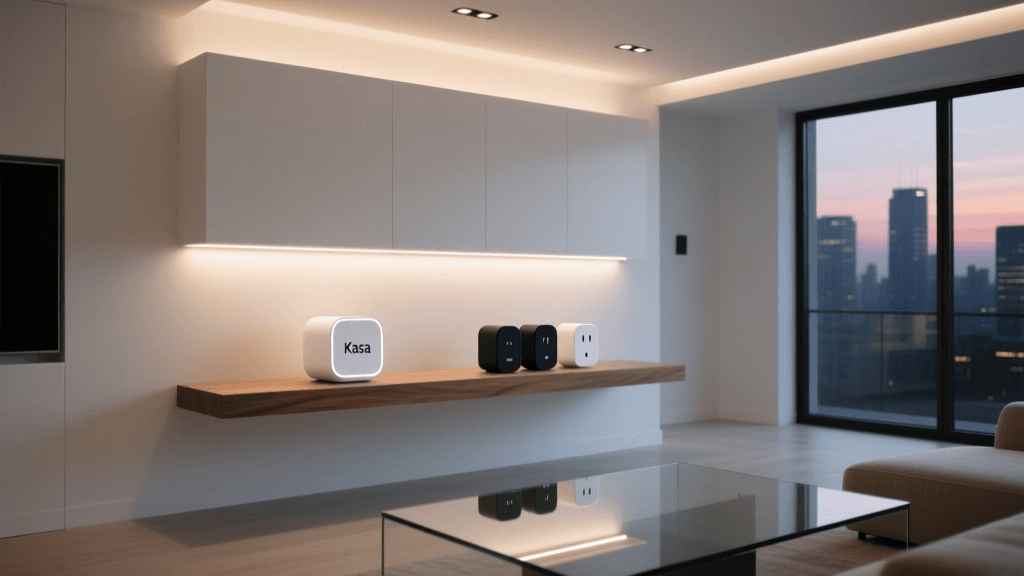
The TP-Link Kasa EP10 official specifications highlight its primary design triumph: its ultra-compact form factor. Measuring roughly 2.3 x 2.3 x 1.5 inches, the EP10 is essentially a small square that hugs the wall. In our real-world testing, the Kasa EP10 consistently left the adjacent outlet completely unobstructed, even when plugged into the top or bottom socket of a standard duplex wall plate. This makes it an ideal choice for tight spaces, such as behind entertainment centers or in kitchens where every outlet counts.
Wyze Plug: Functional but Bulky
The Wyze Plug, while aesthetically pleasing with its matte white finish and subtle LED indicator, is undeniably bulkier. It features a more traditional rectangular block design. While it does not block the second outlet if plugged into the bottom socket of a standard wall plate, plugging it into the top socket will almost certainly obstruct the bottom outlet. If you are buying a 3-pack to use in a single room, you will need to be strategic about which outlets you choose to avoid losing access to standard power.
Installation and Network Setup
Both the Kasa EP10 and the Wyze Plug operate exclusively on 2.4GHz Wi-Fi networks. This is standard for budget smart home devices, as the 2.4GHz band offers better wall penetration and range compared to 5GHz, which is ideal for smart plugs that may be tucked behind furniture.
Setting up the Kasa 4-Pack is a remarkably smooth process. The Kasa app utilizes Bluetooth Low Energy (BLE) to discover the plugs during the initial setup phase, which drastically reduces the frustration of Wi-Fi scanning timeouts. You simply plug them in, open the app, and they are instantly recognized and ready to be assigned to your Wi-Fi network. Setting up four plugs took us less than ten minutes from unboxing to voice control.
The Wyze Plug setup is similarly straightforward but relies more heavily on Wi-Fi scanning and audio-wave pairing in some older firmware versions, though recent updates have streamlined this. The Wyze app guides you through the process efficiently, but we experienced one timeout out of the three plugs during initial setup, requiring a quick reset and retry. While not a dealbreaker, the Kasa BLE-assisted setup feels slightly more premium and foolproof when deploying multiple devices at once.
App Experience and User Interface
When you are managing a dozen smart devices, the app you use daily becomes a critical component of the user experience. This is where the philosophies of TP-Link and Wyze sharply diverge.
The Kasa App: A Dedicated Smart Home Hub
The Kasa app is widely regarded as one of the best in the budget smart home space. It is clean, intuitive, and purpose-built for smart home management. The dashboard gives you a quick overview of all your devices, and the grouping feature allows you to combine multiple EP10 plugs into a single virtual switch (e.g., 'Living Room Lamps'). Scheduling, timers, and 'Away Mode' (which randomly toggles lights to simulate occupancy) are front-and-center and easy to configure. The app feels like a dedicated remote control for your home.
The Wyze App: The Camera-Centric Super App
Wyze, on the other hand, approaches the app experience from a security and monitoring perspective. The Wyze app is a 'super app' designed primarily around Wyze's wildly popular line of budget security cameras, doorbells, and sensors. While you can certainly control your Wyze Plugs from the app, they often feel like an afterthought buried beneath camera feeds and security alerts. Creating automations (called 'Rules' in the Wyze app) is functional but lacks the visual polish and intuitive drag-and-drop logic found in the Kasa app. If you are already deeply invested in Wyze cameras, having everything in one app is a plus. If you just want smart plugs, the Kasa app is vastly superior.
Ecosystem Compatibility and Voice Assistants
Neither the Kasa EP10 nor the Wyze Plug natively supports Apple HomeKit. If you are an Apple purist, you will need to look elsewhere (or rely on third-party bridges like Homebridge). However, both devices offer excellent integration with Amazon Alexa and Google Home.
When linked to Alexa or Google, both plugs respond to voice commands with minimal latency. We tested routines such as 'Alexa, turn on the coffee maker' and 'Hey Google, turn off the living room lamps,' and both brands executed the commands in under a second. However, Kasa has a slight edge in third-party ecosystem support. Kasa devices natively support IFTTT (If This Then That) and SmartThings, allowing for complex, cross-brand automations. Wyze has largely pulled back from IFTTT and SmartThings in recent years, preferring to keep users locked within its own proprietary 'Rules' ecosystem. According to Android Central's smart home experts, broad ecosystem compatibility is a major factor in future-proofing your smart home, giving Kasa a distinct advantage for power users.
Automation, Scheduling, and Advanced Features
When buying a multi-pack, you are likely looking to set up whole-room automations. Both plugs support basic scheduling (e.g., turn on at 6:00 PM, turn off at 11:00 PM) and sun-position scheduling (turn on at sunset, turn off at sunrise). The sunrise/sunset feature is incredibly useful for exterior lighting or living room lamps, as it adjusts automatically throughout the year without requiring manual schedule updates.
One area where both budget plugs fall short is energy monitoring. Unlike premium plugs (such as the Kasa EP25M or Eve Energy), neither the EP10 nor the standard Wyze Plug tracks real-time or historical power consumption. If your goal is to track the energy usage of a window AC unit or a space heater, neither of these multi-packs will serve your needs. They are strictly designed for on/off switching and scheduling for standard lighting and basic appliances.
Network Load and Reliability
A common concern when deploying multi-packs is the strain placed on your home Wi-Fi router. Smart plugs do not consume much bandwidth, but they do maintain constant connections to your router and the manufacturer's cloud servers. Adding four Kasa plugs or three Wyze plugs to your network will increase your DHCP client list and require your router to maintain multiple active 2.4GHz connections.
In our testing on a standard mesh Wi-Fi system, neither bundle caused network congestion or dropped connections. However, it is worth noting that Kasa utilizes a more efficient local polling method when integrated with SmartThings or local hubs, whereas Wyze relies almost entirely on cloud polling. If your internet connection drops, both plugs will lose remote app control and voice assistant integration, but Kasa's physical buttons and some local hub integrations tend to recover slightly faster upon network restoration.
Value Analysis: The Cost-Per-Plug Breakdown
The primary reason to buy a multi-pack is the value proposition. Let us break down the approximate retail economics of these two bundles.
| Feature / Spec | Kasa EP10 4-Pack | Wyze Plug 3-Pack |
|---|---|---|
| Quantity | 4 Plugs | 3 Plugs |
| Approximate Bundle Price | $19.99 | $17.99 |
| Cost Per Plug | ~$5.00 | ~$6.00 |
| Max Amperage | 10 Amps (1.2kW) | 15 Amps (1.8kW) |
| Wi-Fi Band | 2.4GHz | 2.4GHz |
| Energy Monitoring | No | No |
| Physical Outlet Blocking | No (Compact) | Yes (Top Socket) |
While the Wyze 3-Pack has a slightly lower upfront cost, the Kasa 4-Pack offers a better cost-per-plug ratio ($5.00 vs $6.00). Furthermore, the Kasa EP10 is rated for 10 Amps, which is perfectly sufficient for lamps, fans, and small electronics. The Wyze Plug is rated for 15 Amps, making it technically safer for high-draw appliances like space heaters or microwaves. However, as neither plug offers thermal overload protection or energy monitoring, we strongly advise against using either budget plug for high-draw heating appliances, regardless of the 15A rating on the Wyze box.
Deck Score Comparison
To visualize how these two multi-packs stack up across our core testing dimensions, we have mapped their performance in a SmartHomeDeck Radar Chart.
Pros and Cons
Kasa EP10 4-Pack
- Pros: Ultra-compact design never blocks adjacent outlets; excellent, dedicated smart home app; BLE-assisted setup is fast and reliable; lower cost-per-plug; broad third-party compatibility (SmartThings, IFTTT).
- Pros: Sunrise/sunset scheduling is highly accurate; physical button on the side for manual override.
- Cons: Limited to 10 Amps (not for heavy appliances); no energy monitoring; no native Apple HomeKit support.
Wyze Plug 3-Pack
- Pros: 15 Amp rating handles slightly higher loads; integrates seamlessly if you already use Wyze security cameras; matte white finish blends well with modern decor.
- Cons: Bulky design often blocks the second wall outlet; app is cluttered with camera feeds and security prompts; limited third-party ecosystem support; higher cost-per-plug.
Final Verdict: Which Bundle Should You Buy?
When comparing the Kasa EP10 4-Pack and the Wyze Plug 3-Pack, the winner for the vast majority of smart home users is the Kasa EP10 4-Pack. The value proposition is simply too good to ignore. At roughly $5.00 per plug, you are getting a device with a vastly superior physical footprint, a cleaner and more dedicated mobile app, and broader compatibility with third-party automation platforms like SmartThings. The fact that the Kasa plug does not block adjacent outlets is a massive quality-of-life improvement when you are plugging three or four of them into the same room.
The Wyze Plug 3-Pack is not a bad product, but it is a highly specialized one. We only recommend buying the Wyze bundle if you are already deeply entrenched in the Wyze security ecosystem. If your home is already guarded by Wyze Cam v3s, Wyze Doorbells, and Wyze Sense sensors, keeping your smart plugs within the same app and billing ecosystem provides a unified experience that might be worth the slight premium and the bulkier design.
For everyone else looking to automate their holiday lights, living room lamps, or bedroom fans, the Kasa EP10 4-Pack remains the undisputed king of budget multi-pack smart plugs. It delivers reliable performance, excellent app design, and unbeatable value, making it the perfect foundation for scaling up your smart home.
For more detailed smart home comparisons and buying guides, be sure to check out the Wyze official store and our comprehensive smart home archives.