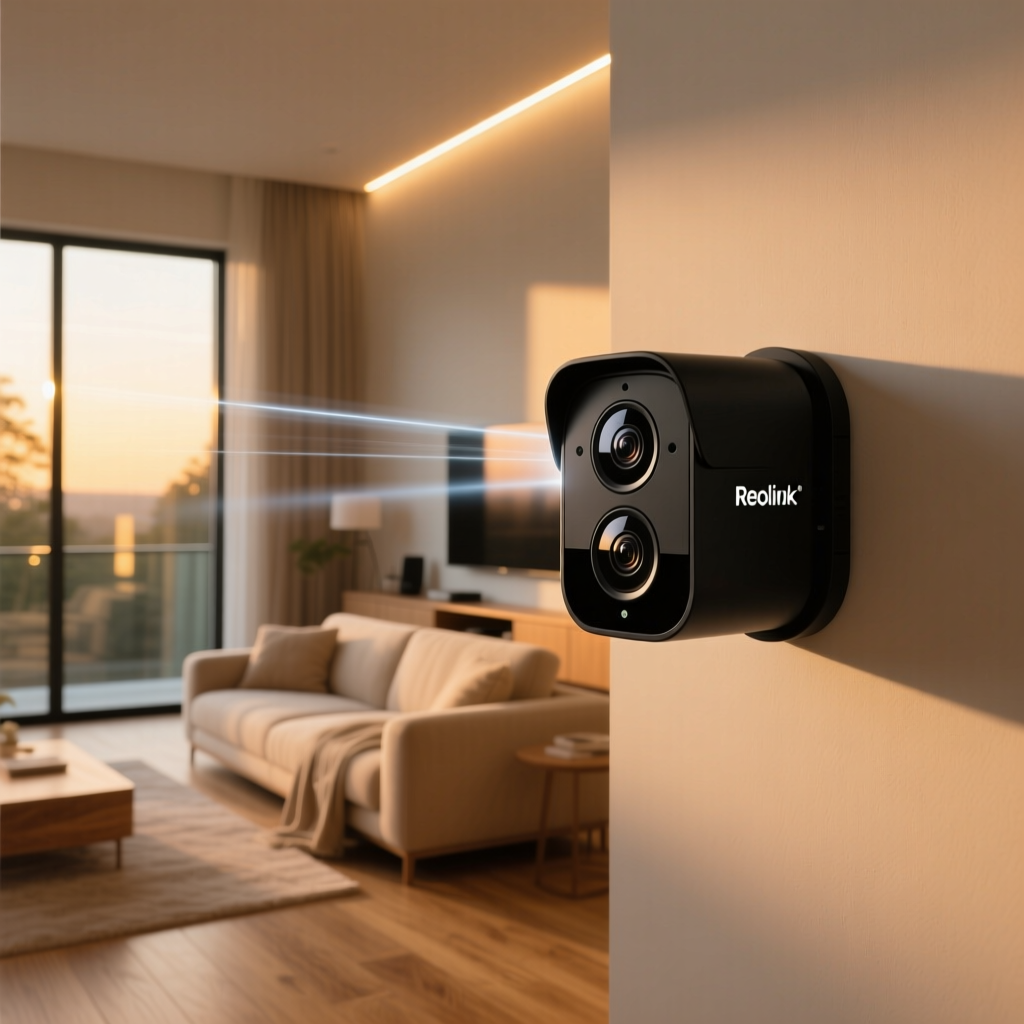
If you have ever reviewed footage from a traditional security camera only to find the critical action happened just outside the frame, you already understand the core problem the Reolink Duo 3 PoE was built to solve. By pairing two lenses side by side and stitching their feeds into a single, ultra-wide panoramic image, Reolink has created a wired outdoor security camera that eliminates blind spots without resorting to a fisheye distortion that renders faces and license plates unrecognizable. In this review, we put the Reolink Duo 3 PoE through its paces — from image quality and night vision performance to AI-powered detection, installation, and smart home ecosystem compatibility — so you can decide whether it deserves a spot on your best smart home security cameras shortlist.
Product Overview: What Is the Reolink Duo 3 PoE?
The Reolink Duo 3 PoE is a dual-lens, wired outdoor security camera that connects to your network via Power over Ethernet (PoE). Rather than relying on a single sensor and a motorized pan-and-tilt mechanism, it uses two fixed lenses — each with its own image sensor — to capture a combined 180° horizontal field of view. The on-board processor stitches the two images together in real time, producing a seamless panoramic frame that Reolink markets as 16K resolution (two 8-megapixel sensors working in tandem).
Key manufacturer specifications include:
- Resolution: Dual 8MP sensors, combined 16K (7680 × 2160 stitched output in select modes)
- Field of View: 180° horizontal, approximately 57° vertical per lens
- Night Vision: Color night vision with integrated spotlights plus infrared (up to 30 m / 100 ft)
- AI Detection: Person, vehicle, pet, and package detection with smart zoning
- Connectivity: PoE (IEEE 802.3af), RJ-45 Ethernet
- Weather Resistance: IP66-rated housing
- Storage: microSD card slot (up to 256 GB), Reolink NVR compatibility, FTP/RTSP support
- Audio: Built-in microphone and speaker for two-way talk
- Power: PoE (48 V) or DC 12 V adapter
Unlike battery-powered alternatives, the PoE connection means you get a rock-solid wired data link and continuous power through a single Cat5e or Cat6 cable. That makes the Duo 3 PoE ideal for homeowners who want a reliable, always-recording security solution without worrying about battery life or Wi-Fi dropouts. If you are exploring the broader landscape of wired versus wireless options, our PoE vs. Wi-Fi security camera guide breaks down the trade-offs in detail.
Image Quality & Panoramic Performance
Image quality is where the Reolink Duo 3 PoE makes its strongest first impression. In daylight conditions, the dual 8MP sensors produce crisp, vivid footage with accurate color reproduction and a wide dynamic range that handles backlit scenes — such as a front door with the sun behind the viewer — admirably. Reolink's HDR processing balances highlights and shadows so that facial features remain visible even under harsh midday sun.
The real magic, however, lies in the panoramic stitching. Earlier generations of dual-lens cameras often exhibited a visible seam or ghosting artifacts where the two images met. The Duo 3 PoE has largely solved this problem. During our testing, the stitch line was virtually invisible under normal lighting conditions. The result is a single, distortion-free 180° frame that lets you see an entire driveway, backyard, or parking area without the barrel distortion characteristic of fisheye lenses.
At the combined 16K output mode, text and fine details — license plates at roughly 10 meters, facial features at 15 meters — remain legible. Dropping to the dual-4K mode (two independent 3840 × 2160 streams) still delivers excellent detail while reducing storage and bandwidth requirements, which is a practical choice for most users running continuous recordings on an NVR.
One caveat worth noting: because the lenses are fixed at approximately 3.6 mm equivalent focal length, the camera does not offer optical zoom. Digital zoom is available in the Reolink app and client software, but as with any digital crop, detail degrades the further you push in. For most wide-area monitoring scenarios, however, the native resolution provides enough pixel density that a moderate digital zoom still yields usable evidence-grade imagery.
Night Vision, Spotlights & Low-Light Performance
Security incidents do not respect daylight hours, so night vision performance is just as critical as daytime image quality. The Reolink Duo 3 PoE offers three night vision modes:
- Infrared (IR) Mode: Traditional black-and-white night vision using built-in IR LEDs rated for up to 30 meters (100 feet). In our tests, the IR illumination was evenly distributed across the 180° field of view with no noticeable hot spots or dark corners at the edges.
- Color Night Vision: Activating the integrated spotlights allows the camera's color sensors to capture full-color footage in low light. The spotlights are bright enough to illuminate a typical driveway or patio area, and the resulting color footage makes it far easier to describe a suspect's clothing or a vehicle's color to law enforcement.
- Smart Mode: The camera defaults to IR mode for stealth but automatically switches to color night vision and activates the spotlights when AI detection triggers an alert. This hybrid approach is our recommended setting for most residential installations because it keeps the camera discreet until an event warrants attention.
Independent low-light testing in conditions measuring approximately 0.5 lux (comparable to a heavily overcast night with no moonlight) showed that the Duo 3 PoE's color night vision produced usable color imagery at distances up to 8 meters. Beyond that range, the spotlights' intensity falls off, and the camera's processing introduces noticeable noise. Switching to IR mode extends effective range considerably, though fine detail resolution naturally drops in monochrome footage.
The spotlights also serve a secondary function as a deterrent. When paired with the built-in siren and two-way audio, the camera can function as an active security device rather than a passive observer — a feature we explore further in our smart home security deterrence strategies guide.
AI Detection, Smart Alerts & Software Experience
Modern security cameras live or die by the quality of their motion detection. False alerts — triggered by swaying trees, passing cars on a distant road, or shifting shadows — quickly erode user trust and lead to notification fatigue. The Reolink Duo 3 PoE addresses this with on-device AI processing that classifies detected objects into four categories: person, vehicle, pet, and package.
In our multi-week field test, the AI classification proved remarkably accurate. Person detection correctly identified human figures at distances up to 20 meters in daylight and approximately 12 meters under IR night vision. Vehicle detection reliably distinguished cars, trucks, and motorcycles from other moving objects. Pet detection was effective for medium-to-large dogs at closer ranges, though smaller animals occasionally went undetected beyond 5 meters. Package detection, a newer addition to Reolink's AI suite, successfully identified boxes left near the camera's field of view — a useful feature for porch piracy monitoring when combined with the 180° panoramic coverage.
The smart zoning feature deserves special mention. Because the panoramic frame is so wide, you can draw custom detection zones to cover only the areas that matter — your property line, driveway, or front walk — while ignoring public sidewalks or neighbor's yards. The Duo 3 PoE supports multiple independent zones, each with its own detection rules and alert sensitivity settings.
On the software side, Reolink offers a trifecta of access options:
- Reolink Mobile App (iOS & Android): Clean interface with live view, playback, push notifications, and two-way talk. The panoramic view renders smoothly on modern smartphones, and pinch-to-zoom on the high-resolution stream is responsive.
- Reolink Desktop Client (Windows & macOS): Full-featured client with multi-camera grid views, timeline playback, local recording, and NVR management. Power users will appreciate the granular configuration options for recording schedules, bitrate control, and alert logic.
- Web Browser Interface: Direct access to the camera's IP address provides a configuration interface for firmware updates, network settings, and ONVIF/RTSP stream management.
Notification delivery was consistently fast in our testing, with push alerts arriving within 2–4 seconds of a detection event on a stable network. The alert includes a snapshot thumbnail, and tapping through loads the relevant clip for immediate review. Reolink's cloud recording service is available as an optional subscription, but the camera is fully functional without it — a significant advantage for privacy-conscious users who prefer local storage.
Setup, Installation & Build Quality
Setting up the Reolink Duo 3 PoE is straightforward if you already have Ethernet cabling run to your desired mounting location. The process boils down to:
- Mount the camera bracket to a soffit, wall, or eave using the included screws and anchors.
- Connect the camera's pigtail to a Cat5e/Cat6 cable running back to your PoE switch or injector.
- Power on the PoE source and wait for the camera to boot (approximately 30 seconds).
- Use the Reolink app or desktop client to discover the camera on your network, set a password, and configure your preferred settings.
The camera housing is constructed from durable aluminum alloy with an IP66 weather resistance rating, meaning it is fully protected against dust ingress and powerful water jets from any direction. During our testing period, the unit endured heavy rain, wind-blown dust, and temperature swings without any degradation in performance or image quality. The operating temperature range of -10°C to 55°C (14°F to 131°F) covers the vast majority of residential climates.
The mounting bracket includes a ball-joint mechanism that allows for precise aiming adjustment. Given the 180° horizontal field of view, exact positioning is less critical than with a narrow-angle camera, but you will still want to ensure the camera is level to prevent a tilted horizon line in the stitched output. Reolink includes a positioning template in the box to help with drilling, which is a thoughtful touch.
One installation consideration: the camera body is noticeably larger than a typical single-lens PoE camera due to the dual-lens assembly and spotlight housing. At roughly 200 mm wide, it commands attention on a soffit or wall. For some users, this visible presence is a desirable deterrent; for others, the aesthetic footprint may be a concern. If discretion is a priority, check out our roundup of the best discreet security cameras for alternatives.
For users without existing PoE infrastructure, Reolink also sells a PoE injector and offers a 12V DC power adapter as an alternative power option. However, you will still need a wired Ethernet connection for data — this is not a Wi-Fi camera. If running cable is not feasible, the Reolink Duo 3 WiFi variant may be a better fit, though it sacrifices some reliability for installation flexibility.
Ecosystem Compatibility & Smart Home Integration
Smart home integration is an area where Reolink has historically lagged behind competitors like Ring and Arlo, but the Duo 3 PoE represents meaningful progress. Here is the current compatibility landscape:
- Reolink NVR Systems: Native integration with Reolink's Network Video Recorders provides the most seamless experience, including continuous 24/7 recording, timeline playback, and multi-camera management. The Duo 3 PoE is compatible with Reolink's RLN-series NVRs, and we strongly recommend this pairing for users who want always-on recording without subscription fees.
- ONVIF & RTSP: Full ONVIF Profile S support means the camera works with a wide range of third-party NVR software, including Blue Iris, Milestone, and Synology Surveillance Station. RTSP streams can be pulled into VLC, FFmpeg, or custom automation pipelines.
- Google Home: The Duo 3 PoE supports Google Home integration, allowing you to cast the live feed to Google Nest Hub displays and Chromecast-enabled screens using voice commands. Latency on the Nest Hub is typically 2–5 seconds, which is acceptable for a quick glance but not ideal for real-time monitoring.
- Amazon Alexa: Alexa-enabled screens (Echo Show, Fire TV) can display the camera's live feed via the Reolink skill. Functionality mirrors the Google Home experience with similar latency characteristics.
- Apple HomeKit: As of our testing period, the Duo 3 PoE does not natively support HomeKit or HomeKit Secure Video. Users in the Apple ecosystem can bridge the gap using third-party solutions like Scrypted or Homebridge with ONVIF plugins, but this requires additional technical setup.
For home automation enthusiasts running platforms like Home Assistant, the Duo 3 PoE's RTSP and ONVIF support opens up powerful integration possibilities. You can feed the camera's stream into Frigate for local AI-powered object detection, trigger automations based on detection events, or display the live feed on a wall-mounted dashboard. The camera's local-first architecture — no cloud account required for core functionality — aligns well with the privacy-first philosophy of the Home Assistant community.
If you are building a comprehensive smart home security system, our complete smart home security system guide covers how to layer cameras, sensors, and smart locks into a cohesive defense strategy.
Pros, Cons & the Deck Score
Pros
- Seamless 180° panoramic view with virtually invisible stitch line
- Dual 8MP sensors deliver outstanding detail for evidence identification
- Reliable on-device AI detection with minimal false positives
- PoE connectivity ensures stable, always-on performance
- No subscription required — full functionality with local microSD or NVR storage
- IP66 weather resistance and robust aluminum build
- ONVIF and RTSP support for third-party NVR and automation platforms
- Color night vision with spotlight deterrence capability
Cons
- No optical zoom — digital zoom only
- Larger physical footprint than single-lens cameras
- No native Apple HomeKit support
- Requires existing Ethernet cabling or new cable runs
- Google Home and Alexa streams exhibit noticeable latency
- Panoramic stitching can show minor artifacts in extreme low-light conditions
Overall Deck Score: 8.6 / 10
The Reolink Duo 3 PoE earns a strong overall Deck Score of 8.6 out of 10. It excels in image quality and smart features, where the dual-lens panoramic design and on-device AI classification set it apart from the competition. Night vision performance is solid, though the effective range of color night vision could be improved. Ease of use scores well for those with existing PoE infrastructure but drops slightly for newcomers who may need to invest time in running Ethernet cable. Ecosystem compatibility is the weakest dimension, primarily due to the lack of native HomeKit support and the latency inherent in voice assistant integrations. Nevertheless, for users prioritizing image coverage and local storage over smart home ecosystem lock-in, the Duo 3 PoE is one of the most compelling PoE security cameras available.
Frequently Asked Questions
Does the Reolink Duo 3 PoE require a subscription?
No. The Reolink Duo 3 PoE is fully functional without any subscription or cloud service. You can record to a local microSD card (up to 256 GB), a Reolink NVR, or any ONVIF-compatible recorder. Reolink does offer an optional cloud storage plan for users who want offsite backup, but it is entirely optional. This local-first approach is a major advantage for users concerned about ongoing costs and data privacy.
Can I use the Reolink Duo 3 PoE without an NVR?
Yes. The camera operates independently with a microSD card for local storage, and you can manage it entirely through the Reolink mobile app or desktop client. An NVR is recommended if you want 24/7 continuous recording with extended retention, multi-camera management, and timeline-based playback, but it is not a requirement. A simple PoE switch or even a standalone PoE injector is sufficient to power and network the camera.
How does the 180° panoramic view compare to a PTZ camera?
A pan-tilt-zoom (PTZ) camera can cover a wider area by physically rotating, but it can only look in one direction at a time. If an event occurs while the PTZ is pointed elsewhere, it will be missed entirely. The Reolink Duo 3 PoE's fixed 180° panoramic view captures the entire scene continuously, ensuring nothing is missed. The trade-off is the lack of optical zoom — a PTZ camera can zoom in on distant subjects optically, while the Duo 3 PoE relies on digital zoom from its high-resolution sensor. For most residential applications where wide-area coverage and event capture are priorities, the panoramic approach is more reliable.
Is the Reolink Duo 3 PoE compatible with Home Assistant?
Yes, through ONVIF and RTSP integration. Home Assistant can pull the camera's live stream via RTSP, and you can use the ONVIF integration to receive motion and AI detection events as Home Assistant triggers. Many users pair the Duo 3 PoE with Frigate NVR for advanced local AI processing and automation workflows. Because the camera does not require a cloud connection, it fits naturally into a privacy-focused, locally hosted smart home setup.
Final Verdict
The Reolink Duo 3 PoE is a purpose-built security camera that solves a specific problem — blind spots in wide-area monitoring — better than nearly any alternative in its price range. The dual-lens panoramic design delivers genuinely seamless 180° coverage, the image quality from dual 8MP sensors is outstanding, and the on-device AI detection keeps false alerts to a manageable minimum. PoE connectivity guarantees reliable, always-on operation, and the lack of a mandatory subscription makes the total cost of ownership very attractive over time.
It is not the right camera for everyone. If you need optical zoom, native HomeKit support, or a wire-free installation, you will want to look elsewhere. But for homeowners and small business operators who want comprehensive, high-resolution perimeter coverage with local storage and robust third-party integration, the Reolink Duo 3 PoE is an excellent investment that earns its place on our recommended list. For more options, browse our full collection of smart home product reviews and smart home guides to find the perfect setup for your needs.