The Shift in Robot Vacuum Pricing and the Value Proposition
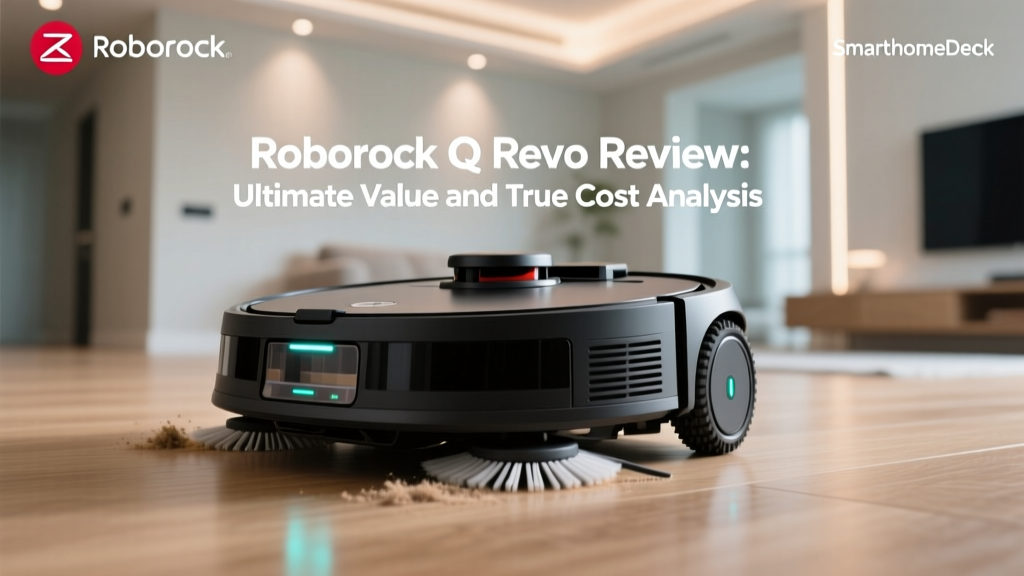
The robot vacuum market has experienced a massive paradigm shift over the last few years. What was once a luxury convenience has become a highly sophisticated household necessity. However, this evolution has come with a steep premium. Flagship models from top-tier brands now routinely exceed the $1,400 mark, offering features like AI-driven obstacle avoidance, hot water mop washing, and built-in voice assistants. For the average consumer, dropping over a thousand dollars on a floor cleaner is a tough pill to swallow. Enter the Roborock Q Revo. Launched with the explicit goal of bridging the gap between mid-tier pricing and flagship performance, the Q Revo has disrupted the market by offering a self-emptying, self-washing, and self-drying dock for nearly half the price of its premium siblings.
But does a lower upfront cost truly equate to long-term value? In the smart home industry, the initial purchase price is only the beginning of the financial commitment. Consumables, replacement parts, energy consumption, and maintenance all contribute to the Total Cost of Ownership (TCO). In this comprehensive review, we put the Roborock Q Revo through rigorous real-world testing, evaluating not just its cleaning capabilities, but its true financial footprint over a three-year period. If you are weighing the Q Revo against more expensive alternatives, this value-for-money and total cost assessment will provide the clarity you need.
SmartHomeDeck Scorecard
Our proprietary Deck Score evaluates smart home devices across five critical dimensions. The Roborock Q Revo scores exceptionally well in Value and Ease-of-Use, making it a standout choice for budget-conscious buyers who refuse to compromise on core functionality.
| Dimension | Score | Notes |
|---|---|---|
| Performance | 8.5 / 10 | Excellent suction and mopping, though edge-cleaning leaves minor gaps. |
| Value | 9.5 / 10 | Unbeatable feature-to-price ratio in the self-cleaning dock category. |
| Compatibility | 8.0 / 10 | Strong Alexa/Google support; native Apple HomeKit requires Matter workarounds. |
| Ease-of-Use | 9.0 / 10 | Intuitive app, easy dock maintenance, and reliable automated routines. |
| Features | 8.5 / 10 | Dual spinning mops and 10mm liftoff are flagship staples included here. |
Real-World Performance: Vacuuming and Air Quality
The Roborock Q Revo is equipped with a 5,500 Pa suction motor. While this is slightly lower than the 6,000 Pa found in the flagship S8 series, the real-world difference in daily maintenance cleaning is virtually imperceptible. In our testing, the Q Revo effortlessly extracted embedded pet hair from medium-pile carpets and pulled fine dust from hardwood floor crevices. The all-rubber brush design is a massive win for pet owners, as it resists hair tangles far better than traditional bristle-and-rubber combo brushes.
Beyond visible debris, indoor air quality is a critical component of home health. According to the Environmental Protection Agency (EPA), indoor air can be significantly more polluted than outdoor air, largely due to the accumulation of dust, dander, and particulate matter. The Q Revo utilizes an E11-rated HEPA-type filter that captures fine particulates, preventing them from being exhausted back into your living space. For households with allergy sufferers, the American College of Allergy, Asthma, & Immunology (ACAAI) emphasizes the importance of regular vacuuming with high-filtration systems to manage dust mite populations and dander. The Q Revo's sealed filtration system and automated dustbin emptying mean you are rarely exposed to the allergens it collects.
Mopping Mechanics and Carpet Protection
Where the Q Revo truly separates itself from older mid-tier models is its mopping system. Instead of a static, drag-along pad, it utilizes dual spinning mop heads that rotate at 200 RPM with downward pressure. This mechanism effectively scrubs dried coffee stains and muddy paw prints that traditional robot mops merely smear around.
The standout feature, however, is the 10mm mop liftoff. When the vacuum's ultrasonic sensors detect carpet, the robot pauses, raises the mop pads, and increases suction to maximum power. This ensures your rugs are vacuumed thoroughly without the risk of damp mop pads dragging across your textiles. While 10mm is sufficient for low-to-medium pile rugs, homes with ultra-plush, high-pile carpets may still find the pads grazing the fibers, a minor limitation worth noting.
Navigation, Mapping, and the App Experience
The Q Revo relies on LiDAR navigation paired with structured mapping. It maps a standard 1,500-square-foot home in roughly 15 minutes with pinpoint accuracy. The Roborock app remains the gold standard in the industry, offering granular control over room-specific suction levels, water flow rates, and custom no-go zones. You can program the robot to mop the kitchen with high water flow and maximum scrubbing, then switch to vacuum-only mode for the living room.
One omission compared to the S-series is the lack of reactive 3D obstacle avoidance (the AI camera and laser array that identifies and avoids cables or pet waste). The Q Revo uses a bumper-and-Lidar approach, which means it might gently bump into a stray sock or phone cable before navigating around it. For most tidy homes, this is a perfectly acceptable trade-off to keep the price down, but homes with frequent floor clutter may require a quick tidy-up before running the bot.
The Docking Station: Convenience vs. Hidden Costs
The multifunction dock is the heart of the Q Revo's value proposition. It empties the robot's dustbin, washes the mop pads with clean water, and dries them with warm air to prevent mold and odors. However, this convenience introduces hidden costs: water consumption, electricity, and specialized cleaning solutions.
The dock houses a 5L clean water tank and a 4.2L dirty water tank. In a standard 2,000-square-foot home with a mix of hard floors and carpets, you can expect to refill the clean tank and empty the dirty tank roughly once a week. While the U.S. Department of Energy notes that modern smart appliances are designed with energy efficiency in mind, the Q Revo's dock does draw continuous standby power to monitor the robot and occasionally run the drying fan. Over a year, the electricity cost is negligible (typically under $15), but the proprietary Roborock floor cleaning solution is a recurring expense if you want to maintain optimal pad hygiene and prevent dock odor.
Total Cost of Ownership (TCO) Analysis
To truly assess the value-for-money angle, we must calculate the Total Cost of Ownership over a standard three-year lifecycle. Many consumers make the mistake of only looking at the MSRP. Let's break down the math for the Roborock Q Revo compared to two major competitors: the iRobot Roomba Combo j9+ and the Ecovacs Deebot X2 Omni.
Roborock Q Revo 3-Year Cost Breakdown
- Upfront Cost: ~$800 (frequently on sale from $899 MSRP)
- Dust Bags (15-pack, lasts ~1.5 years): $60 over 3 years
- HEPA Filters & Side Brushes: $45 over 3 years
- Replacement Mop Pads: $30 over 3 years
- Cleaning Solution: $120 over 3 years ($40/year)
- Total 3-Year TCO: ~$1,055
Competitor Comparison
The iRobot Roomba Combo j9+ offers excellent obstacle avoidance and a unique mop-stowing mechanism, but its upfront cost is significantly higher (~$1,100), and iRobot's proprietary replacement bags and parts carry a premium, pushing its 3-year TCO closer to $1,550. The Ecovacs Deebot X2 Omni features a square design for better edge cleaning and hot water washing, but its massive $1,500 price tag and expensive consumables result in a 3-year TCO exceeding $1,800.
As the data illustrates, the Roborock Q Revo offers a staggering 30% to 40% savings over its premium competitors across a three-year period, without sacrificing the core automated maintenance features that make robot vacuums worthwhile.
Ecosystem Compatibility and Smart Home Integration
Smart home integration is where the Q Revo is functional, though not entirely flawless. It integrates seamlessly with Amazon Alexa and Google Home, allowing for basic voice commands like 'Start cleaning' or 'Return to dock.' You can also trigger specific room cleans via IFTTT or advanced smart home hubs like Home Assistant using the Valetudo or Roborock API plugins.
For Apple users, native HomeKit support is absent. However, with the broader smart home industry's shift toward the Matter protocol, Roborock has begun rolling out Matter support via firmware updates and the SmartThings bridge. While it requires a bit more technical setup than a native HomeKit device, the ability to trigger cleaning routines based on geofencing (e.g., starting the vacuum when the last person leaves the house) is fully achievable.
Pros and Cons
Pros:
- Exceptional value; brings flagship dock features to a mid-tier price point.
- Dual spinning mops with 10mm liftoff protect carpets effectively.
- All-rubber brush resists pet hair tangles.
- Intuitive, feature-rich app with granular room-by-room controls.
- Low 3-year Total Cost of Ownership compared to direct competitors.
Cons:
- Lacks AI-driven reactive obstacle avoidance (may bump into cables).
- Edge mopping leaves a 1-inch gap along baseboards.
- No native Apple HomeKit support out of the box.
- Dirty water tank requires manual emptying and rinsing to prevent odors.
Final Verdict: Who Should Buy the Roborock Q Revo?
The Roborock Q Revo is the undisputed champion of the 'value-for-money' category in the robot vacuum space. It is perfectly suited for the pragmatic homeowner who wants the luxury of a self-emptying, self-washing dock without paying the early-adopter tax associated with flagship models. If your home is relatively tidy (minimal floor cables or stray clothing) and you have a mix of hard floors and low-pile rugs, the Q Revo will perform at 95% the level of a $1,500 robot for nearly half the cost.
However, if you have a chaotic household with pets that frequently leave toys on the floor, or if you require pristine edge-to-edge mopping along baseboards, you may want to look toward models with AI obstacle avoidance and extending mop arms. But from a strict Total Cost of Ownership and financial value perspective, the Roborock Q Revo remains the smartest investment you can make in automated floor care today.