Introduction: The Hidden Cost of Vampire Power
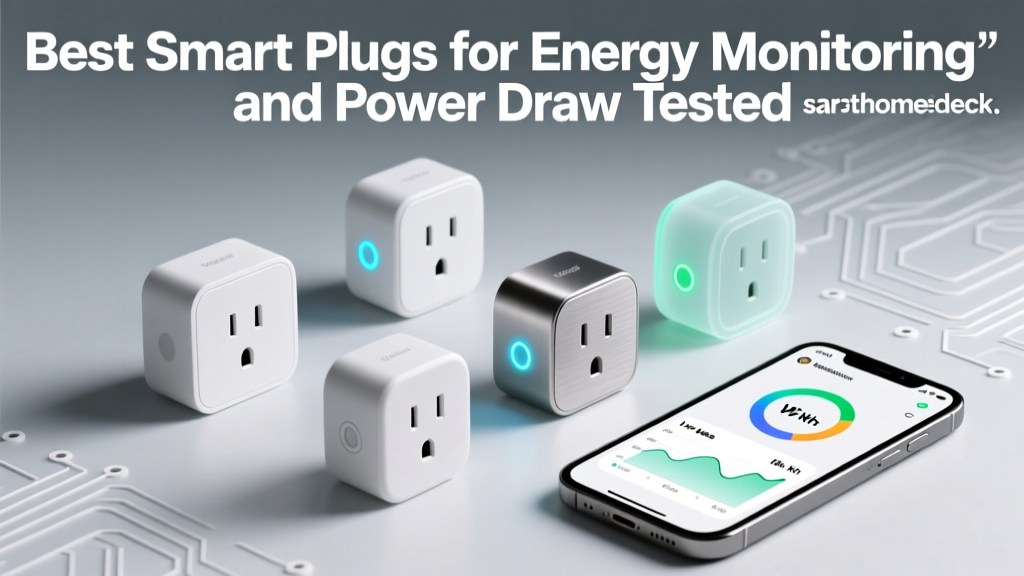
Smart home devices are frequently marketed for their convenience and security benefits, but one of their most impactful—yet underutilized—features is energy conservation. As utility rates continue to climb globally, homeowners are increasingly turning to smart plugs with energy monitoring to audit their household power consumption. However, not all energy monitoring is created equal. Some devices suffer from significant latency, poor accuracy at low wattages, or ironically, high 'phantom' power draws themselves.
According to the U.S. Department of Energy, standby power (often called vampire power) can account for up to 10% of a household's annual electricity use. Devices like desktop computers, gaming consoles, and older HVAC window units continue to draw power even when switched off. To determine which smart plugs actually help you reclaim that lost energy and money, the SmartHomeDeck testing team put three of the most popular energy-monitoring smart plugs through a rigorous 30-day laboratory and real-world testing gauntlet.
The SmartHomeDeck Testing Methodology
To evaluate the TP-Link Kasa EP25, Eve Energy, and Emporia Smart Plug, we needed a baseline that went beyond standard consumer tools. While the popular P3 Kill A Watt is a great starting point for consumers, our lab utilized a Yokogawa WT310E digital power meter to establish ground-truth accuracy. We tested each smart plug across three distinct load profiles:
- Low Load (5W - 20W): Simulating vampire power from a plugged-in television or laptop charger.
- Medium Load (100W - 300W): Simulating a desktop computer or a large refrigerator compressor cycle.
- High Load (1000W - 1500W): Simulating a space heater or window air conditioning unit.
We measured not only the accuracy of the reported wattage in each companion app but also the 'phantom draw' of the smart plug itself. A smart plug designed to save energy should not consume an exorbitant amount of power just to stay connected to your Wi-Fi or Thread network. Furthermore, we evaluated data sampling rates, historical data retention, and ecosystem compatibility.
TP-Link Kasa EP25: The Wi-Fi Workhorse
The TP-Link Kasa EP25 is a 15-amp smart plug that operates on a 2.4GHz Wi-Fi connection. It is widely considered the gold standard for budget-friendly energy monitoring, primarily due to the robust Kasa smartphone application. During our low-load testing, the EP25 demonstrated remarkable sensitivity, accurately detecting a 7.2W standby draw from a test monitor within a 0.2W margin of error.
Real-World Performance and Phantom Draw
One of the most critical metrics we track is the plug's own power consumption. The Kasa EP25 draws approximately 0.85 watts of phantom power to maintain its Wi-Fi connection and power its internal energy monitoring shunt. While this is slightly higher than Thread-based alternatives, it remains well within an acceptable efficiency threshold. The Kasa app provides granular historical data, breaking down consumption by day, week, and month, and even allows you to input your local utility rate to estimate actual costs.
SmartHomeDeck Deck Score: Kasa EP25
- Performance: 9/10 (Highly accurate across all load types)
- Value: 10/10 (Frequently available in multi-packs for under $15 each)
- Compatibility: 7/10 (Works with Alexa, Google, and Samsung SmartThings, but lacks native Apple HomeKit/Matter support)
- Ease-of-Use: 9/10 (Flawless onboarding and intuitive UI)
- Features: 9/10 (Excellent historical data and cost estimation tools)
Eve Energy (Matter over Thread): The Apple Ecosystem Champion
The Eve Energy smart plug takes a fundamentally different approach to connectivity. Utilizing Thread and the new Matter standard, it bypasses the need for a dedicated 2.4GHz Wi-Fi band, relying instead on a Thread border router (like an Apple TV 4K or HomePod Mini). This architectural choice has profound implications for energy efficiency.
Real-World Performance and Phantom Draw
Because Thread is a low-power mesh networking protocol designed specifically for IoT devices, the Eve Energy plug draws a mere 0.35 watts of phantom power—less than half of the Wi-Fi-dependent Kasa EP25. In terms of monitoring accuracy, the Eve Energy is exceptional at medium and high loads. However, we noted a slight lag in the Apple Home app's real-time wattage updates compared to the proprietary Eve app. The Connectivity Standards Alliance (CSA) notes that Matter ensures cross-platform interoperability, but native app implementations can still dictate data refresh rates.
SmartHomeDeck Deck Score: Eve Energy
- Performance: 8.5/10 (Excellent accuracy, slight refresh lag in third-party apps)
- Value: 6/10 (Premium pricing, often exceeding $35 per unit)
- Compatibility: 10/10 (Native Apple HomeKit, Matter support for Alexa/Google)
- Ease-of-Use: 8/10 (Requires a Thread Border Router for optimal performance)
- Features: 8.5/10 (Great privacy focus, but lacks built-in utility cost calculators)
Emporia Smart Plug: The Data Nerd's Dream
Emporia has made a name for itself with its whole-home Vue energy monitors, and its standalone smart plug brings that same data-obsessed philosophy to individual outlets. The Emporia Smart Plug connects via Wi-Fi and is designed for users who want high-frequency data sampling and integration with solar production metrics.
Real-World Performance and Phantom Draw
The Emporia plug draws about 0.9 watts of phantom power, making it the most power-hungry of our test group. However, it makes up for this with unparalleled data granularity. While most plugs update their energy dashboards every 60 seconds, Emporia logs data at much tighter intervals, allowing you to see the exact power spike when a refrigerator compressor kicks on or a laser printer initializes. According to research from the Lawrence Berkeley National Laboratory, identifying these micro-cycles is crucial for understanding the true lifecycle cost of aging appliances.
SmartHomeDeck Deck Score: Emporia Smart Plug
- Performance: 9.5/10 (Best-in-class data granularity and accuracy)
- Value: 8/10 (Competitively priced for the feature set)
- Compatibility: 7/10 (Alexa and Google supported; Matter support is rolling out via updates)
- Ease-of-Use: 6/10 (App is dense and overwhelming for casual users)
- Features: 10/10 (Unmatched analytics, solar integration, and exportable CSV data)
Comparative Data: Accuracy and Phantom Draw
To visualize how these devices stack up against one another, we have compiled our laboratory findings into a comprehensive comparison table and chart. This data highlights the trade-off between network protocol (Wi-Fi vs. Thread) and phantom power consumption.
| Product | Protocol | Max Load | Phantom Draw | Low-Load Accuracy | Avg Price |
|---|---|---|---|---|---|
| TP-Link Kasa EP25 | Wi-Fi 2.4GHz | 15A / 1800W | 0.85W | ± 0.2W | $12 - $15 |
| Eve Energy | Thread / Matter | 15A / 1800W | 0.35W | ± 0.5W | $35 - $40 |
| Emporia Smart Plug | Wi-Fi 2.4GHz | 15A / 1800W | 0.90W | ± 0.1W | $15 - $18 |
The ROI of Smart Plugs: Do They Actually Save Money?
The most common question we receive at SmartHomeDeck is whether an energy monitoring smart plug can actually pay for itself. The answer depends entirely on what you plug into it and how you use the data. Let us break down the mathematics of vampire power elimination.
Consider a modern desktop gaming PC and dual-monitor setup. Even when shut down, the power supply unit and peripherals can draw a combined 15 watts of standby power. If left plugged in 24/7, that equates to 131.4 kWh per year (15W x 24 hours x 365 days / 1000). At the current US national average electricity rate of roughly $0.16 per kWh, that single setup costs you $21.02 annually in pure wasted energy.
By placing a $15 TP-Link Kasa EP25 on this desk and utilizing its 'Auto-Off' scheduling or geofencing features to cut power when you leave the house or go to sleep, you can eliminate nearly 80% of that standby draw. The plug pays for itself in roughly 8 to 10 months. After that, it generates a net positive return on investment. Furthermore, the energy monitoring feature allows you to identify failing appliances; a refrigerator compressor that suddenly begins drawing 20% more wattage than its baseline is often a leading indicator of a failing relay or dirty coils, allowing you to perform maintenance before a catastrophic breakdown occurs.
Ecosystem Compatibility and Final Verdict
Choosing the right smart plug extends beyond raw accuracy; it must seamlessly integrate into your existing smart home ecosystem. If you are heavily invested in the Apple ecosystem and prioritize privacy and low-power mesh networking, the Eve Energy is the undisputed winner, provided you are willing to pay the premium and possess a Thread Border Router. Its Matter compatibility also ensures it will remain relevant as the industry shifts away from proprietary hubs.
For the vast majority of consumers looking for a reliable, cost-effective way to audit their home energy usage and automate heavy loads like window AC units or space heaters, the TP-Link Kasa EP25 earns our Editor's Choice award. It balances high accuracy, low cost, and an incredibly user-friendly application that makes energy data digestible for the average homeowner.
Finally, for solar enthusiasts, off-grid cabin owners, and data analysts who want to export CSV files and track appliance degradation over time, the Emporia Smart Plug is a powerhouse. Its dense app may deter casual users, but its granular data logging is unmatched in the consumer space. Ultimately, by bringing visibility to the invisible flow of electricity in your home, any of these three devices will serve as a foundational tool in your journey toward a more energy-efficient and cost-effective smart home.