The Hidden Cost of Vampire Power in Smart Homes
As smart home enthusiasts, we frequently focus on the convenience of automation, the elegance of voice control, and the security of connected cameras. However, an often-overlooked aspect of building a connected home is the energy footprint of the devices themselves. More importantly, how effective are these devices at helping us eliminate "vampire power"—the phantom electricity drawn by appliances when they are ostensibly turned off? According to the Lawrence Berkeley National Laboratory, standby power accounts for roughly 5% to 10% of residential electricity use. This translates to billions of dollars wasted annually and millions of tons of unnecessary carbon emissions.
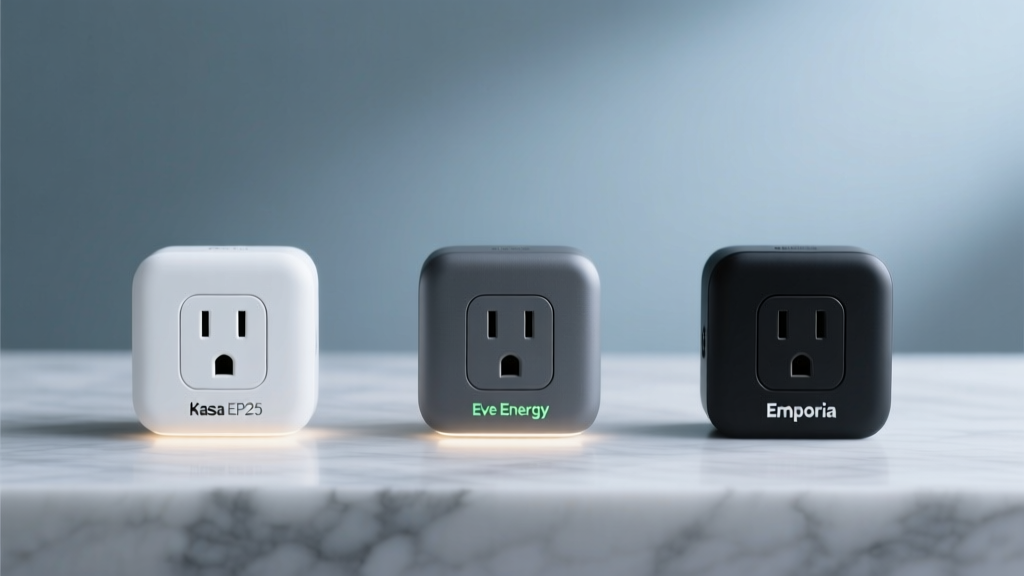
To combat this, energy-monitoring smart plugs have surged in popularity. But a critical paradox emerges: How much power does the smart plug itself consume to stay connected to your Wi-Fi or Thread network? And how accurate is its internal energy monitoring compared to a professional-grade multimeter? In this comprehensive power draw test and review, we put three of the most highly rated energy-monitoring smart plugs under the microscope: the TP-Link Kasa EP25, the Eve Energy, and the Emporia Smart Plug. We evaluate their baseline power consumption, measurement accuracy, ecosystem compatibility, and real-world return on investment (ROI).
Our Testing Methodology
To ensure our energy efficiency and power draw testing is rigorous and reproducible, we established a controlled testing environment. We utilized a calibrated P3 Kill A Watt P4460 as our baseline "source of truth" for real power (Watts), apparent power (VA), and power factor. Additionally, we employed a FLIR ONE Pro thermal imaging camera to monitor heat dissipation from the smart plugs themselves; excess heat is a direct indicator of wasted energy and internal inefficiency.
Each smart plug was tasked with monitoring two distinct loads over a continuous 14-day period:
- High-Draw Resistive Load: A 1,500W space heater to test maximum amperage handling, thermal throttling, and high-wattage accuracy.
- Complex Electronics Load: An entertainment center (TV, soundbar, gaming console, and streaming box) to test low-wattage standby detection, power factor accuracy, and vampire load identification.
We recorded the smart plug's self-reported standby power draw (the energy it uses just to stay connected to your network) and compared its cumulative kilowatt-hour (kWh) reporting against the Kill A Watt baseline to determine the accuracy margin.
TP-Link Kasa EP25: The Mainstream Champion
The TP-Link Kasa EP25 has long been the default recommendation for budget-conscious smart home builders. Priced typically around $25 for a two-pack, it offers 15-amp support and built-in energy monitoring via the highly polished Kasa app.
Power Draw and Accuracy
In our testing, the Kasa EP25 exhibited a standby power draw of 0.85 Watts. While not the lowest on the market, it is well within acceptable limits for a Wi-Fi-based device. When monitoring the entertainment center, the EP25 successfully identified the 18W vampire load generated by the TV and soundbar in standby mode. Its accuracy margin hovered around +/- 2.5% compared to the Kill A Watt, which is excellent for consumer-grade equipment. Under the 1,500W space heater load, the plug's internal relay remained cool to the touch, and thermal imaging showed only a mild 4°C temperature increase over ambient, indicating high-quality internal components.
App Experience and Automations
The Kasa app excels in data visualization, offering daily, weekly, and monthly run-time and consumption graphs. You can easily export this data to a CSV file for deeper spreadsheet analysis. Furthermore, Kasa's "Smart Actions" allow you to create automations based on power draw. For example, you can set a rule to turn off the plug entirely if the connected device draws less than 20W for more than 15 minutes, effectively killing the vampire load of your entertainment center.
Pros and Cons
- Pros: Excellent price-to-performance ratio, reliable Wi-Fi connectivity, intuitive app with data export, robust 15A relay.
- Cons: Lacks Matter support, relies on 2.4GHz Wi-Fi which can congest crowded networks, standby draw is higher than Thread-based alternatives.
Eve Energy: The Premium Matter and Thread Contender
The Eve Energy plug represents the premium tier of smart home energy monitoring. Designed initially for Apple HomeKit, it has since been updated to support the Matter standard via Thread networking. This shift in protocol has profound implications for both network stability and energy efficiency.
Power Draw and Accuracy
Because Thread is a low-power mesh networking protocol, the Eve Energy plug boasts an incredibly low standby power draw of just 0.42 Watts—roughly half that of the Wi-Fi-dependent Kasa EP25. Over a year, this difference saves roughly 3.7 kWh per plug, which is a marginal financial saving but a significant philosophical win for energy purists. Accuracy is stellar, with a deviation of only +/- 1.2% from our baseline. The Eve app provides a beautiful, granular view of your energy costs, allowing you to input your local utility's exact cost per kWh, including tiered pricing and time-of-use rates.
Ecosystem and Matter Compatibility
With native Matter over Thread support, the Eve Energy plug integrates seamlessly into Apple Home, Google Home, Amazon Alexa, and Samsung SmartThings without relying on a proprietary cloud server. This local control not only ensures your automations run instantly but also means your data isn't constantly being transmitted to a remote server, further reducing the hidden energy cost of cloud computing infrastructure.
Pros and Cons
- Pros: Ultra-low standby power draw, Matter/Thread support for local control, highly accurate energy tracking, supports complex utility rate structures.
- Cons: Premium price point (often $40+ per plug), requires a Thread border router for optimal performance, bulkier physical design can block adjacent outlets.
Emporia Smart Plug: The Data Nerd's Dream
Emporia made a name for itself with the Vue whole-home energy monitor, and their standalone Smart Plug brings that same obsessive level of data granularity to individual appliances. If you want to know exactly what your dehumidifier is costing you per hour, this is the plug for you.
Power Draw and Accuracy
The Emporia Smart Plug draws 1.1 Watts in standby, making it the most power-hungry of our trio. However, it makes up for this by offering second-by-second real-time data streaming when paired with the Emporia app. Its accuracy margin is a tight +/- 1.5%. Where Emporia truly shines is in its ability to categorize energy usage and integrate with solar panel production data if you have solar installed, allowing you to automate appliances to run only when your home is generating excess solar energy.
Pros and Cons
- Pros: Unmatched data granularity, solar-aware automations, real-time second-by-second tracking, competitive pricing.
- Cons: Highest standby power draw of the group, app interface can be overwhelming for casual users, physical design is quite large.
Data Visualization: Standby Draw and Accuracy
To visualize the efficiency and accuracy of these three contenders, review the chart below detailing their standby power consumption and measurement deviation from our laboratory baseline.
Bar chart comparing the standby power draw in watts and accuracy deviation percentage of the Kasa EP25, Eve Energy, and Emporia smart plugs.
Real-World Energy Savings and ROI
Buying an energy-monitoring smart plug is only the first step. The real financial return comes from utilizing the data to create automated shutdown routines. According to the U.S. Department of Energy, estimating and actively managing appliance energy use is one of the most effective ways to lower utility bills. Below is a breakdown of potential annual savings based on our real-world automation tests.
| Device / Scenario | Monthly Vampire Cost (Est.) | Smart Plug Automation Solution | Projected Annual Savings |
|---|---|---|---|
| Entertainment Center | $4.50 | Auto-off when TV power drops below 20W for 15 mins | $38.00 |
| Space Heater (Forgotten) | $18.00 | Interlock with room motion sensor (2-hour max run) | $145.00 |
| Desktop PC & Monitors | $6.20 | Sleep-state wattage trigger (shuts off monitors) | $52.00 |
| Window AC Unit | $8.00 | Geofencing (turns off when all users leave home) | $65.00 |
When applied across an entire home, the ROI on a $25 smart plug can be realized in as little as three months, with the added benefit of reducing your household's carbon footprint.
Understanding Power Factor and Apparent Power
A common pitfall in DIY energy monitoring is confusing Real Power (Watts) with Apparent Power (Volt-Amps, or VA). Devices with inductive or capacitive loads—such as refrigerator compressors, laser printers, or older fluorescent lighting—often have a "Power Factor" of less than 1.0. This means they draw more current than their actual wattage implies. All three smart plugs tested here (Kasa, Eve, and Emporia) correctly measure Real Power (Watts), which is the metric your utility company uses to bill you. Cheaper, unbranded smart plugs often measure Apparent Power and apply a flat multiplier, leading to wildly inaccurate billing estimates. When shopping for energy-monitoring plugs, always verify that the manufacturer explicitly states the device measures Real Power and True RMS.
Final Deck Scores and Verdict
How do these devices stack up across our proprietary SmartHomeDeck scoring dimensions? Here is the final breakdown.
TP-Link Kasa EP25
- Performance: 8.5/10
- Value: 9.5/10
- Compatibility: 7.0/10 (No Matter)
- Ease-of-Use: 9.0/10
- Features: 8.5/10
- Overall Deck Score: 8.5/10
Verdict: The best choice for budget-conscious users who want reliable Wi-Fi monitoring and don't mind the lack of Matter support.
Eve Energy
- Performance: 9.5/10
- Value: 7.0/10
- Compatibility: 10/10 (Matter/Thread)
- Ease-of-Use: 8.5/10
- Features: 9.0/10
- Overall Deck Score: 8.8/10
Verdict: The undisputed champion for energy purists and Apple Home/Matter enthusiasts who demand the lowest possible standby draw and local network control.
Emporia Smart Plug
- Performance: 9.0/10
- Value: 8.5/10
- Compatibility: 8.0/10
- Ease-of-Use: 7.5/10
- Features: 9.5/10
- Overall Deck Score: 8.5/10
Verdict: The ultimate tool for data nerds and solar-panel owners who want second-by-second granularity and advanced solar-aware automations.
Conclusion
Eliminating vampire power is one of the most impactful, yet least glamorous, upgrades you can make to your smart home. By deploying energy-monitoring smart plugs strategically across your home's heaviest phantom loads, you can offset the cost of the plugs within months while contributing to a more sustainable energy grid. Whether you choose the budget-friendly Kasa EP25, the Matter-ready Eve Energy, or the data-rich Emporia plug, the most important step is to move beyond simple remote control and embrace automated, wattage-triggered energy conservation.