The True Economics of Smart Climate Control
When evaluating smart home upgrades, few devices offer as direct a path to financial return as the smart thermostat. Unlike smart lighting or automated blinds, which offer marginal energy benefits, a smart thermostat directly controls your home's most energy-intensive systems: heating and cooling. According to the U.S. Department of Energy, homeowners can save as much as 10% a year on heating and cooling by simply adjusting their thermostat 7°-10°F for 8 hours a day. Smart thermostats automate this process, eliminating human error and forgetfulness.
However, the hardware itself represents a significant upfront investment. In this comprehensive value-for-money assessment, we analyze the total cost of ownership (TCO) for the top three market contenders: the Google Nest Learning Thermostat, the Ecobee SmartThermostat Premium, and the Amazon Smart Thermostat. We will look beyond the retail price tag to evaluate installation variables, subscription models, ecosystem compatibility, and long-term energy savings to determine which device truly offers the best return on investment.
Defining Total Cost of Ownership (TCO) in Smart HVAC
To accurately judge value, we must adopt a five-year horizon. The TCO of a smart thermostat includes the initial hardware cost, professional installation fees (if you lack a C-wire or DIY experience), optional premium subscription services, and the offsetting energy savings over a standard lifespan. The ENERGY STAR program notes that certified smart thermostats save an average of 8% on heating and cooling bills annually. However, real-world savings depend heavily on your local climate, utility rates, and the specific algorithmic efficiency of the device you choose.
According to the Environmental Protection Agency (EPA), smart thermostats that earn the ENERGY STAR label have been independently certified to deliver significant energy savings without sacrificing performance or comfort.
Let us break down the three dominant players in the market and assess their financial impact on your household budget.
Google Nest Learning Thermostat: The Premium Automation King
Upfront Cost: ~$249
Installation: DIY-friendly, but a C-wire adapter may be needed ($15-$30).
Subscriptions: None for core climate features.
The Google Nest Learning Thermostat remains the benchmark for automated climate control. Its primary value proposition is its proprietary "set it and forget it" algorithm. Over the first two weeks of use, it learns your schedule, temperature preferences, and the thermal dynamics of your home, eventually building a customized heating and cooling profile that requires zero manual programming.
From a value perspective, Nest excels in HVAC health monitoring. It actively tracks your system's run times and alerts you via the Google Home app if it detects anomalies, such as an air conditioner compressor failing to engage or a furnace taking too long to heat the space. This early warning can save homeowners thousands in emergency repair costs by allowing for scheduled maintenance rather than catastrophic failure during a heatwave or blizzard.
Furthermore, the Nest Renew feature optimizes your HVAC usage based on your local power grid's clean energy availability, potentially lowering costs if your utility provider offers time-of-use (TOU) pricing plans. While the $249 price tag is steep, the combination of energy savings, HVAC protection, and zero required subscriptions makes it a highly justifiable investment for tech-forward homes.
- Pros: Beautiful mirrored design, excellent algorithmic learning, robust HVAC health monitoring, native Matter support.
- Cons: High upfront cost, lacks included remote room sensors, requires a strong Wi-Fi signal.
Ecobee SmartThermostat Premium: The Sensor-Driven Powerhouse
Upfront Cost: ~$249
Installation: Includes a Power Extender Kit (PEK) for homes without a C-wire.
Subscriptions: Optional Ecobee Smart Home & Video Recording ($5/mo) for advanced security, though core climate features are entirely free.
Ecobee takes a fundamentally different approach to energy savings by focusing on real-time occupancy rather than historical schedules. The Premium model ships with a SmartSensor for doors and windows, plus an included remote room sensor. This ensures that the rooms you are actually using are kept at the target temperature, preventing the HVAC system from overworking to heat or cool empty spaces based on a single hallway sensor.
According to Ecobee's internal data and third-party testing, their smart sensor ecosystem can save users up to 26% annually on heating and cooling costs in larger homes. While the upfront cost matches the Nest, the inclusion of the PEK (saving potential electrician fees of $100-$150) and a room sensor makes the out-of-the-box value significantly higher. Additionally, the Premium model includes a built-in air quality monitor that tracks VOCs and CO2 levels, effectively replacing the need for a standalone $100 air quality monitor.
- Pros: Includes room sensor and PEK, built-in Alexa and Siri support, excellent multi-room management, air quality monitoring.
- Cons: The built-in speaker is mediocre for music, app interface can be complex for beginners.
Amazon Smart Thermostat: The Budget Disruptor
Upfront Cost: ~$79
Installation: Requires a C-wire; no adapter included.
Subscriptions: None.
Developed in partnership with Honeywell, the Amazon Smart Thermostat strips away the premium frills to focus on raw, affordable utility. It lacks the predictive learning of the Nest or the multi-room sensor ecosystem of the Ecobee, relying instead on Alexa Hunches and manual scheduling via the Alexa app. Alexa Hunches can automatically adjust the temperature when it senses you are asleep or away from home, based on your phone's location and Alexa usage patterns.
However, when calculating pure ROI, the Amazon device is unrivaled. Because the break-even point is achieved in just a few months of energy savings, it represents the absolute best value-for-money option for budget-conscious homeowners, renters, or landlords outfitting multiple properties. The hardware backbone is reliable Honeywell engineering, ensuring that your HVAC system is protected with standard safety protocols.
- Pros: Extremely affordable, reliable Honeywell hardware backbone, seamless Alexa integration, simple setup.
- Cons: No predictive learning, strictly requires C-wire, basic glossy plastic display, no support for remote sensors.
TCO and Energy Savings Comparison Table
| Feature | Amazon Smart | Nest Learning | Ecobee Premium |
|---|---|---|---|
| Upfront Cost | $79 | $249 | $249 |
| C-Wire Adapter Included? | No | No (Sold Separately) | Yes (PEK) |
| Remote Sensors Included? | No | No | Yes (1 Room, 1 Door/Window) |
| Air Quality Monitoring | No | No | Yes (VOC, CO2) |
| Est. Annual Energy Savings | 8% | 10-12% | 12-15% |
Visualizing the ROI: 5-Year Net Cost Analysis
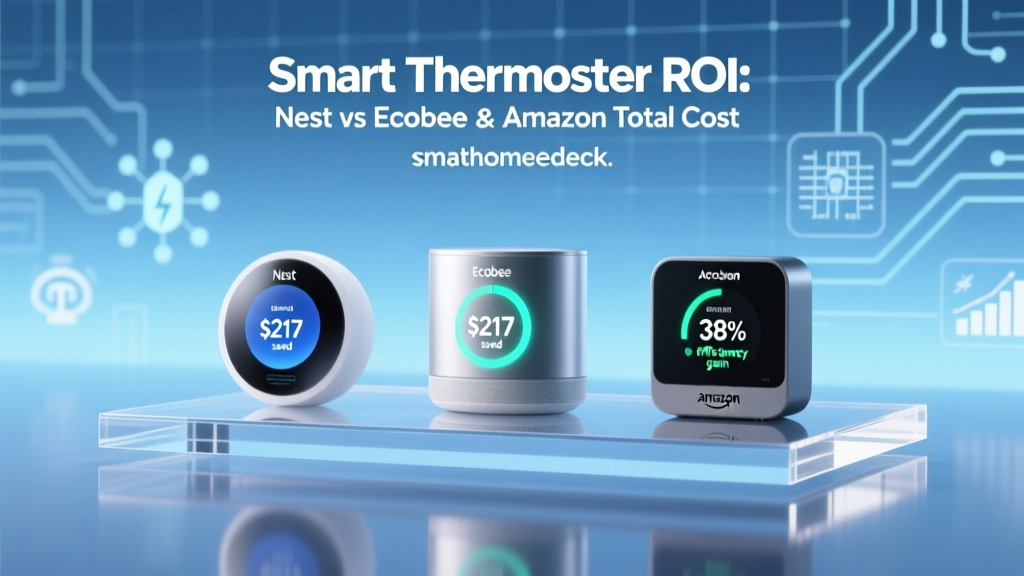
To understand the true financial impact, we must subtract the estimated 5-year energy savings from the initial hardware and installation costs. The chart below illustrates the estimated net cost of ownership over five years, assuming an average annual HVAC spend of $1,200 and factoring in included accessories.
5-Year Net Cost of Ownership
Note: Lower numbers indicate better long-term financial value. The Amazon Smart Thermostat yields the lowest net cost due to its minimal upfront investment, while the Ecobee edges out the Nest due to included accessories and higher multi-room efficiency.
Hidden Costs: Installation, Wiring, and Ecosystem Lock-in
When budgeting for a smart thermostat, the retail price is only the beginning. The most common hidden cost is the C-wire (Common Wire). Modern smart thermostats require continuous power to maintain their Wi-Fi connections and bright displays. Older homes often lack a C-wire, relying instead on "power stealing" from the HVAC control wires. While the Nest can sometimes manage without a C-wire, it often leads to system glitches or battery drain. The Amazon thermostat strictly requires one. If your home lacks this wire, you will either need to buy an adapter (like the Nest Power Connector) or hire an electrician to run a new wire, which can cost between $150 and $300. Ecobee brilliantly sidesteps this hidden cost by including a Power Extender Kit (PEK) in the box, which wires into your furnace control board to simulate a C-wire.
Another hidden cost is ecosystem lock-in. If you are heavily invested in Apple HomeKit, the Nest Learning Thermostat requires a Matter-compatible hub (like an Apple TV 4K or HomePod) to function within the Apple ecosystem, adding to the cost if you don't already own one. Ecobee supports HomeKit natively, while the Amazon thermostat is largely confined to the Alexa ecosystem.
The Deck Score: Value-for-Money Assessment
At SmartHomeDeck, we evaluate products across five core dimensions to determine their true worth.
Google Nest Learning Thermostat
- Performance: 9/10 (Flawless scheduling and HVAC monitoring)
- Value: 7/10 (High upfront cost, sensors sold separately)
- Compatibility: 9/10 (Excellent Matter and Google integration)
- Ease-of-Use: 10/10 (The best dial interface and app UX)
- Features: 8/10 (Lacks built-in air quality or room sensors)
- Deck Score: 8.6/10
Ecobee SmartThermostat Premium
- Performance: 9.5/10 (Superior multi-room climate balancing)
- Value: 8.5/10 (High upfront cost offset by included accessories)
- Compatibility: 9/10 (Native support for Alexa, Siri, and Google)
- Ease-of-Use: 8/10 (App is feature-dense but slightly cluttered)
- Features: 10/10 (Air quality, sensors, and smart home hub built-in)
- Deck Score: 9.0/10
Amazon Smart Thermostat
- Performance: 7.5/10 (Reliable but lacks predictive intelligence)
- Value: 10/10 (Unbeatable ROI and break-even speed)
- Compatibility: 7/10 (Strictly tied to Alexa, no Matter/Thread yet)
- Ease-of-Use: 8.5/10 (Simple, straightforward, no-nonsense)
- Features: 6/10 (Basic scheduling and Alexa Hunches only)
- Deck Score: 7.8/10
Final Verdict: Which Thermostat Wins the Value War?
The "best" value depends entirely on your home's layout and your existing smart home ecosystem. If you are looking for the absolute fastest financial break-even point and already have a C-wire and an Alexa-centric home, the Amazon Smart Thermostat is the undisputed champion of budget ROI. It pays for itself in less than a single season of HVAC use.
However, if you are evaluating total value over a five-year period, the Ecobee SmartThermostat Premium takes the top spot. By including the PEK adapter and a remote room sensor in the box, Ecobee saves you from hidden installation costs and accessory upcharges. Furthermore, the addition of air quality monitoring and superior multi-room efficiency ensures that your HVAC system runs only when and where it is needed, maximizing long-term energy savings while protecting your household's health. For the comprehensive smart home enthusiast, Ecobee offers the most complete, high-value package on the market today.