The Smart Thermostat ROI Paradox
When upgrading to a connected home, the smart thermostat is almost always the first device consumers purchase. The pitch is universally appealing: automate your climate control, adjust the temperature from your phone, and let artificial intelligence optimize your energy usage to lower monthly utility bills. However, the sticker price of premium smart thermostats can cause significant sticker shock. With flagship models pushing past the $250 mark, homeowners are rightfully asking whether the long-term energy savings actually justify the initial investment.
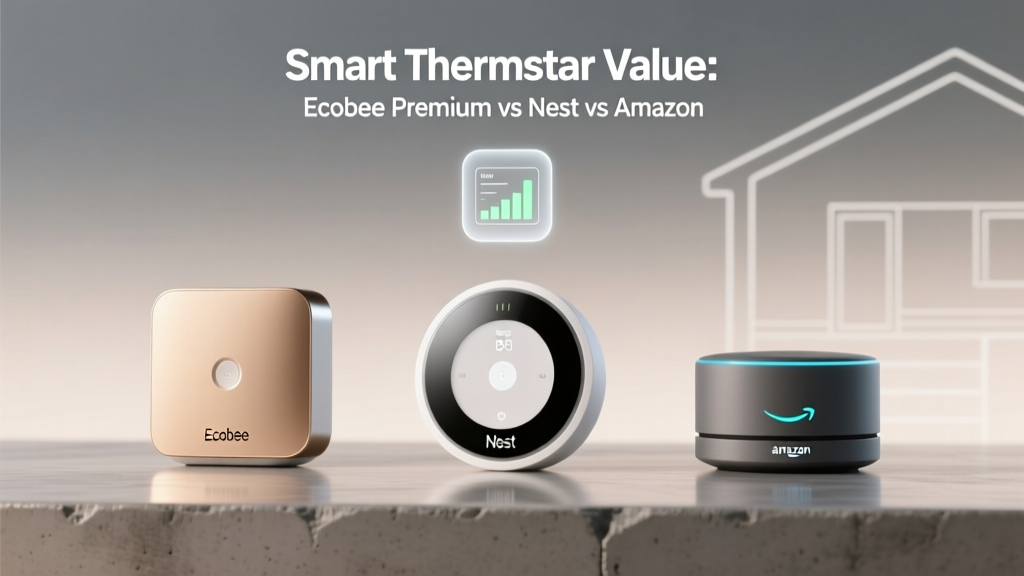
At SmartHomeDeck, we believe that evaluating a smart home device requires looking far beyond the MSRP. A true Value-for-Money and Total Cost Assessment must factor in hardware costs, professional installation fees, hidden subscription requirements, ecosystem lock-in, and verifiable energy savings over a multi-year period. In this comprehensive review, we are putting three of the most popular smart thermostats on the market head-to-head: the budget-friendly Amazon Smart Thermostat, the AI-driven Google Nest Learning Thermostat (3rd Gen), and the feature-packed Ecobee Smart Thermostat Premium. We will break down the total cost of ownership (TCO) and calculate the real-world return on investment (ROI) for each device.
Contender Breakdown: Hardware and Upfront Costs
The initial hardware cost is the most obvious barrier to entry, but it also dictates the baseline for your ROI timeline. Here is how our three contenders stack up at retail:
- Amazon Smart Thermostat ($79.99): Positioned as the ultimate budget option, this device strips away the premium bells and whistles (like built-in microphones and advanced learning AI) in favor of reliable, app-based scheduling and Alexa integration. It is essentially a rebranded Honeywell Home T9 with Amazon's software layer.
- Google Nest Learning Thermostat ($229.99): The pioneer of the category. The 3rd Generation Nest features a stunning mirrored display, auto-schedule learning, and Farsight sensors that wake the screen when you enter the room. It remains a premium hardware piece with a price tag to match.
- Ecobee Smart Thermostat Premium ($249.99): The most expensive of the trio, but it includes crucial hardware in the box: a SmartSensor for occupancy and temperature detection in remote rooms, plus built-in air quality monitoring and a speaker/microphone array for voice assistants.
The Installation Variable: C-Wires and Professional Fees
A critical, often overlooked component of the Total Cost Assessment is installation. Smart thermostats require continuous power to keep their Wi-Fi radios and displays active. This is typically delivered via a C-wire (Common wire). If your home's HVAC control board lacks a C-wire, you will face additional costs.
The Amazon Smart Thermostat strictly requires a C-wire or a compatible power adapter. If you do not have one, you will either need to buy a third-party adapter ($15-$20) or hire an HVAC technician to run a new wire, which typically costs between $100 and $150.
The Nest Learning Thermostat famously claims it does not require a C-wire, relying instead on 'power stealing' from the heating and cooling wires. However, modern high-efficiency HVAC systems often reject this method, leading to short-cycling or Wi-Fi dropouts. Many HVAC professionals strongly recommend installing a C-wire or a Nest Power Connector ($29) to ensure system stability, effectively raising the real-world installation cost.
The Ecobee Premium shines in the value department here because it includes a Power Extender Kit (PEK) in the box. The PEK wires directly into your HVAC control board, bypassing the need for a dedicated C-wire at the thermostat wall plate. This saves DIYers from buying extra hardware and can save homeowners the $150 professional wiring fee, instantly offsetting the Ecobee's higher MSRP.
Energy Savings: Calculating the Real-World ROI
To determine if these devices pay for themselves, we must look at authoritative data regarding home energy consumption. According to the U.S. Department of Energy, heating and cooling account for nearly 48% of the energy use in a typical U.S. home, making it the largest single energy expense for most households. If the average annual household energy bill is roughly $2,000, heating and cooling cost approximately $960 per year.
Furthermore, the EPA's ENERGY STAR program certifies that qualified smart thermostats save an average of 8% on heating and cooling costs annually. Applying this 8% savings to our $960 baseline yields an estimated annual savings of $76.80 per year. Let us look at how this impacts the payback period for each device, assuming a conservative DIY installation or an averaged-out installation cost.
Multi-Zone and Sensor Economics
The 8% baseline assumes a single-zone home with uniform insulation. However, real-world homes have hot and cold spots. The Ecobee Premium includes a SmartSensor, which allows the thermostat to prioritize occupied rooms rather than just the hallway where the thermostat is mounted. This targeted heating and cooling can push energy savings closer to 10-12% in larger, multi-story homes, accelerating the ROI timeline compared to the Nest and Amazon models, which rely solely on the thermostat's internal sensors unless you purchase additional remote sensors separately ($39 to $79).
Utility Rebates: The Hidden Subsidy
Before finalizing your TCO, you must check with your local utility provider. Because smart thermostats reduce peak load on the power grid, many municipal and private utility companies offer instant rebates ranging from $50 to $100 for installing an ENERGY STAR certified device. Both the Ecobee Premium and the Nest Learning Thermostat frequently qualify for maximum tier rebates, which can effectively halve the Amazon Smart Thermostat's price advantage on day one.
Total Cost of Ownership (TCO) Comparison Table
| Feature / Cost Metric | Amazon Smart Thermostat | Nest Learning (3rd Gen) | Ecobee Premium |
|---|---|---|---|
| Hardware MSRP | $79.99 | $229.99 | $249.99 |
| Included Remote Sensors | None | None | 1 SmartSensor |
| C-Wire Solution Included? | No | No | Yes (PEK) |
| Est. Professional Install | $125 (if C-wire needed) | $125 (recommended) | $0 (DIY via PEK) |
| Avg. Utility Rebate | $50 | $100 | $100 |
| Net Year 1 Cost | $154.99 - $254.99 | $254.99 | $149.99 |
| Est. Annual Energy Savings | $76.80 | $76.80 | $95.00 (with sensor) |
| Payback Period | 2 - 3.3 Years | 3.3 Years | 1.5 Years |
Visualizing the 5-Year ROI
The following chart visualizes the 5-Year Total Cost of Ownership (Hardware + Estimated Pro Install - Rebates) against the projected 5-Year Cumulative Energy Savings. A positive ROI is achieved when the savings bar exceeds the cost bar.
Ecosystem Lock-In and Subscription Costs
A true value assessment must also consider the software ecosystem and potential subscription fees. The Amazon Smart Thermostat is deeply tied to Alexa. While it does not have a built-in speaker, it requires an Alexa device for voice control. It lacks native Apple HomeKit support, which is a dealbreaker for iOS-centric households.
The Nest Learning Thermostat operates within the Google Home ecosystem. It recently received Matter support, broadening its compatibility, but its best features (like detailed energy history reports) are gated within the Google Home and Nest apps. There are no mandatory subscriptions for the thermostat itself, unlike Nest cameras.
The Ecobee Premium is the undisputed king of compatibility. It natively supports Apple HomeKit, Amazon Alexa, Google Assistant, and the new Matter protocol. Furthermore, it includes a built-in microphone and speaker, meaning it can function as a standalone Alexa or Siri voice assistant without needing an external smart speaker. While Ecobee offers an optional 'Ecobee Secure' subscription for advanced home security monitoring via their door/window sensors, the core climate control and smart sensor features are entirely free of subscription fees.
The SmartHomeDeck Scoring Matrix
We evaluate every device across our proprietary Deck Score dimensions to provide a holistic view of its market position.
- Performance (HVAC Control & Connectivity): Ecobee (9.5/10), Nest (9.0/10), Amazon (7.5/10). Ecobee's remote sensor gives it a massive edge in multi-room performance.
- Value (ROI & TCO): Ecobee (9.0/10), Amazon (8.5/10), Nest (7.0/10). Once rebates and included hardware (PEK, Sensor) are factored in, Ecobee offers staggering value.
- Compatibility (Ecosystems): Ecobee (10/10), Nest (8.5/10), Amazon (6.0/10). Ecobee's native HomeKit and Matter support future-proofs the investment.
- Ease-of-Use (App & UI): Nest (9.5/10), Ecobee (8.5/10), Amazon (8.0/10). Nest's auto-learning requires the least amount of manual scheduling.
- Features (Sensors, Air Quality, Audio): Ecobee (9.5/10), Nest (8.0/10), Amazon (5.0/10). The inclusion of VOC and air quality monitoring pushes Ecobee to the top.
Final Verdict: Which Thermostat Wins the Value War?
If you are strictly looking at the price tag on the shelf, the Amazon Smart Thermostat appears to be the undisputed value champion. For renters or homeowners with simple, single-zone HVAC systems and an existing C-wire, the Amazon device provides reliable app-based control and Alexa integration for under $80. It is a fantastic entry-level device that will pay for itself in roughly 12 to 18 months.
However, when we conduct a rigorous Total Cost Assessment, the Ecobee Smart Thermostat Premium emerges as the true value-for-money winner for the majority of homeowners. The inclusion of the Power Extender Kit saves you from a potential $150 HVAC service call. The inclusion of a SmartSensor prevents the need to buy $40 add-on sensors later. The native support for every major voice assistant and smart home protocol (including Apple HomeKit and Matter) ensures you will never have to replace the device if you switch smartphone ecosystems. When combined with aggressive utility rebates, the Ecobee Premium's net year-one cost often undercuts the Nest and rivals the Amazon, all while delivering superior multi-room climate performance and air quality monitoring.
The Google Nest Learning Thermostat remains a beautiful, well-built device with an excellent auto-scheduling algorithm. But from a strict financial and ROI perspective, its reliance on professional installation for stable power, lack of included remote sensors, and premium MSRP make it the hardest of the three to justify purely on a value-for-money basis. Choose the Nest if you are deeply embedded in the Google ecosystem and prioritize minimalist hardware design; choose the Ecobee if you want the most comprehensive, financially sound smart climate investment on the market.