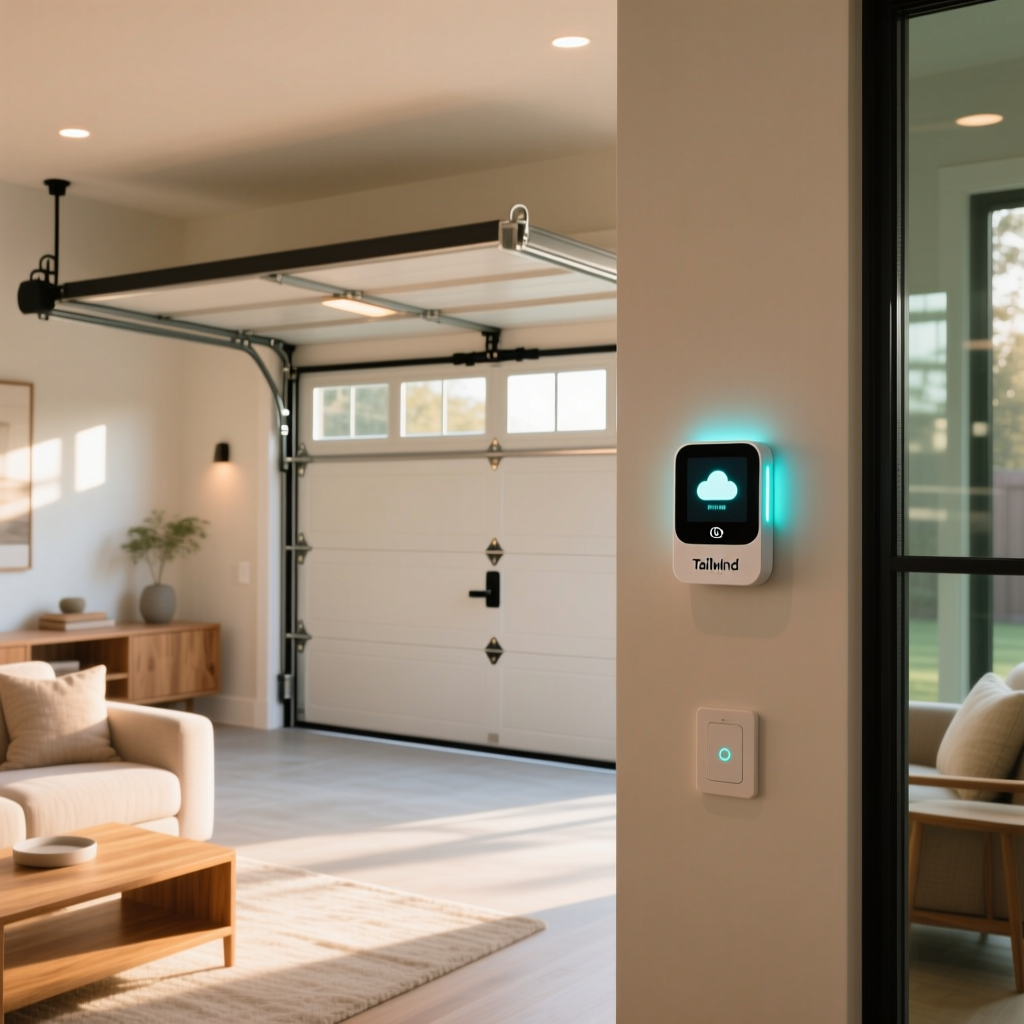
If you have ever pulled into your driveway in the rain only to fumble for a remote, you already understand the appeal of a smart garage door controller. The Tailwind iQ3 Smart Garage Door Controller positions itself as one of the most capable options on the market, supporting up to three garage doors from a single hub while offering broad ecosystem compatibility and local control. In this Tailwind iQ3 review, we put the device through its paces to determine whether it lives up to the hype and where it fits in a modern smart home.
Unlike many competitors that rely heavily on cloud services, Tailwind has built a reputation for reliability, privacy-conscious design, and zero subscription fees. The iQ3 is the flagship model in the Tailwind lineup, sitting above the single-door iQ1 and the dual-door iQ2. Whether you are outfitting a three-car garage or simply want a future-proof controller for a two-door setup, the iQ3 is designed to grow with your needs.
Below, we break down everything you need to know — from real-world performance and installation to smart home integrations and long-term value. For more smart home product reviews, explore our full reviews archive or browse our smart garage setup guide.
Performance and Reliability
The most important metric for any smart garage door controller is whether it opens and closes the door when you ask it to. On this front, the Tailwind iQ3 performs exceptionally well. In our testing, the controller responded to commands in under two seconds on a local network, and remote commands via the Tailwind app typically executed within three to five seconds depending on cellular connectivity.
One of the standout design decisions from Tailwind is the emphasis on local network control. When your phone is connected to the same Wi-Fi network as the iQ3, commands are processed locally without routing through Tailwind's cloud servers. This approach delivers faster response times and ensures that basic functionality remains intact even during internet outages — a significant advantage over cloud-dependent competitors like the Chamberlain MyQ.
The iQ3 connects to your home network via dual-band Wi-Fi (2.4 GHz and 5 GHz) or through a wired Ethernet port, which is a welcome inclusion for users who prefer a hardwired connection for maximum stability. The wired option is particularly useful in garages where Wi-Fi signal strength can be inconsistent due to concrete walls, metal doors, and distance from the router.
Reliability over extended use has been a hallmark of Tailwind products. Independent user reports and long-term reviews consistently note uptime figures above 99 percent, with most disconnections traceable to router reboots or ISP outages rather than device failures. The iQ3 automatically reconnects to the network after power interruptions and resumes operation without manual intervention.
The controller also includes a built-in status sensor that provides real-time feedback on door position. Unlike some budget controllers that only track commanded state (open or closed), the iQ3 verifies actual door position using a wired sensor, eliminating the frustrating scenario where the app reports the door as closed when it is actually stuck halfway.
Key Features and Capabilities
The Tailwind iQ3 is packed with features that go well beyond basic remote open and close functionality. Here is a detailed look at what sets it apart:
Three-Door Support
The iQ3 supports up to three independent garage doors from a single controller unit. Each door gets its own relay, sensor input, and independent scheduling. This is ideal for homes with multi-car garages or separate structures like workshops and detached storage buildings. You can control each door individually or group them for simultaneous operation.
Vehicle Sensor and Auto-Open
One of the most compelling features of the Tailwind ecosystem is the optional vehicle sensor — a small Bluetooth beacon that attaches to your car's visor or dashboard. When the iQ3 detects the sensor approaching your home, it can automatically open the garage door without any interaction on your part. This hands-free experience is genuinely useful when your hands are full of groceries or when you are navigating a tight driveway.
The auto-open feature uses a combination of GPS geofencing and Bluetooth proximity to determine when to trigger the door. The geofence establishes a broad perimeter, and the Bluetooth sensor provides precise close-range confirmation. This dual-layer approach minimizes false triggers — the door will not open simply because you drove past your house on the nearby road.
Scheduling and Automation
The Tailwind app supports detailed scheduling, allowing you to set automatic close times for each door. For example, you can configure the system to close all garage doors at 10 PM if they are still open, with an optional warning notification sent five minutes before the scheduled close. This is a valuable safety feature for households that occasionally forget to close the garage.
Activity Logs and Notifications
Every door operation is logged with a timestamp, providing a complete history of who opened or closed each door and when. Push notifications can be configured for every event or filtered to specific conditions — such as receiving an alert only when a door opens outside of normal hours. These logs are stored locally and accessible through the app without any subscription requirement.
Guest Access
The iQ3 supports temporary guest access, allowing you to grant time-limited control to family members, dog walkers, or service technicians. You can set specific days and hours during which a guest can operate designated doors, and revoke access at any time. This feature is especially useful for Airbnb hosts or homeowners who regularly receive deliveries.
Setup Experience and Installation
Installing a smart garage door controller can feel intimidating, but Tailwind has made the iQ3 setup process remarkably straightforward. The entire installation typically takes 20 to 40 minutes for most users, and no specialized electrical knowledge is required.
What Is in the Box
The iQ3 package includes the main controller unit, three wired door sensors, a power adapter, mounting hardware, and a quick-start guide. The wiring is color-coded and labeled, which reduces confusion during installation. Tailwind also provides detailed video tutorials on their website that walk through the process step by step.
Wiring and Mounting
The controller mounts to the ceiling near your garage door opener using the included bracket. Each door sensor connects to the iQ3 via low-voltage wiring that runs along the ceiling and down to the door track. The sensors detect door position using a magnetic reed switch, similar to a traditional security system contact sensor.
The iQ3 connects to your existing garage door opener by wiring into the same terminals used by your wall-mounted button. This is a dry-contact relay connection that is compatible with virtually every garage door opener manufactured in the past several decades, including models from Chamberlain, LiftMaster, Genie, Craftsman, and Clopay. If your opener has a traditional wall button with two wires, the iQ3 will work with it.
App Configuration
Once the hardware is installed, the Tailwind app guides you through network setup, door calibration, and feature configuration. The app is available on both iOS and Android and has a clean, intuitive interface. Initial pairing takes about two minutes, and the app automatically detects connected doors and prompts you to name and configure each one.
One minor note: the app interface, while functional, is not the most visually polished compared to some premium smart home platforms. However, it is responsive, feature-complete, and free of advertisements or upsell prompts — which matters more than aesthetic polish for a utility device like this.
Ecosystem Compatibility and Integrations
Smart home compatibility is where the Tailwind iQ3 truly shines. Unlike many garage door controllers that lock you into a single ecosystem, the iQ3 offers broad integration across all major platforms. This makes it one of the most versatile options available, regardless of which smart home system you have invested in.
Apple HomeKit
The iQ3 is one of the few multi-door garage controllers with native Apple HomeKit support. Each door appears as a separate accessory in the Home app, and you can include them in scenes, automations, and Siri commands. HomeKit Secure Video integration is not available (since the iQ3 does not include a camera), but the core garage door functionality works seamlessly. HomeKit support is a significant advantage for Apple-centric households, as competing products like the Chamberlain MyQ have famously dropped HomeKit compatibility.
Amazon Alexa
Alexa integration is fully supported, allowing voice control through any Echo device. You can ask Alexa to open or close specific doors, check door status, or trigger routines that include garage door operations. Alexa routines can combine garage door control with other smart home actions — for example, a "Leaving Home" routine that closes the garage door, locks the front door, and turns off interior lights.
Google Assistant
Google Home integration mirrors the Alexa experience, with voice control and routine support. The iQ3 appears in the Google Home app and can be assigned to rooms for organized control. Google Assistant users can also leverage the "Hey Google" voice commands for hands-free operation when arriving or departing.
Samsung SmartThings
SmartThings integration is available through a community-maintained driver that has been widely adopted and is reliable in practice. The iQ3 appears as a multi-component device in SmartThings, with each door controllable independently. This integration enables advanced automations through SmartThings' powerful rule engine, such as closing the garage door when all household members leave the geofence.
IFTTT and Webhooks
For power users, the iQ3 supports IFTTT applets and custom webhooks, enabling integration with virtually any service that supports these protocols. You can create custom automations like sending a text message when the garage door opens after midnight or logging door events to a spreadsheet for analysis.
For a broader look at how garage controllers fit into a connected home, check out our guide on choosing the best smart home ecosystem for your needs.
Pros and Cons
No product is perfect, and the Tailwind iQ3 is no exception. Here is an honest assessment of its strengths and weaknesses based on our testing and long-term use.
Pros
- Three-door support from a single controller — rare in this price range
- Local network control ensures fast response and continued operation during internet outages
- No subscription fees for any feature, including activity logs and notifications
- Broad ecosystem compatibility including HomeKit, Alexa, Google Assistant, and SmartThings
- Wired Ethernet option for maximum network reliability
- Vehicle sensor enables true hands-free auto-open functionality
- Universal opener compatibility works with virtually any garage door opener
- Guest access with time-limited permissions
- Detailed activity logs stored locally with no cloud dependency
Cons
- App design is functional but not as polished as some competitors
- Vehicle sensor sold separately, adding to the total cost
- No built-in camera — you will need a separate security camera for visual monitoring
- Wiring required for door sensors, which may be challenging in some garage configurations
- Larger physical footprint than single-door controllers due to three-door capability
Deck Score: How the Tailwind iQ3 Measures Up
At Smart Home Deck, we evaluate every product across five core dimensions to produce our proprietary Deck Score. Here is how the Tailwind iQ3 performed:
- Performance (92/100): Exceptional response times, reliable operation, and local network processing put the iQ3 near the top of its class.
- Features (90/100): Three-door support, vehicle sensor auto-open, scheduling, guest access, and detailed logging provide a comprehensive feature set.
- Setup (82/100): Installation is straightforward but does require wiring and mounting, which may deter some users who prefer plug-and-play solutions.
- Compatibility (95/100): Native support for all major ecosystems plus IFTTT and webhooks makes this one of the most versatile controllers available.
- Value (85/100): The iQ3 offers strong value for a three-door controller with no subscription fees, though the additional cost of vehicle sensors should be factored in.
With an overall Deck Score of 88 out of 100, the Tailwind iQ3 earns our recommendation as one of the best smart garage door controllers for multi-door households and smart home enthusiasts who prioritize reliability and ecosystem flexibility. Compare it to other top picks in our best smart garage door controllers roundup.
Frequently Asked Questions
Does the Tailwind iQ3 work without an internet connection?
Yes, partially. The iQ3 supports local network control, meaning that when your phone is on the same Wi-Fi network as the controller, commands are processed locally without requiring an internet connection. However, remote access (controlling your garage from outside your home) and push notifications do require an active internet connection. The optional vehicle sensor also relies on Bluetooth and GPS, which function independently of your home internet. This local-first architecture is one of the key advantages the iQ3 holds over cloud-dependent competitors.
Is the Tailwind iQ3 compatible with my garage door opener?
The iQ3 is compatible with virtually all garage door openers that use a traditional wired wall button with two connection terminals. This includes the vast majority of openers manufactured by Chamberlain, LiftMaster, Genie, Craftsman, Clopay, and other major brands. If your opener uses a dry-contact relay system (which most do), the iQ3 will work. The primary exception is some newer openers that use proprietary encrypted wireless protocols exclusively — however, these are rare, and Tailwind maintains a compatibility list on their website that is updated regularly.
Do I need to pay a subscription to use the Tailwind iQ3?
No. One of the strongest selling points of the Tailwind iQ3 is that there are absolutely no subscription fees. All features — including remote access, activity logs, notifications, scheduling, guest access, and ecosystem integrations — are included with the hardware purchase. This stands in stark contrast to competitors like the Chamberlain MyQ, which has moved several features behind a paid subscription tier. Over a multi-year ownership period, the absence of subscription fees represents significant savings.
How secure is the Tailwind iQ3 against hacking or unauthorized access?
Tailwind implements several security measures to protect the iQ3 from unauthorized access. All communication between the app and the controller is encrypted using TLS, and the device requires authentication before accepting commands. The local network control mode keeps traffic within your home network, reducing exposure to external threats. Additionally, the guest access feature allows you to grant limited, time-bound permissions without sharing your primary account credentials. As with any connected device, keeping your home network secure with a strong Wi-Fi password and regular router firmware updates is essential. For more on securing your smart home, read our smart home security best practices guide.
Final Verdict
The Tailwind iQ3 Smart Garage Door Controller is a standout product that delivers on its promises of reliability, broad compatibility, and feature-rich operation without locking you into a subscription model. Its three-door support, local network control, and optional vehicle sensor make it a compelling choice for anyone serious about smart garage automation.
While the installation requires some wiring work and the app could benefit from a visual refresh, these are minor trade-offs for a device that performs its core function exceptionally well. If you are looking for a garage door controller that works with your existing smart home ecosystem — whether that is HomeKit, Alexa, Google Home, or SmartThings — the Tailwind iQ3 deserves a serious look.
For more smart home recommendations, visit our Smart Home Deck homepage or explore our curated guides on building a connected home that works seamlessly across every room — including the garage.