The Ultimate High-End Smart Living Room: Where Luxury Meets Intelligence
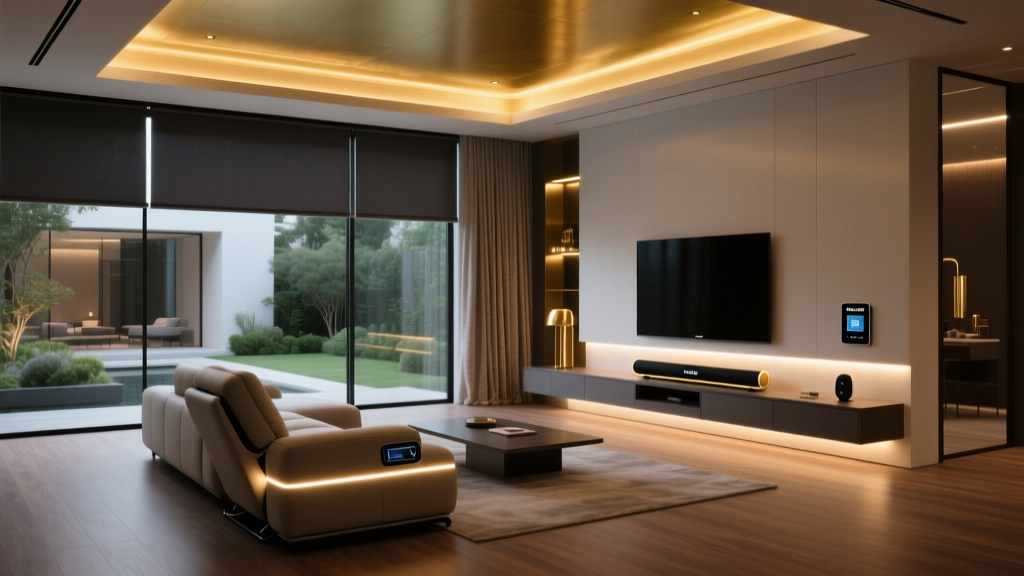
For discerning homeowners and interior designers, the living room is more than a gathering space—it’s the emotional and technological heart of the home. A true premium smart living room transcends voice-controlled lights and basic streaming. It integrates cinematic audiovisual fidelity, architectural-grade lighting control, motorized window treatments with sun-tracking intelligence, whole-home automation orchestrated by a dedicated processor—and all wrapped in a design-conscious, cable-free aesthetic. This isn’t about adding gadgets; it’s about engineering an immersive, intuitive, and timeless experience.
Why "Premium" Demands a Different Architecture
Off-the-shelf smart home ecosystems (e.g., Apple HomeKit or Google Home) excel at interoperability but falter under the demands of high-fidelity audio, multi-zone shading synchronization, or millisecond-accurate AV switching. As CEDIA’s 2026 Residential Technology Trends Report confirms, 78% of luxury residential projects now require a dedicated control system—not a cloud-dependent app—with local processing, encrypted IP-based device management, and certified integrator support. That means choosing platforms built for scalability, reliability, and bespoke programming—not just convenience.
Core Pillars of the Premium Living Room
A truly high-end setup rests on four non-negotiable pillars:
- Intelligent Environmental Control: Motorized shading, circadian lighting, and climate that adapts silently—not via apps, but via occupancy, time-of-day, and sunlight angle.
- Cinematic Audiovisual Integration: Discrete, high-resolution video display + immersive, object-based audio—fully synchronized, auto-calibrated, and controlled from one interface.
- Dedicated Automation Backbone: A local, secure, professionally programmed platform—not reliant on internet uptime—that orchestrates every subsystem as a unified experience.
- Architectural Integration & Aesthetics: Zero-visible wires, custom-finished hardware, flush-mounted keypads, and acoustic treatments that enhance—not compromise—design intent.
Recommended Premium Hardware Stack (2026)
Below is a curated, interoperable stack used by CEDIA-certified integrators for $250K+ residences. All components are UL-listed, support RS-232/IP/IR control, and integrate natively into Savant Pro or Crestron Home.
| Category | Product | Key Specs | Integration Notes | MSRP Range |
|---|---|---|---|---|
| Lighting Control | Lutron RadioRA 3 Quantum | 1000W per dimmer, DALI-2 & 0–10V support, built-in sun sensor input, 24/7 energy monitoring | Native two-way IP integration with Savant & Crestron; supports dynamic circadian tuning via Lutron Aurora API | $2,100–$4,800 (system) |
| Motorized Shades | Lutron Serena QS Triathlon (Battery) | 3.5" roller tube, 99.9% UV block, 10-year battery life, sun-angle calibration via Lutron app | Wireless mesh syncs with RadioRA 3; shades auto-adjust based on real-time solar position data | $695–$1,250 per shade (standard 60" W × 84" H) |
| AV Processor & Display | Sony X95K 85" Mini-LED TV + Trinnov Altitude16 Processor | XR Contrast Booster 10, 120Hz HDMI 2.1, Dolby Vision IQ; Trinnov supports 16-channel immersive audio + room correction | Trinnov connects via RS-232 & IP to Savant; Sony TV uses Bravia Core API for deep metadata control | $8,499 (TV) + $14,995 (Altitude16) |
| Immersive Audio | Sonos Arc Ultra + In-Wall Subwoofer (RBH SI-W12) | Arc Ultra: 11 drivers, Dolby Atmos, HDMI eARC, Trueplay tuning; RBH sub: 12" down-firing, 500W RMS, THX Ultra certified | Sonos supports native IP control via Sonos S2 API; RBH integrates via RTI or Savant drivers | $1,799 (Arc Ultra) + $1,499 (SI-W12) |
| Control Platform | Savant Pro (Savant Pro Server + Pro Touch 10") | Local Linux server, 100+ device drivers, AI-driven scene prediction, encrypted local-only mode option | Pre-certified drivers for all above devices; supports custom UI design, multi-floor zoning, and remote diagnostics for integrators | $4,295 (server) + $1,295 (touchscreen) |
Installation Realities: What Premium Really Costs (Beyond Hardware)
Hardware is only ~40% of a premium living room’s total investment. The rest lies in labor, infrastructure, and calibration:
- Structured Wiring: CAT6A (or fiber) to every device location; dedicated 20A circuit for AV rack; EMI-shielded conduit for analog audio runs. Budget: $3,500–$7,200.
- Acoustic Treatment: Professionally modeled bass traps, diffusers, and broadband absorption (e.g., GIK Acoustics Panel System). Critical for achieving THX or Dolby Reference-level performance. Budget: $4,800–$9,500.
- Calibration & Commissioning: Trinnov AutoCal + Dirac Live Bass Control + Lutron light tuning + Savant UI walkthrough. Requires 16–24 hours onsite by CEDIA Elite integrator. Budget: $3,200–$5,600.
- Custom Finishes: Solid brass keypads (Lutron Maestro Custom), recessed in-wall touchscreens (Savant Pro Wall Mount Kit), and powder-coated AV rack (Middle Atlantic MRK Series). Budget: $2,100–$4,300.
Automation Routines That Define the Experience
Premium automation isn’t about “turn on lights.” It’s about context-aware, anticipatory behavior:
- Sunrise Sequence (5:45 AM): Lutron lights warm to 2200K at 1% intensity; Serena shades lift 15% to diffuse dawn light; HVAC pre-cools to 72°F; Savant pushes weather & calendar to Pro Touch.
- Cinema Mode (Triggered by “Watch Movie”): All shades close fully; ambient lights fade to 5%; TV powers on and switches to HDR10+ profile; Trinnov loads “Cinema” EQ + upmixes stereo content; Sonos Arc Ultra engages Dolby Atmos decoder; AC reduces fan speed to minimize noise floor.
- Goodnight (11:00 PM): Lights ramp to 0% over 90 seconds; shades close; HVAC shifts to “Sleep” mode (76°F, low fan); AV rack enters low-power standby; Savant logs energy usage and checks for firmware updates.
Design & Aesthetic Integration: The Invisible Tech Principle
In luxury interiors, technology must recede. That means:
- No visible cables: All HDMI, speaker wire, and control lines run through in-wall conduits or beneath raised flooring. Use Belden’s in-wall rated CL3/FT4 cables—not retail-grade “HDMI in-wall kits.”
- Flush-mounted interfaces: Lutron Pico remotes embedded in walnut backboxes; Savant Pro Touch installed with zero bezel using Kwikset’s SlimMount kit.
- Acoustic transparency: Speaker grilles matched to wall finish (e.g., acoustically transparent fabric stretched over drywall); in-ceiling speakers (e.g., Triad Platinum ICS) positioned per ITU-R BS.775-3 stereo triangle guidelines.
Energy & Longevity: The Hidden ROI of Premium Systems
While upfront costs are significant, premium systems deliver measurable long-term value. Lutron’s 2026 Energy Savings Dashboard shows homes using RadioRA 3 with Serena shades reduce cooling loads by up to 27% annually—translating to $420–$980/year in HVAC savings for a 500-sq-ft living room. Further, Savant Pro’s local-first architecture avoids cloud subscription fees ($199/year typical for mid-tier platforms) and ensures full functionality during internet outages—a critical factor for high-net-worth clients, per Architectural Record’s 2026 feature on offline-first residential tech.
Annual Energy Savings Comparison: Premium vs. Mid-Tier Smart Living Rooms (per 500 sq ft)
Final Considerations Before You Begin
Before engaging an integrator:
- Require CEDIA Certification: Verify your integrator holds active CEDIA Certified Technician (CCT) or CEDIA Designer (CD) credentials—check CEDIA’s official directory.
- Insist on a System Diagram: Demand a full one-page schematic showing all devices, control paths (IP/RS-232/IR), power sources, and network topology—not just a product list.
- Test the UI Yourself: Ask for a demo of the Savant or Crestron interface on your own iPad *before* signing. Does it load instantly? Are scenes labeled intuitively? Can you adjust audio zones without tapping 5 times?
A premium smart living room is not a collection of devices—it’s a carefully authored environment. When engineered correctly, it disappears into the background, emerging only when needed: softening light before dinner, deepening bass for a film score, or gently waking you with the first glow of sunrise. That invisibility, that seamlessness, is the ultimate hallmark of luxury—and the reason high-end systems continue to command 3.2× the average project budget, according to the 2026 CEDIA Trends Report. Invest in the architecture—not the accessories—and your living room won’t just be smart. It will be wise.