Transform Your Sleep Sanctuary Without Breaking the Bank
The concept of a 'smart bedroom' often evokes images of expensive automated blinds, high-end sleep trackers, and complex control panels that cost thousands of dollars. However, the true purpose of bedroom automation is not to fill the room with flashy gadgets, but to create a seamless, distraction-free environment that promotes deep, restorative sleep. By focusing on high-impact, low-cost devices, you can completely transform your sleep hygiene and daily routines without exceeding a modest budget.
At SmartHomeDeck, we believe that intelligent home design should be accessible to everyone. Whether you are outfitting a small apartment studio or upgrading a master suite, a budget of $200 is more than enough to introduce circadian lighting, automated climate monitoring, and voice-controlled routines. In this comprehensive guide, we will break down the ultimate budget-friendly smart bedroom setup, providing specific product recommendations, exact pricing, and step-by-step automation guides to help you achieve a premium smart home experience on a starter budget.
The Philosophy of a Budget Smart Bedroom
Before diving into the shopping list, it is crucial to understand the core philosophy of bedroom automation. Unlike the living room or kitchen, which are hubs of activity and entertainment, the bedroom is a sanctuary for rest. According to the National Heart, Lung, and Blood Institute, maintaining a cool, dark, and quiet environment is essential for healthy sleep habits. Therefore, every smart device you introduce to this space must serve one of three purposes:
- Circadian Alignment: Adjusting light temperature and brightness to match the natural rising and setting of the sun, which regulates melatonin production.
- Frictionless Control: Allowing you to turn off lights, lock doors, or adjust the thermostat without ever leaving the comfort of your bed.
- Ambient Optimization: Monitoring and managing room temperature, humidity, and noise levels to prevent sleep disruptions.
Pro Tip: Avoid placing screens or bright LED indicators in your direct line of sight from the bed. The goal is 'invisible technology' that works quietly in the background.
The Under $200 Shopping List: Core Components
To maximize your budget, we are bypassing expensive proprietary hubs and relying on Wi-Fi and Zigbee devices that integrate seamlessly with free ecosystems like Amazon Alexa, Google Home, or Apple HomeKit. Here is the exact bill of materials for our budget smart bedroom.
1. Smart Hub and Audio: Amazon Echo Pop (Approx. $30)
The Amazon Echo Pop is a compact, budget-friendly smart speaker that serves as the brain of your bedroom. Its small footprint makes it perfect for a crowded nightstand. Beyond voice commands, it acts as an alarm clock, a white noise machine, and an intercom. By utilizing Alexa's built-in sleep sounds and 'Do Not Disturb' schedules, you eliminate the need for a dedicated sound machine.
2. Circadian Lighting: Wyze Bulb Color (2-Pack) (Approx. $20)
Lighting is the most critical factor in sleep hygiene. The Wyze Bulb Color offers tunable white light (from warm 2200K to cool 6500K) and millions of colors. You will use the warm, dim amber tones in the evening to signal to your brain that it is time to wind down, and the cool, bright white tones in the morning to simulate a natural sunrise and help you wake up feeling refreshed.
3. Appliance Control: Kasa Smart Plug Mini (4-Pack) (Approx. $25)
Smart plugs are the unsung heroes of budget automation. This 4-pack allows you to 'smartify' your existing dumb devices. Use them to control a bedside salt lamp, a traditional box fan, a coffee maker in the adjoining bathroom, or a decorative LED accent light. According to the ENERGY STAR electronics guidelines, managing phantom power loads with smart plugs can also contribute to minor energy savings over time.
4. Environmental Monitoring: Aqara Temperature and Humidity Sensor (Approx. $15)
The ideal sleep temperature is generally around 65 degrees Fahrenheit (18 degrees Celsius). This tiny Zigbee sensor provides highly accurate, real-time data to your smart home app. While it requires a basic Zigbee hub (which can be found refurbished for under $10, or you can use an older SmartThings hub), the data it provides is invaluable for triggering automations based on room conditions.
5. Midnight Navigation: Sonoff SNZB-03 Motion Sensor (Approx. $15)
Getting up in the middle of the night to use the restroom can ruin your sleep cycle if you are blinded by overhead lights. This budget motion sensor can be mounted near the baseboards to trigger low-level lighting only when you swing your legs out of bed.
6. Master Control: Aqara Wireless Mini Switch (Approx. $15)
Mount this small button to your nightstand or headboard. It serves as a physical 'master kill switch' for your room, ensuring you do not have to fumble with your phone or shout voice commands into the dark when you are ready to sleep.
7. Ambient Bias Lighting: Govee Smart LED Strip (16.4ft) (Approx. $30)
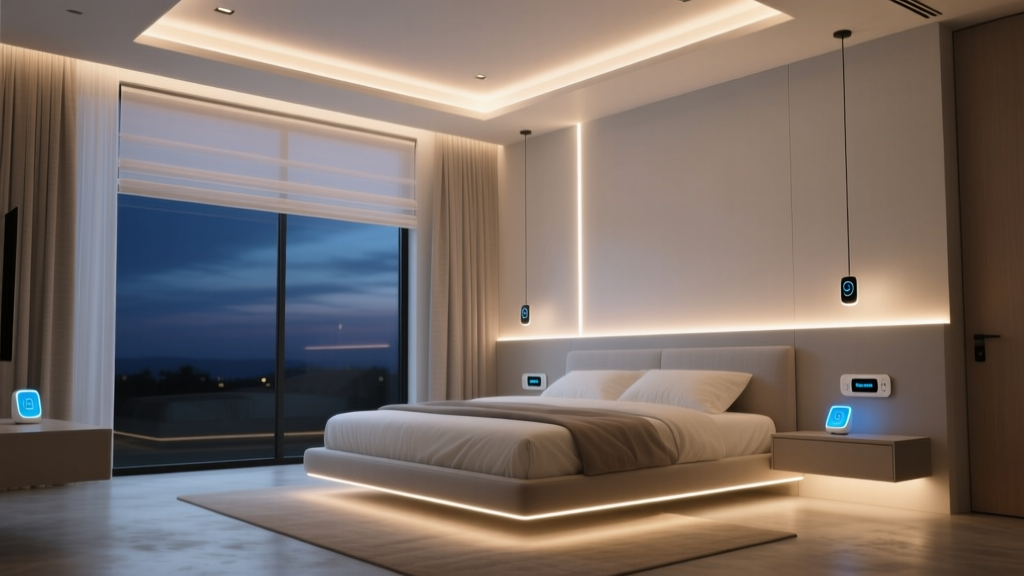
Place this behind your headboard or under the bed frame. Bias lighting reduces eye strain if you read in bed and provides a soft, diffused glow that makes the room feel like a high-end boutique hotel.
Budget Breakdown Table
| Device Category | Recommended Model | Est. Price | Primary Function |
|---|---|---|---|
| Smart Speaker | Amazon Echo Pop | $30 | Voice control, alarms, white noise |
| Smart Bulbs | Wyze Bulb Color (2-Pack) | $20 | Circadian lighting, sunrise simulation |
| Smart Plugs | Kasa Mini (4-Pack) | $25 | Fan, lamp, and accessory control |
| Climate Sensor | Aqara Temp & Humidity | $15 | Room environment monitoring |
| Motion Sensor | Sonoff SNZB-03 | $15 | Under-bed midnight lighting trigger |
| Smart Button | Aqara Wireless Mini | $15 | Bedside master sleep switch |
| LED Strip | Govee 16.4ft RGBIC | $30 | Ambient headboard/under-bed glow |
| Total | Complete Setup | $150 | Leaves $50 for mounts/tape |
Essential Automation Routines for Sleep Hygiene
Hardware is only half the equation; the true magic of a smart bedroom lies in the software automations. Using the native Alexa app or a platform like IFTTT, you can program these three essential routines to run seamlessly in the background.
1. The 'Circadian Sunrise' Morning Routine
Waking up to a blaring alarm in a pitch-black room causes a spike in cortisol, leaving you groggy. Instead, use your Wyze bulbs to simulate a natural dawn.
- Trigger: 30 minutes before your scheduled wake-up time.
- Action 1: Set Wyze bulbs to 1% brightness and 2200K (warm amber).
- Action 2: Over the next 25 minutes, gradually increase brightness to 100% and shift the color temperature to 5000K (cool daylight).
- Action 3: At your exact wake-up time, the Echo Pop plays a gentle acoustic playlist or your preferred morning news briefing, and the Kasa smart plug turns on your coffee maker in the kitchen.
2. The 'Deep Sleep' Master Shutdown
This routine is triggered by a single press of the Aqara Wireless Mini Switch on your nightstand. It removes all friction from going to sleep.
- Trigger: Single click on Aqara Button.
- Action 1: Turn off all Wyze bulbs and Govee LED strips immediately.
- Action 2: Turn off the Kasa smart plug connected to your bedroom fan or reading lamp.
- Action 3: Set the Echo Pop volume to 40% and begin playing 'Brown Noise' or 'Rain Sounds' on a 4-hour sleep timer.
- Action 4: Enable 'Do Not Disturb' mode on the Echo Pop until 7:00 AM to prevent notification chimes from interrupting your REM cycles.
3. The 'Midnight Navigation' Safety Routine
Navigating to the bathroom at 2:00 AM should not require turning on overhead lights, which can suppress melatonin production and make it difficult to fall back asleep.
- Trigger: Sonoff Motion Sensor detects movement (positioned to only trigger when you sit up or step out of bed).
- Condition: Only run between 11:00 PM and 6:00 AM.
- Action 1: Turn on the Govee LED strip (mounted under the bed frame) to 5% brightness in a deep red hue. Red light has the least impact on circadian rhythms.
- Action 2: After 3 minutes of no detected motion, slowly fade the LED strip back to off.
Installation, Aesthetics, and Design Considerations
When working with a budget, aesthetic compromises are common, but they are not inevitable. The key to making a budget smart bedroom look like a custom-installed professional setup is meticulous cable management and strategic device placement.
Hiding the Tech Clutter
Smart plugs are notoriously bulky and can block adjacent outlets. Mount your Kasa smart plugs behind the nightstand or under the desk where they are out of sight. Use adhesive cable clips (which cost only a few dollars) to route the power cord for your Govee LED strip along the back edge of the headboard. If your headboard is mounted to the wall, consider running the LED strip along the top edge to create a beautiful 'halo' effect that washes the ceiling with soft light, completely hiding the physical strip from view.
Sensor Placement Strategy
Motion and temperature sensors should never be the focal point of your room. The Sonoff motion sensor can be mounted using double-sided foam tape on the side of your nightstand, angled downward toward the floor. This prevents false triggers from pets walking across the room and ensures it only activates when you physically get out of bed. The Aqara temperature sensor can be discreetly placed on a high bookshelf or mounted near the center of the room to get an accurate ambient reading, away from the direct heat of electronics or the cold draft of a window.
Managing the Echo Pop
While the Echo Pop is small, its LED light ring can be distracting in a dark room. In the Alexa app, navigate to the device settings and enable 'Auto-Night Mode' or manually set the brightness to the lowest possible level. Furthermore, ensure the speaker is angled toward your pillow for clear voice recognition at low volumes, allowing you to whisper commands like 'Alexa, turn off the lamp' without waking a partner.
Maximizing Your Remaining Budget
With the core setup coming in at approximately $150, you have $50 remaining in your budget. How you allocate this depends on your specific pain points:
- For Hot Sleepers: Invest in a budget smart IR blaster (like the SwitchBot Hub Mini, approx. $25) to connect your existing dumb window AC unit to your smart home ecosystem, allowing you to pre-cool the room before bed.
- For Light Sleepers: Purchase a high-quality blackout curtain and use the remaining funds on a motorized curtain robot (like the basic SwitchBot Curtain rod attachment) to automate natural light blocking.
- For Readers: Add a second set of smart bulbs to a dedicated reading sconce, or upgrade your nightstand lamp with a smart socket adapter.
Conclusion: Smart Sleep is Accessible Sleep
Building a smart bedroom under $200 is not about sacrificing quality; it is about prioritizing the technologies that genuinely impact your daily life. By focusing on circadian lighting, automated environmental controls, and frictionless midnight navigation, you can create a sanctuary that actively works to improve your sleep hygiene. The devices listed in this guide offer incredible versatility, allowing you to start small and expand your ecosystem over time. Remember, the best smart home setup is the one you do not have to think about—it simply anticipates your needs, fades into the background, and lets you focus on what matters most: getting a perfect night of rest.