The Ultimate Smart Home Aquarium Room Guide: Water Monitoring, Lighting, and Automation
For dedicated aquarists, a living room tank is only the beginning. The true holy grail of the hobby is the dedicated aquarium room—often referred to as a "fish room." This specialized space allows for bulk water storage, centralized filtration systems, and the housing of multiple aquatic ecosystems ranging from freshwater planted tanks to complex saltwater reef setups. However, managing a room full of water, electricity, and sensitive livestock requires meticulous attention to detail. This is where smart home technology transforms from a luxury into an absolute necessity.
Integrating smart home devices into your aquarium room provides unparalleled peace of mind. Automated water monitoring, precision lighting schedules, and emergency shutoff routines protect both your aquatic life and your home from catastrophic failures. In this comprehensive guide, we will explore how to design, equip, and automate your smart aquarium room, ensuring your underwater ecosystems thrive while you enjoy the benefits of modern home automation.
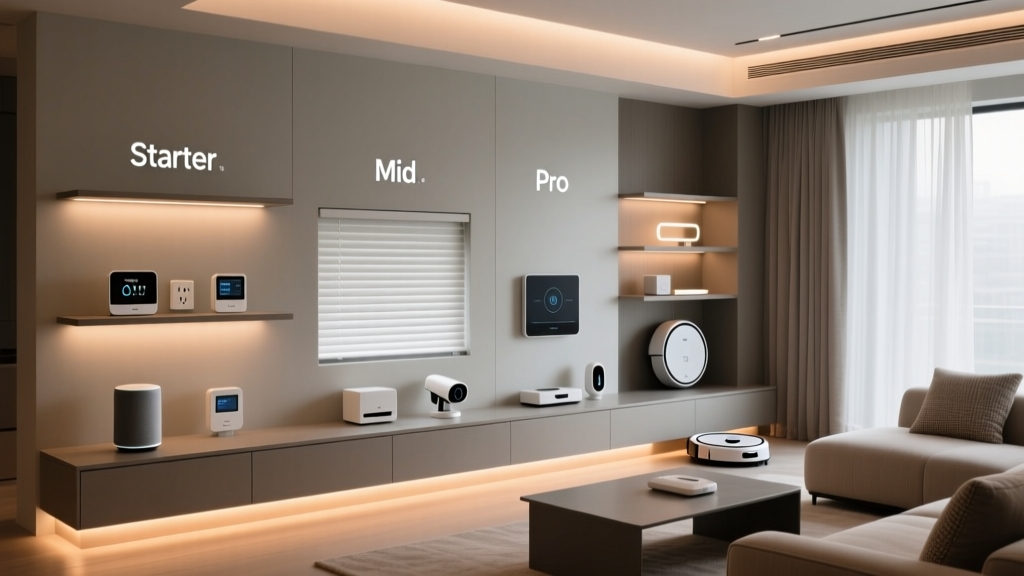
Budget Tiers for Your Smart Aquarium Setup
Building a smart fish room can be scaled to fit virtually any budget. Whether you are looking for basic disaster prevention or a fully autonomous aquatic laboratory, there is a tier that matches your needs. Below, we break down the smart home aquarium ecosystem into three distinct budget tiers.
Starter Tier: Disaster Prevention & Basic Control
The Starter Tier focuses on protecting your home from water damage and ensuring your equipment turns on and off reliably. This tier is perfect for hobbyists with one or two large tanks who want peace of mind without breaking the bank.
- Smart Leak Sensors: Placed on the floor beneath the tanks, near the sink, and under RO/DI (Reverse Osmosis/Deionization) storage barrels. These are your first line of defense against catastrophic floods.
- Smart Plugs: Used to control aquarium lighting and non-critical peripherals. They allow you to set schedules and monitor basic energy consumption.
- Wi-Fi Temperature Alarms: Standalone wireless temperature probes that send push notifications to your phone if the water temperature drifts outside a safe range, indicating a heater or chiller failure.
Mid Tier: Parameter Stability & Environmental Control
The Mid Tier introduces active management of water parameters and room climate. This is the sweet spot for serious hobbyists managing multiple tanks, frag rooms, or sensitive reef setups.
- Smart Relays & Dosing Pumps: Utilizing smart relays to trigger peristaltic dosing pumps, maintaining precise alkalinity, calcium, and magnesium levels based on daily consumption.
- App-Controlled LED Lighting: High-end aquarium LEDs that connect via Bluetooth or Wi-Fi, allowing for dynamic sunrise/sunset transitions, lunar cycles, and seasonal acclimation schedules.
- Room Climate Automation: Smart plugs and switches tied to humidity sensors to control exhaust fans and dehumidifiers, preventing mold and structural damage caused by tank evaporation.
- Advanced Water Monitors: Drop-in digital probes that continuously monitor pH, ORP (Oxidation-Reduction Potential), and salinity, logging data to the cloud for long-term trend analysis.
Pro Tier: Full Autonomy & Custom Dashboards
The Pro Tier is for the master aquascaper or commercial breeder who demands total control, redundancy, and automation. This tier often relies on local smart home hubs and custom programming.
- Automated Water Change Systems: Solenoid valves integrated with smart relays and flow meters to automatically drain and refill tanks with temperature-matched RO/DI water on a set schedule.
- Local Smart Home Hubs: Using platforms like Home Assistant to build custom dashboards, integrating aquarium controllers, room cameras, and water sensors into a single, unified interface that does not rely on cloud servers.
- Smart Camera Integration: Waterproof or macro-lens cameras positioned inside or outside the tank to monitor coral polyp extension, fish health, and algae growth remotely.
- Redundant Auto Top-Off (ATO) Systems: Optical and mechanical float switches wired to smart relays, ensuring that evaporation is replaced instantly while preventing accidental overfills through software-based time limits.
Essential Smart Devices for Aquarium Water Monitoring
Water is the lifeblood of your aquarium, and its parameters must remain stable to ensure the health of your fish, invertebrates, and plants. While manual testing with liquid kits remains a staple of the hobby, smart water monitoring devices provide continuous, real-time data that manual tests simply cannot match.
Continuous Parameter Monitors
Modern aquarium controllers and smart probes can track a variety of essential parameters. Temperature is the most critical; even a two-degree swing can stress fish and trigger ich outbreaks. Smart temperature probes should be tied to automation routines that cut power to heaters if they stick in the "on" position—a common failure mode that can literally boil a tank. For reef keepers, monitoring pH and ORP is vital. A drop in ORP can indicate a die-off or a bacterial bloom, allowing you to intervene before the entire system crashes. You can explore our roundup of the best smart water sensors to find probes that integrate seamlessly with your existing ecosystem.
Leak Detection Systems
An aquarium room holds dozens, if not hundreds, of gallons of water. A cracked sump, a slipped PVC hose, or a failed bulkhead can empty a tank onto your floor in minutes. Smart leak sensors are non-negotiable in a fish room. Place spot sensors directly under the main display, the sump, and the RO/DI reservoir. For broader coverage, consider water-sensing cables that can be routed along the baseboards of the entire room. When integrated with a smart home hub, a leak detection event can trigger an emergency shutoff valve on your home's main water line or the dedicated line feeding your RO/DI system, stopping the flood at its source.
Smart Plugs and Relays for Pumps
Return pumps, wavemakers, and protein skimmers are the mechanical hearts of your aquarium. While you generally want these running 24/7, having them connected to smart plugs or hardwired smart relays allows you to cut power remotely. This is incredibly useful during maintenance, feeding times, or when a sensor detects a dry sump condition. Always ensure you read our smart plug safety guide to understand wattage limits and the importance of using outdoor-rated or moisture-sealed plugs in humid environments.
Automated Aquarium Lighting & Climate Control
Lighting and climate control are two areas where smart home technology dramatically improves both the biological health of your aquarium and the structural integrity of your fish room.
Circadian Rhythms and Photosynthesis
Aquatic life relies heavily on light cycles. In the wild, the sun does not snap on at 8:00 AM and off at 8:00 PM. Smart aquarium lighting controllers allow you to program gradual sunrise and sunset transitions, which reduces stress in fish and triggers natural feeding behaviors. For planted tanks and reef aquariums, the light spectrum and intensity (PAR) must be carefully managed. Smart LED fixtures can simulate cloud cover, seasonal shifts, and even lunar phases to encourage coral spawning. By integrating your aquarium lights with your broader smart lighting ecosystem, you can synchronize the room's ambient lighting with the tank's photoperiod, creating a stunning visual display when you enter the room.
Managing Humidity and Room Climate
The enemy of the smart home fish room is humidity. Open-top tanks, sumps, and protein skimmers generate massive amounts of water vapor. Over time, this humidity will corrode electrical contacts, ruin drywall, and breed toxic black mold. Automating your room's climate is essential. By placing a smart humidity sensor in the center of the room, you can trigger a smart plug connected to a high-capacity dehumidifier or an inline exhaust fan. Set the automation to activate the exhaust fan when humidity exceeds 55%, venting the moist air outside. For deeper insights into managing moisture in specialized spaces, check out our guide on smart home climate control.
Smart Thermostats and Heater Management
While aquarium heaters have their own internal thermostats, they are notoriously prone to failure. Relying solely on the heater's built-in dial is a risk. Instead, use an external, smart-compatible temperature probe placed in the highest-flow area of your sump or display tank. Connect your heater to a heavy-duty smart plug or relay. Set the smart system to act as a secondary failsafe: if the water temperature exceeds your target by more than two degrees, the smart plug cuts power to the heater and sends a critical alert to your phone. This dual-layer approach ensures your livestock is never subjected to lethal temperature spikes.
Installation Tips & Safety Precautions
Combining water, high-wattage heating elements, and sensitive smart home electronics requires strict adherence to safety protocols. A poorly installed smart fish room is a fire and electrocution hazard.
The Drip Loop and GFCI Protection
Every single electrical cord in your aquarium room must feature a "drip loop." This means the cord should hang down below the level of the outlet before looping back up to plug in. If water travels down the cord from a leak or condensation, it will drip off the bottom of the loop onto the floor rather than running directly into the electrical socket. Furthermore, all outlets in the fish room must be GFCI (Ground Fault Circuit Interrupter) protected. If a heater cracks or a pump shorts out in the water, the GFCI will detect the imbalance in current and cut power in milliseconds, preventing lethal shocks.
Protecting Smart Devices from Corrosion
Saltwater creep and high humidity will destroy standard indoor smart home devices. When selecting smart thermostats, sensors, and plugs for the fish room, look for devices with high IP (Ingress Protection) ratings. If you must use standard indoor smart plugs, house them in waterproof, gasket-sealed electrical enclosures mounted on the wall above the tank level. Apply dielectric grease to any exposed electrical contacts or probe connections to prevent oxidation and corrosion.
Network Topology in a Water-Filled Room
Water is an exceptional absorber of 2.4GHz radio frequencies—the exact frequency used by Wi-Fi and many smart home devices. A room filled with hundreds of gallons of water will create massive Wi-Fi dead zones. Relying on Wi-Fi for critical aquarium monitors is a recipe for disconnected sensors and missed alerts. Instead, build a robust mesh network using Zigbee, Thread, or Matter protocols, or hardwire your critical aquarium controllers via Ethernet. For more information on building a reliable network in challenging environments, read our comparison of Matter vs. Zigbee hubs.
Advanced Automation Routines for Aquarists
The true power of a smart aquarium room is unlocked through automation routines. By linking your sensors, relays, and smart plugs, you can create complex sequences that mimic natural processes and respond to emergencies instantly. Here are the essential routines every smart aquarist should implement.
The "Feeding Time" Routine
When you feed your fish, strong return pumps and wavemakers can blow the food into the overflow weir before the fish have a chance to eat, leading to poor nutrition and excess waste in the sump. Create a "Feeding Time" routine triggered by a smart button mounted near the tank or a voice command. The Logic: When triggered, the routine turns off the return pumps and wavemakers, dims the aquarium lights to 20% to reduce fish skittishness, and starts a 15-minute countdown. Once the timer expires, the routine automatically restores full pump power and normal lighting. This ensures food stays in the water column and reduces nutrient export issues.
The "Water Change & Maintenance" Routine
Performing water changes involves lowering the water level, which can expose submersible heaters and pump intakes to the air. Running a heater in the air will cause it to overheat, shatter, or melt in seconds. The Logic: Triggering the "Maintenance Mode" routine cuts power to all heaters, UV sterilizers, and protein skimmers via smart relays. It also pauses the Auto Top-Off (ATO) system so it doesn't try to refill the tank while you are actively draining it. Once you finish your maintenance and refill the tank, a single tap restores power to all life-support systems.
The "Emergency Leak" Protocol
This is the most critical routine in your smart home arsenal. The Logic: If a smart leak sensor on the floor detects moisture, the hub immediately triggers a critical, high-priority alarm to your phone and any smart speakers in the house. Simultaneously, the routine cuts power to all return pumps and wavemakers to stop water from being pumped out of the sump and onto the floor. If your RO/DI system is connected to a smart water valve, the routine shuts the valve completely, preventing a stuck float valve from flooding the room continuously. For a deeper dive into scripting these life-saving sequences, explore our guide on smart home automation routines.
Automated Dosing and Nutrient Export
For reef tanks, maintaining stable alkalinity and calcium is a daily chore. By integrating smart dosing pumps with your continuous water monitors, you can create a closed-loop feedback system. If the pH or alkalinity probe reads a value slightly below your target, the smart hub triggers the dosing pump relay for a calculated number of seconds to add the exact required amount of buffer. This micro-dosing approach prevents the massive parameter swings associated with manual, once-a-day dosing.
Designing the Smart Fish Room
Aesthetics and functionality must work hand-in-hand when designing a dedicated aquarium room. The environment is inherently wet, humid, and prone to spills, so your design choices must reflect these realities.
Cable Management and Waterproofing
Never run cables across the floor where they can be submerged in the event of a leak or damaged by a rolling water cart. Install PVC cable trays or conduit along the ceiling or high on the walls to route power and data cables. Use waterproof junction boxes for any connections that must occur near the tanks. Label every single cable and plug at both ends; when an emergency strikes at 2:00 AM, you do not want to be guessing which plug controls the main return pump.
Dedicated IoT Networks
Because an aquarium room generates a lot of network traffic (especially if you are running IP cameras and continuous data logging), it is highly recommended to place your fish room devices on a dedicated IoT VLAN (Virtual Local Area Network). This not only improves network performance but also adds a layer of cybersecurity, ensuring that a compromised smart plug cannot be used to access your primary home network. Many advanced Home Assistant aquarium setups utilize local servers mounted in waterproof enclosures directly inside the fish room to ensure zero latency and total independence from internet outages.
Ergonomics and Sensor Placement
Design your tank stands and sump areas with smart sensor placement in mind. Ensure that temperature probes are secured in high-flow areas using magnetic mounts or zip ties, avoiding spots where they might be bumped during glass cleaning. Mount your smart displays or control tablets on articulating arms attached to the wall or stand, keeping them safely away from splashing water while allowing for easy viewing during maintenance.
Frequently Asked Questions (FAQ)
Can smart water monitors completely replace manual testing?
While smart water monitors are incredible tools for tracking trends and providing real-time alerts, they should not entirely replace manual testing. Digital probes, especially pH and ORP sensors, require regular calibration with reference solutions to remain accurate. Salinity probes can drift over time due to temperature fluctuations and biofilm buildup. Use your smart monitors for daily oversight and trend analysis, but continue to verify critical parameters like ammonia, nitrite, nitrate, and phosphate using traditional liquid test kits on a weekly basis.
How do I protect my smart devices from aquarium humidity and salt creep?
Humidity and salt creep are the primary killers of electronics in a fish room. To protect your devices, avoid placing smart plugs or hubs directly on the floor or on the rim of the tank. Mount them on the wall at least three feet above the water line. Use NEMA-rated waterproof enclosures for any devices that must remain near the water. Additionally, ensure your room has automated exhaust ventilation to keep ambient humidity below 55%, which drastically reduces the rate of corrosion on circuit boards and electrical contacts.
What happens to my aquarium automation if the Wi-Fi or internet goes down?
This is why local control is paramount in aquarium automation. If your smart devices rely entirely on cloud servers, an internet outage means you lose all monitoring and automated routines. To prevent this, utilize a local smart home hub (such as Home Assistant, Hubitat, or a dedicated local aquarium controller) that processes logic on your local network. Furthermore, critical life-support equipment like return pumps and heaters should be plugged directly into standard wall outlets or mechanical timers, using smart relays only as secondary failsafes or for non-critical automation like lighting and dosing.
Are smart plugs safe for high-wattage aquarium heaters and pumps?
Standard indoor smart plugs are typically rated for 10 to 15 amps, which is sufficient for most aquarium heaters and pumps. However, the humid environment of a fish room can degrade the internal components of a standard plug, leading to resistance, heat buildup, and potentially a fire. Always check the wattage draw of your equipment and ensure it is well below the smart plug's maximum rating. For high-draw equipment like large UV sterilizers, chillers, or multiple heaters, bypass smart plugs entirely and use hardwired, heavy-duty smart relays installed inside a sealed electrical box.
How do I automate top-off water systems safely without flooding?
Automating an Auto Top-Off (ATO) system requires redundant layers of safety. Never rely on a single smart valve or mechanical float switch. A safe smart ATO setup uses an optical sensor as the primary trigger, backed up by a mechanical float switch set slightly higher as a physical failsafe. Crucially, the smart controller must enforce a "daily dose limit." For example, if the system calculates that the tank only evaporates one gallon a day, the smart logic should cut power to the ATO pump if it runs for more than the time required to dispense 1.5 gallons. This software-based time limit ensures that even if a sensor fails or gets covered in snails, the system cannot pump the entire reservoir into your display tank.