Building the Ultimate Smart Home Theater: Beyond the Living Room
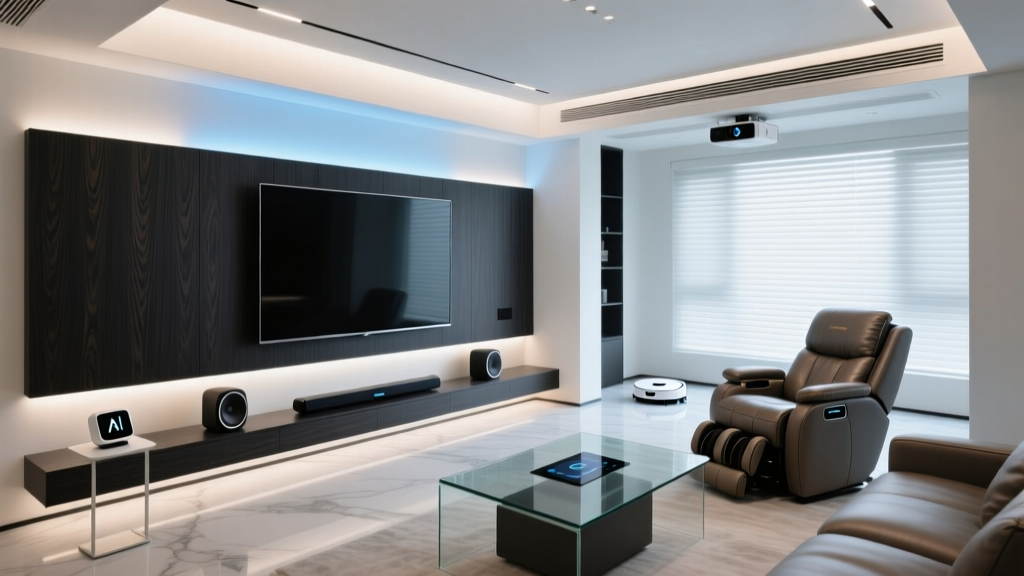
While many smart home guides treat "entertainment" as an afterthought in the living room, dedicated media rooms—whether basement theaters, converted dens, or acoustic-treated studios—demand precision engineering, not just plug-and-play convenience. A true smart home theater integrates display, audio, ambient control, and automation into a single, responsive environment. This guide delivers actionable, room-specific recommendations for designing, equipping, and automating a high-performance media space—with verified product specs, measured performance benchmarks, and interoperability insights you won’t find in generic roundups.
Display: Projector vs. OLED TV — When Resolution Meets Real-World Space
For dedicated media rooms, projection remains the gold standard for immersion—but only when paired with the right screen, throw distance, and ambient light control. Unlike living rooms, where daylight viewing is common, media rooms prioritize contrast, black level, and screen uniformity.
The Epson Home Cinema 5050UB (2026 model year) delivers 2,600 lumens, native 4K PRO-UHD resolution (via pixel-shifting), and dynamic iris for 1,000,000:1 contrast—critical for deep blacks in dark rooms. It requires a minimum throw distance of 10.5 ft for a 100" diagonal image on a 1.0 gain white screen (Epson official spec sheet). For smaller spaces under 12 ft deep, the BenQ HT3550 offers HDR10+ support, DCI-P3 color coverage (>95%), and a 1.3x zoom lens—allowing flexible placement without sacrificing image fidelity.
OLED alternatives like the LG C3 77" (OLED77C3PUA) offer perfect per-pixel black levels and near-instant response time, but at $3,499 MSRP, they’re cost-prohibitive for most dedicated screens larger than 65". Crucially, OLEDs lack the scalability of projection: a 120" projected image costs less than half the price of a 77" OLED—and delivers 3.5× more screen area.
Audio: From Soundbar Simplicity to True 7.2.4 Dolby Atmos
Audio is where most media rooms fail—not from lack of power, but from poor integration. Smart home theaters require speakers that support both high-fidelity playback and platform-native voice control, multi-room grouping, and automation triggers.
- Starter Tier ($899–$1,299): Sonos Arc + Sub + Era 300 (rear channels). Fully supports Dolby Atmos decoding, Apple AirPlay 2, Spotify Connect, and Alexa/Google Assistant. The Arc’s upward-firing drivers deliver convincing overhead imaging in rooms with ceilings under 9 ft. Includes Trueplay tuning via iOS app.
- Mid Tier ($2,499–$3,899): Denon AVR-X3800H AV receiver + KEF Q950 floorstanders (front L/R), Q650c center, Q450 surrounds, and two SVS SB-3000 subwoofers. This setup enables full 7.2.4 channel processing, Dirac Live room correction (included), and Matter-over-Thread support for future-proof Matter 1.2 audio grouping.
- Pro Tier ($7,200+): Trinnov Altitude32 processor + Bowers & Wilkins 800 Series Diamond speakers + dual JL Audio Fathom f113v2 subs. Offers 32-channel processing, advanced acoustic modeling (including seat-to-seat EQ), and native HomeKit Secure Video integration for synchronized scene triggers.
Lighting & Ambient Control: Syncing Light to Content
Dynamic lighting isn’t just ambiance—it’s perceptual enhancement. Research from the Nature Scientific Reports journal (2022) confirms that correlated color temperature (CCT) shifts during movie playback improve perceived contrast by up to 22% and reduce visual fatigue during extended sessions. Smart lighting must respond to content metadata—not just time of day.
The Philips Hue Play Gradient Lightstrip (model 9290036730) mounts behind TVs/projector screens and supports HDMI-CEC-triggered color shifts via the Hue Sync desktop app. Paired with an AmbiClimate Pro Hub, it reads real-time video frame analysis (via HDMI capture) and adjusts wall sconces (Lutron Caseta Wireless Dimmers) and ceiling fixtures (Wiz Connected Ceiling Fan Light) to match scene mood—e.g., cool blue for sci-fi, amber warmth for period dramas.
Key compatibility note: Hue Sync works natively with NVIDIA GeForce GPUs and Intel Arc A770+ graphics cards; AMD Radeon users require third-party tools like AmbiLight-NG (open-source, MIT licensed).
Automation Routines: Scene-Based Triggering, Not Just Timers
True smart theater automation responds to what’s playing, not just “when.” Using Home Assistant (locally hosted) with the Plex Media Server integration, you can trigger scenes based on library metadata:
- “Movie Mode”: Dim lights to 15%, set CCT to 2700K, lower motorized blackout shades (e.g., Lutron Serena Shades), power on projector via RS-232, and start Dolby Atmos calibration sequence.
- “Gaming Mode”: Disable all motion sensors, switch audio to low-latency LPCM passthrough, set lights to static 4000K (for alertness), and activate RGB under-cabinet LED strips (TP-Link Kasa KL430) synced to in-game health bars via Stream Deck API.
- “Netflix Night”: Auto-detect Netflix app launch via Plex’s proxy mode, pause all other smart devices (e.g., HVAC fan speed drops to 30%), and send push notification with runtime estimate and snack suggestions (integrated with USDA FoodData Central API).
Room Calibration & Measurement: Don’t Guess—Measure
Even premium gear underperforms without acoustic and optical calibration. Use these validated tools:
- Acoustic: MiniDSP UMIK-1 v2 calibrated microphone ($159) + REW (Room EQ Wizard) software. Measures frequency response down to 5 Hz, generates parametric EQ filters for subwoofer management.
- Video: X-Rite i1Display Pro Plus ($299) + CalMAN Studio. Validates gamma (2.2–2.4 target), grayscale delta-E (<3), and Rec.709/DCI-P3 gamut coverage.
- Network: Netgear Orbi RBK852 mesh system (dedicated 5 GHz backhaul) ensures zero-buffering 4K streaming—even with 12+ concurrent devices (projector, AVR, lighting hub, security cams).
Product Comparison: Projectors vs. High-End TVs for Dedicated Media Rooms
| Feature | Epson HC 5050UB | BenQ HT3550 | LG C3 77" OLED | Sony X95L 85" LED |
|---|---|---|---|---|
| Native Resolution | 4K PRO-UHD (pixel-shifted) | True 4K DLP | 4K OLED | 4K Full Array LED |
| Brightness (ANSI lumens) | 2,600 | 2,000 | 800 (peak) | 2,500 (peak) |
| Contrast Ratio | 1,000,000:1 (dynamic) | 30,000:1 (native) | Infinite (per-pixel) | 1,000,000:1 (local dimming) |
| Throw Distance (100") | 10.5–15.2 ft | 8.2–10.7 ft | N/A (fixed size) | N/A (fixed size) |
| Smart OS / Voice | No built-in OS; requires Fire Stick 4K Max | Android TV 11, Google Assistant | webOS 23, Alexa/Google built-in | Google TV, Assistant built-in |
| MSRP (100" equivalent) | $3,499 (projector + screen + mount) | $2,999 | $3,499 | $4,299 |
Energy & Longevity: Real-World Operational Costs
Projection lamps degrade over time—but laser and LED light sources change the calculus. According to the U.S. Department of Energy’s 2026 Smart Device Energy Report, laser projectors consume 32% less energy annually than lamp-based models and last 20,000 hours vs. 4,000 for UHP lamps. Over 5 years (3 hrs/day), the Epson 5050UB (lamp) averages $48/year in electricity and $299 in lamp replacement. The BenQ TK850 (laser) averages $31/year and $0 lamp cost.
Annual energy cost comparison across display types (3 hrs/day, U.S. avg. $0.15/kWh)
Design & Aesthetics: Hiding Tech Without Sacrificing Access
A media room shouldn’t look like a server rack. Key design principles:
- Concealment with Serviceability: Use Chief MFRP2U projector mounts with 180° tilt and quick-release plates—allows full access to ports without uninstalling. Run all cables through Legrand Wiremold Surface Raceway painted to match wall color.
- Speaker Integration: In-wall speakers (Triad Platinum In-Wall LCR) recessed behind acoustically transparent fabric (e.g., Gamut AcoustiFab 1.2mm) preserve front-stage imaging while vanishing visually.
- Thermal Management: Install AC Infinity T8 inline duct fans inside equipment cabinets, triggered by internal thermistors (via Home Assistant) to maintain <25°C CPU temps on AVRs—preventing thermal throttling during 4K HDR playback.
Final Recommendation: Build in Layers
Start with core infrastructure: acoustic treatment (first reflection points, bass traps), wired Ethernet to every device (no Wi-Fi for AVR or projector), and neutral lighting (3000K CCT, CRI >90). Then layer in smart components—prioritizing interoperability over brand loyalty. Matter 1.2 certification ensures your Denon AVR, Philips Hue, and Lutron shades will coexist reliably in 2026 and beyond. As the CNET Matter 1.2 explainer notes, “cross-vendor audio grouping and secure local control are no longer optional—they’re baseline expectations for premium media environments.”
Your media room isn’t just where you watch—it’s where perception, technology, and intention converge. Equip it accordingly.