The Smart Home Crossroads: Choosing Your Digital Foundation
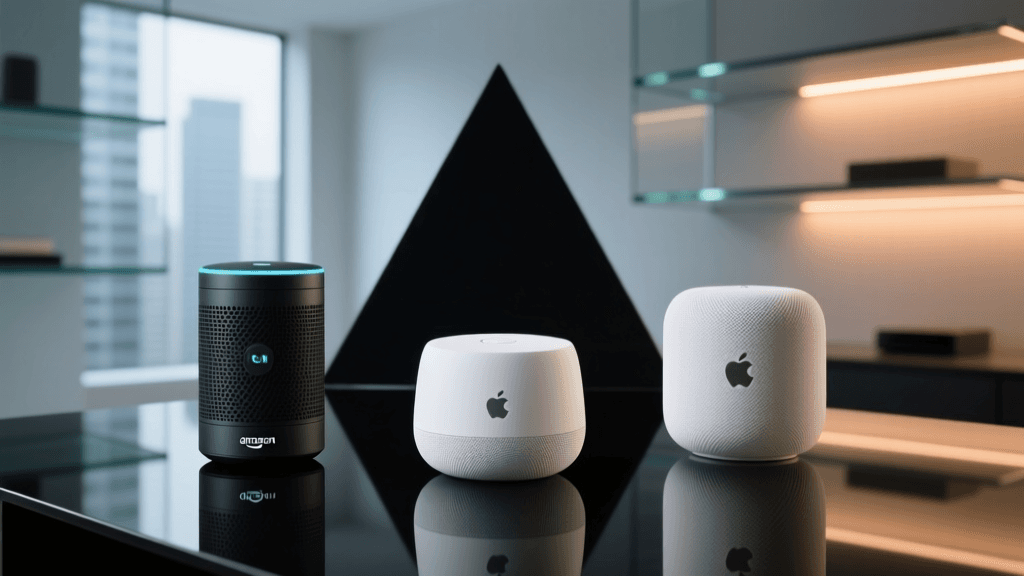
Building a smart home is no longer just about buying a single connected lightbulb; it is about committing to a digital foundation. The modern smart home market is dominated by three distinct titans: Amazon Alexa, Google Home, and Apple HomeKit. Each ecosystem operates with a fundamentally different philosophy, hardware strategy, and approach to user privacy. Choosing the wrong ecosystem can lead to fragmented automations, incompatible devices, and unnecessary subscription fees. In this comprehensive head-to-head comparison, we dissect the 'Big Three' to help you determine which platform aligns with your technical requirements, budget, and privacy standards.
Core Philosophies: Commerce vs. Intelligence vs. Privacy
Before diving into hardware specifications, it is crucial to understand the corporate motivations driving each ecosystem.
Amazon Alexa: The Retail Juggernaut
Amazon's primary goal with Alexa is to integrate seamlessly into your purchasing habits and daily routines, keeping you within the Amazon retail ecosystem. Consequently, Alexa boasts the largest volume of third-party 'Works with Alexa' devices. Amazon aggressively subsidizes its Echo hardware, often selling smart speakers and displays at or below cost during Prime Day or Black Friday events. This results in an incredibly low barrier to entry, making Alexa the default choice for budget-conscious consumers and renters.
Google Home: The AI and Search Powerhouse
Google approaches the smart home as an extension of its search and AI dominance. Google Assistant consistently outperforms Alexa in natural language processing (NLP), contextual understanding, and handling complex, multi-part queries. If you ask Google, 'Hey Google, what's on my calendar and do I need an umbrella?', it will synthesize data from multiple services flawlessly. However, Google's business model is inherently tied to data collection, which raises valid privacy concerns for security-focused users.
Apple HomeKit: The Premium Walled Garden
Apple treats the smart home like its mobile operating system: a highly controlled, secure, and premium 'walled garden.' HomeKit requires strict hardware certification from manufacturers, ensuring that devices perform reliably and securely. The trade-off is a higher cost of entry, fewer supported niche devices, and a reliance on premium hardware like the HomePod and Apple TV. For iPhone users who prioritize end-to-end encryption and seamless ecosystem integration, HomeKit is unparalleled.
Hardware Hub Capabilities & Specifications
Your smart speaker or display acts as the nerve center of your home. Below is a comparison of the flagship entry-level hubs from each ecosystem, all priced around the $99 mark.
| Feature | Amazon Echo (4th Gen) | Google Nest Hub (2nd Gen) | Apple HomePod mini |
|---|---|---|---|
| Price | $99.99 | $99.99 | $99.00 |
| Form Factor | Spherical (5.3 x 5.3 x 5.2 in) | Display (7.0 x 4.6 x 2.7 in) | Cylindrical (3.3 x 3.9 in) |
| Built-in Hub | Zigbee & Matter Hub | No (Requires separate Thread hub) | Thread Border Router |
| Audio Profile | Dual 0.8-inch tweeters, 3.0-inch woofer | Full-range 1.9-inch driver | Full-range driver, dual passive radiators |
| Unique Sensors | Temperature sensor | Soli radar (Sleep tracking) | U1 chip (Proximity handoff) |
The Amazon Echo (4th Gen) stands out for its built-in Zigbee hub, allowing you to connect devices like the Philips Hue smart bulbs or third-party Zigbee door sensors directly to the speaker without needing separate bridges. The Google Nest Hub (2nd Gen) excels in visual feedback and kitchen utility, utilizing its 7-inch display for recipe viewing and its Soli radar for non-intrusive sleep tracking. Meanwhile, the Apple HomePod mini leverages its U1 chip to provide haptic feedback when an iPhone user brings their device close, and it acts as a Thread border router, future-proofing your home for low-latency mesh networking.
The Matter Protocol: A Unifying Force or a Band-Aid?
The introduction of the Matter protocol by the Connectivity Standards Alliance (CSA) was promised as the great unifier of the smart home. Matter allows devices to communicate locally over Wi-Fi or Thread, bypassing cloud servers and reducing latency. However, how each ecosystem handles Matter reveals their ongoing turf war.
- Alexa: Amazon has aggressively pushed Matter support via firmware updates to most modern Echo devices. However, advanced features like energy monitoring or specific color-tuning might still require the manufacturer's native app.
- Google Home: Google's redesigned Home app is built with Matter at its core. Nest Hubs act as excellent Matter controllers, though Google's reliance on Wi-Fi over Thread in some older hubs can cause network congestion in homes with 50+ devices.
- Apple HomeKit: Apple has embraced Matter, allowing HomeKit users to finally integrate popular devices like the Ecobee SmartThermostat or Nanoleaf shapes without requiring proprietary HomeKit firmware. Yet, Apple still mandates the use of a Home Hub (Apple TV 4K or HomePod) for remote access and automations, maintaining its hardware paywall.
Privacy and Security Architecture: The Dealbreaker
In an era where smart devices are essentially microphones and cameras placed in our most private spaces, security architecture is paramount. According to the Cybersecurity and Infrastructure Security Agency (CISA), securing IoT devices requires rigorous network segmentation and strict access controls, but the baseline security of the ecosystem itself dictates your vulnerability.
Apple HomeKit: The Gold Standard for Privacy
Apple's approach is outlined in their official privacy documentation, which emphasizes on-device processing and end-to-end encryption. HomeKit Secure Video (HKSV) analyzes camera footage locally using the A-series chips in Home Hubs, ensuring that facial recognition data never reaches Apple's servers. Furthermore, HomeKit data is encrypted in transit and at rest, meaning even Apple engineers cannot view your smart home layout or routines.
Google Home: The Data Harvesting Concern
Google's business model relies on data aggregation. While Google asserts in its Nest privacy support documentation that audio recordings are not used for ad targeting, the sheer volume of telemetry data collected by Google Nest devices is staggering. Users must actively opt-out of data sharing programs and manually delete voice histories to maintain a semblance of privacy. For users deeply embedded in Google Workspace and Android, this trade-off is often acceptable; for privacy advocates, it is a dealbreaker.
Amazon Alexa: Convenience at a Cost
Alexa's privacy controversies often stem from its 'Amazon Sidewalk' network, which automatically opted users into sharing a small slice of their Wi-Fi bandwidth to create a neighborhood mesh network. While Amazon has introduced robust privacy dashboards and the ability to auto-delete voice recordings, the default settings heavily favor data retention and retail integration.
Performance Benchmark: Automations and Voice Intelligence
A smart home is only as good as its automations. We benchmarked the 'Big Three' based on routine complexity, conditional logic capabilities, and third-party device support volume.
Alexa's Routine Engine is incredibly deep. It supports 'Hunches' (e.g., turning off lights if Alexa senses you are asleep), multi-step delays, and complex conditional triggers based on geofencing or specific sensor states. Google Home has improved its 'Script Editor' for advanced users, allowing for webhooks and local execution, but its standard app interface is more limited than Alexa's. Apple HomeKit automations are highly reliable and execute locally (resulting in zero-latency actions), but the native Home app lacks advanced conditional logic (like 'If motion is detected AND it is after 10 PM AND the TV is off'), often forcing power users to rely on third-party apps like Home+ or Controller for HomeKit.
Cost of Entry and Long-Term Value
When calculating the Total Cost of Ownership (TCO) for a smart home, hardware is only the first expense.
- Amazon Alexa: Lowest TCO. Echo devices are frequently discounted to $25-$40. Blink and Ring cameras (Amazon subsidiaries) offer cheap hardware but require mandatory 'Ring Home' subscriptions ($4.99/mo) for cloud recording.
- Google Home: Moderate TCO. Nest devices hold their retail value longer than Echo devices. Nest Aware subscriptions ($8/mo) are required for intelligent camera alerts and continuous video recording, but they cover all cameras on a single account.
- Apple HomeKit: Highest TCO. HomeKit-compatible hardware carries a 'HomeKit tax' due to strict certification requirements (e.g., a HomeKit-enabled Lutron Caseta starter kit costs ~$200, compared to generic Wi-Fi alternatives for $40). Furthermore, utilizing HKSV requires an iCloud+ subscription ($0.99 to $14.99/mo depending on storage tier), though Apple does not charge per-camera fees like Amazon or Google.
The Final Verdict: Which Ecosystem Wins?
There is no single 'best' ecosystem; there is only the best ecosystem for your specific user profile.
Choose Amazon Alexa If:
You are on a budget, live in a rented space where non-destructive Wi-Fi/Zigbee devices are preferred, and you want access to the widest variety of cheap, third-party gadgets. It is the undisputed king of retail integration and entry-level smart home adoption.
Choose Google Home If:
You are an Android user, heavily rely on Google Calendar/Workspace, and prioritize conversational AI over rigid automation scripts. The Nest ecosystem is ideal for users who want a smart display in the kitchen and value contextual, hands-free information retrieval.
Choose Apple HomeKit If:
You are an iPhone household that values privacy, local network execution, and premium build quality above all else. If you are willing to pay the 'HomeKit tax' for enterprise-grade security and zero-latency automations, Apple's walled garden remains the most stable and secure smart home foundation on the market.