The Smart Home Ecosystem Wars: An Overview
The modern smart home has evolved from a niche hobbyist playground into a fundamental pillar of daily living. However, as the market has matured, it has consolidated around three dominant tech giants, each vying for control of your living room, kitchen, and front door. The smart home ecosystem wars are no longer just about who has the best voice assistant; they are about data privacy, hardware integration, automation reliability, and long-term platform sustainability. For consumers, choosing between Amazon Alexa, Google Home, and Apple HomeKit is one of the most consequential tech decisions they will make, as it dictates the hardware they can buy and how seamlessly their devices will communicate.
In this comprehensive head-to-head comparison, we will dissect the core philosophies, hardware offerings, compatibility matrices, and privacy frameworks of the Big Three. Whether you are outfitting a new home from scratch or looking to expand your existing setup, understanding the nuances of these ecosystems is critical to avoiding the dreaded 'walled garden' trap.
Core Philosophies: Aggregator vs. Assistant vs. Fortress
Amazon Alexa: The Aggressive Aggregator
Amazon’s strategy with Alexa has always been one of sheer ubiquity and volume. By opening its API early and aggressively subsidizing Echo hardware, Amazon created a massive footprint. Alexa is designed to be the ultimate aggregator, prioritizing broad device compatibility, third-party 'Skills', and e-commerce integration. If a smart device exists, chances are it works with Alexa. However, this open-door policy has historically led to a cluttered app experience and inconsistent voice recognition accuracy compared to its rivals.
Google Home: The Contextual Assistant
Google approaches the smart home through the lens of information retrieval and artificial intelligence. Powered by Google Assistant, the Google Home ecosystem excels at natural language processing, contextual follow-up questions, and deep integration with Google services like Calendar, Maps, and YouTube. Google’s hardware, primarily the Nest line, focuses on ambient computing and proactive assistance, utilizing on-device machine learning to anticipate user needs rather than just reacting to commands.
Apple HomeKit: The Walled Garden of Privacy
Apple’s HomeKit is the antithesis of Amazon’s aggregator model. It is a tightly controlled, premium 'walled garden' that prioritizes user privacy, local processing, and seamless integration within the iOS ecosystem. Apple mandates strict security protocols for hardware manufacturers seeking the 'Works with Apple Home' badge. While this results in a highly reliable and secure experience, it has historically limited the sheer volume of compatible devices and kept the cost of entry significantly higher than its competitors.
Hardware Showdown: Speakers, Hubs, and Displays
The gateway to any smart home ecosystem is the hub or smart speaker. Here is how the entry-level and flagship hardware stacks up across the three platforms.
| Category | Amazon Alexa | Google Home | Apple HomeKit |
|---|---|---|---|
| Entry-Level Speaker | Echo Dot (5th Gen) - $49.99 | Nest Mini - $49.99 | HomePod mini - $99.00 |
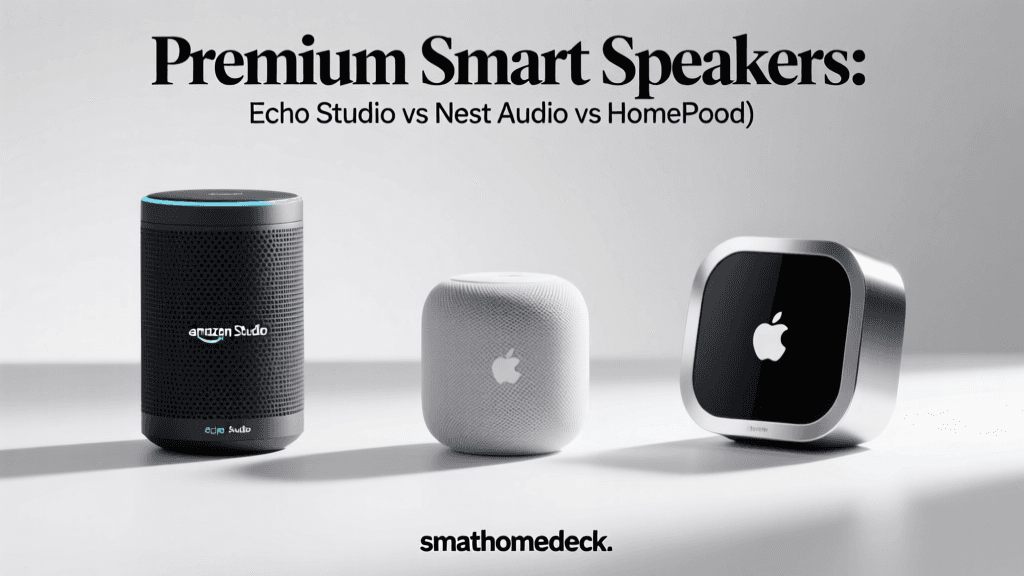
| Premium Speaker | Echo Studio - $199.99 | Nest Audio - $99.99 | HomePod (2nd Gen) - $299.00 |
| Smart Display | Echo Show 15 - $299.99 | Nest Hub Max - $229.99 | No native display (Relies on iPad) |
| Dedicated Hub | Echo (4th Gen) w/ Zigbee | Nest Hub (2nd Gen) | Apple TV 4K (Ethernet) - $149.00 |
| Mesh Wi-Fi w/ Thread | eero 6+ | Nest Wifi Pro | Apple Airport (Discontinued) |
When evaluating audio quality and hardware build, Apple undeniably commands the premium tier. The HomePod mini utilizes computational audio to deliver a surprisingly rich, room-filling sound that outclasses the Nest Mini and Echo Dot. Below is a data-driven comparison of flagship smart speaker audio quality scores based on acoustic testing and frequency response analysis.
In the smart display category, Amazon and Google dominate. The Echo Show 15 is a marvel for kitchen organization, featuring a 15.6-inch 1080p screen, Fire TV integration, and visual widgets. Google’s Nest Hub (2nd Gen) leverages its Soli radar chip for non-wearable sleep tracking and serves as an excellent digital photo frame via Google Photos. Apple, notably, lacks a dedicated smart display, forcing users to rely on third-party solutions or mount an iPad using accessories like the Logitech Base.
Device Compatibility and the Matter Revolution
Historically, Amazon Alexa boasted over 140,000 compatible devices, while Google Home trailed slightly behind, and Apple HomeKit languished with fewer than 5,000 certified accessories. This disparity forced Apple users to rely on expensive bridge hubs, like the Philips Hue Bridge or the Lutron Caseta Smart Bridge, to translate non-HomeKit signals into Apple's secure ecosystem.
However, the landscape is undergoing a seismic shift thanks to Matter, the open-source connectivity standard developed by the Connectivity Standards Alliance (CSA). Matter operates over Wi-Fi and Thread, creating a unified application layer that allows devices to communicate locally and be controlled simultaneously by Alexa, Google Home, and Apple HomeKit. With the rollout of Matter 1.0 and subsequent updates, the 'Works with' exclusivity wars are ending. A Matter-certified smart plug from Eve or a smart lock from Yale can now be added to all three ecosystems concurrently, drastically reducing the compatibility advantage previously held by Amazon and Google.
Despite Matter's promise, legacy devices still rely on proprietary clouds. Alexa remains the undisputed king of backward compatibility, supporting niche RF protocols, Zigbee (via built-in hubs in higher-end Echo devices), and even Amazon Sidewalk for long-range outdoor sensors. Google has heavily invested in Thread border routers (built into Nest Wifi Pro and Nest Hubs), positioning itself as a leader in the low-latency mesh networking required for the next generation of smart home sensors.
Automations and Routines: The Brains of the Operation
A smart home is only as good as its automations. Voice commands are convenient, but background routines are what truly elevate a house to 'smart' status.
Amazon Alexa Routines
Alexa offers the most granular and diverse triggers for routines. Users can initiate actions based on time, sunrise/sunset, device state, location (geofencing), and even specific voice phrases. Alexa’s 'Hunches' feature uses machine learning to automatically turn off lights or lock doors if it suspects you have forgotten. However, the Alexa app interface can feel overwhelming and cluttered when managing complex, multi-step routines.
Google Home Automations
Google recently overhauled its Home app, introducing a much more intuitive 'Starter' and 'Action' block system for building automations. Google excels at contextual routines, such as adjusting the Nest Thermostat based on the real-time traffic data from your Google Maps commute. While it previously relied heavily on third-party services like IFTTT, the native Google Home app is now robust enough for 95% of household logic, though it still lacks the deep, local sensor-triggered reliability of HomeKit.
Apple HomeKit Scenes and Automations
Apple HomeKit provides the most reliable, latency-free automation experience because it prioritizes local execution via the Home Hub (Apple TV or HomePod). If your internet goes down, your HomeKit motion sensor will still trigger your hallway lights. The Home app’s logic builder is clean and user-friendly, though it is more rigid than Alexa. For power users, third-party apps like 'Controller for HomeKit' or 'Home+ 6' unlock advanced scripting capabilities, including variables and complex conditional logic that Apple’s native app hides.
Privacy and Security: Who is Listening?
Privacy is the most significant differentiator among the Big Three. According to extensive reviews by Mozilla's Privacy Not Included guide, smart home devices are notorious for data harvesting, with voice assistants frequently analyzing user interactions to build advertising profiles.
Amazon and Google: Both companies rely heavily on cloud processing for voice commands and device telemetry. While they have introduced features like on-device wake-word detection and physical mute switches, the bulk of your smart home data—usage patterns, device states, and voice transcripts—is processed on remote servers. This data is intrinsically tied to their broader advertising and e-commerce business models.
Apple HomeKit: Apple’s business model is hardware and services, not targeted advertising. Consequently, Apple Privacy standards dictate that HomeKit data is end-to-end encrypted. Siri requests are processed on-device whenever possible, and anonymous, rotating identifiers are used for cloud requests. Furthermore, HomeKit Secure Video (HKSV) is a game-changer for home security. Unlike Ring or Nest cameras that require expensive monthly subscriptions for cloud recording, HKSV analyzes camera feeds locally using the HomePod or Apple TV, encrypts the video, and stores it securely in iCloud without counting against your storage quota (requires an iCloud+ subscription).
Cost of Entry and Long-Term Value
Budgeting for a smart home varies wildly depending on your chosen ecosystem.
- The Alexa Route (Budget-Friendly): Amazon frequently discounts Echo Dots to $24.99 during Prime Day or Black Friday. Third-party Alexa-compatible bulbs, plugs, and switches from brands like Wyze, Kasa, and Sengled are incredibly affordable. You can outfit a 3-bedroom home with basic Alexa smart lighting and voice control for under $300.
- The Google Home Route (Mid-Tier): Google’s hardware sits in the middle. Nest thermostats, Nest Protect smoke alarms, and Nest cameras carry a premium price tag, but they offer superior design and AI-driven features. Expect to spend around $600 to fully integrate Google’s premium hardware into a medium-sized home.
- The Apple HomeKit Route (Premium): HomeKit demands a premium. You need a HomePod mini ($99) or Apple TV 4K ($129+) just to act as a hub. Compatible accessories, such as Lutron Caseta switches, Ecobee thermostats, and Eve sensors, cost 30% to 50% more than their generic Wi-Fi counterparts. A comprehensive HomeKit setup can easily exceed $1,500, though the trade-off is unmatched reliability, local control, and zero hidden subscription fees for features like Secure Video.
The Final Verdict: Which Ecosystem is Right for You?
There is no single 'best' smart home ecosystem; the right choice depends entirely on your technical proficiency, budget, and privacy tolerance.
Choose Amazon Alexa If:
You are a budget-conscious tinkerer who wants access to the widest variety of affordable smart devices. Alexa is ideal for users who want to experiment with niche gadgets, utilize complex routine triggers, and integrate their smart home with their Amazon shopping and Audible accounts. It is the undisputed champion of sheer compatibility and aggressive hardware discounting.
Choose Google Home If:
You are deeply embedded in the Android and Google Workspace ecosystem. If you value natural conversational AI, proactive assistance, and seamless integration with Google Calendar, Maps, and YouTube, Google Home is unparalleled. It is also the best choice for users looking to build a robust Thread network using Nest Wifi Pro routers and Nest smart displays.
Choose Apple HomeKit If:
You are an iPhone user who prioritizes privacy, security, and local automation reliability above all else. If you are willing to pay a premium for high-quality hardware, despise cloud latency, and want the peace of mind that comes with end-to-end encryption and HomeKit Secure Video, Apple’s walled garden is the most refined and secure smart home experience available today.
Ultimately, the advent of the Matter protocol means you no longer have to swear a blood oath to a single tech giant. You can mix and match Matter-certified devices across platforms, but your choice of hub and voice assistant will still define the daily rhythm of your smart home.