The Ecosystem Anchor: Why Your Smart Speaker Choice Matters
The smart home landscape has evolved far beyond simple voice commands for setting timers and playing music. Today, the central smart speaker in your home acts as the nerve center for a complex web of interconnected devices, sensors, and automations. As the industry transitions toward unified standards like Matter and Thread, the hardware capabilities of your primary smart speaker—specifically its built-in radios, processing power, and acoustic engineering—dictate the ceiling of your smart home's performance.
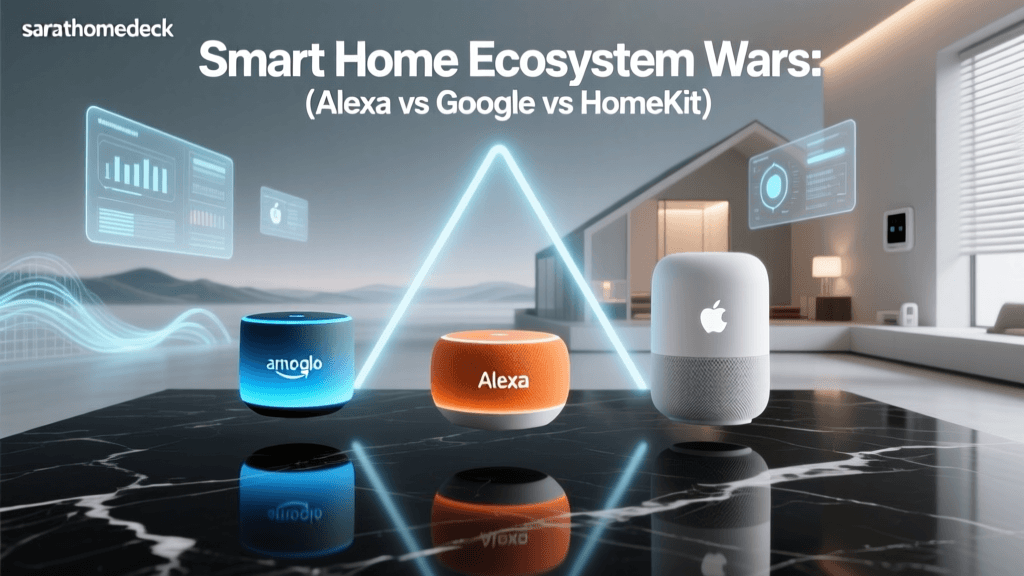
In the ongoing ecosystem wars, three flagship devices stand as the gatekeepers to their respective platforms: the Amazon Echo (4th Gen) representing Alexa, the Google Nest Audio championing Google Home, and the Apple HomePod (2nd Gen) anchoring HomeKit. While all three deliver exceptional audio and voice assistance, their underlying hardware and ecosystem philosophies diverge drastically. Choosing between them is no longer just about which voice assistant you prefer; it is about selecting the foundational protocol support, privacy model, and automation engine that will govern your home for the next decade.
In this comprehensive head-to-head comparison, we dissect the acoustic profiles, smart home hub capabilities, protocol support (including Zigbee, Thread, and Matter), and privacy frameworks of these three ecosystem titans to help you decide which smart speaker deserves the central spot in your living room.
Contender 1: Amazon Echo (4th Gen) - The Universal Commander
Amazon has long positioned the Echo line as the most versatile and compatible smart home hub on the market, and the spherical 4th Generation Echo is the culmination of that strategy. Priced aggressively at $99, the Echo (4th Gen) is a powerhouse of connectivity, designed to bridge the gap between legacy smart home devices and modern standards.
Acoustic Profile and Hardware
Amazon completely overhauled the audio architecture in the 4th Gen. It features a 3.0-inch woofer and dual 0.8-inch tweeters, powered by Dolby processing. The result is a rich, room-filling sound with surprisingly punchy bass for a speaker of its size. While it may lack the spatial audio wizardry of Apple's offering, it delivers a warm, balanced audio profile that easily outperforms its predecessors and competes fiercely with the Nest Audio.
Smart Home Hub Capabilities
Where the Echo truly flexes its muscles is in its internal radios. It is one of the only mainstream smart speakers to include a built-in Zigbee hub, a temperature sensor, and Low Energy (LE) audio support. The inclusion of Zigbee means you can connect hundreds of third-party sensors, smart locks, and lights directly to the Echo without needing to clutter your Wi-Fi network or purchase proprietary bridges. Furthermore, Amazon has rolled out over-the-air updates to make the Echo a Matter controller and Thread border router, future-proofing it for the next generation of smart home tech.
The built-in temperature sensor is a subtle but brilliant addition, allowing users to create routines like 'Turn on the smart AC if the living room exceeds 74 degrees.' This level of native, localized automation makes Alexa the undisputed king of complex, multi-step routines.
Contender 2: Google Nest Audio - The Audiophile's Search Engine
Google's approach to the smart home has always prioritized software intelligence, search capabilities, and seamless integration with Google services over raw hardware radios. The Google Nest Audio ($99) reflects this philosophy, focusing heavily on delivering premium sound quality while relying on the broader Nest ecosystem for local smart home coordination.
Acoustic Profile and Hardware
The Nest Audio is widely considered the best-sounding smart speaker in the $100 price bracket. It houses a 75mm woofer and a 19mm tweeter, delivering a remarkably clear midrange and deep, resonant bass. Google's software-driven 'Ambient IQ' automatically adjusts the EQ based on the acoustics of your room and the ambient noise level, ensuring your music or podcasts sound pristine whether you are vacuuming or sitting quietly on the couch.
Smart Home Hub Capabilities
Unlike the Amazon Echo, the Nest Audio does not contain a built-in Zigbee or Thread radio. It connects exclusively via Wi-Fi and Bluetooth. To utilize Thread or act as a local hub for Matter devices, Google requires you to have a separate Nest Hub (the smart display) or a dedicated Thread border router on your network. This is a significant hardware omission for a device meant to anchor a smart home.
However, Google Home's software ecosystem is incredibly robust. Google's voice recognition is arguably the most natural and context-aware on the market, easily handling complex, multi-part queries and follow-up questions without needing the wake word repeated. If your smart home relies primarily on Wi-Fi-enabled devices (like LIFX, Philips Hue via bridge, or Ecobee), the Nest Audio serves as a flawless voice commander, even if it lacks the local radio hardware of its competitors.
Contender 3: Apple HomePod (2nd Gen) - The Secure Sonic Powerhouse
Apple's HomePod (2nd Gen), priced at a premium $299, is a device that prioritizes audiophile-grade sound, strict privacy, and seamless integration within the Apple walled garden. It is less of a universal smart home hub and more of a luxury acoustic instrument that doubles as a secure home automation anchor.
Acoustic Profile and Hardware
The audio engineering in the 2nd Gen HomePod is nothing short of spectacular. Driven by the Apple S7 chip, it utilizes a 4-inch high-excursion woofer, five horn-loaded tweeters, and four force-canceling passive radiators. The result is true Spatial Audio with Dolby Atmos support. The room-sensing technology uses internal microphones to analyze the room's acoustics and automatically tune the audio output in real-time. For pure music listening, the HomePod is the undisputed champion of this trio.
Smart Home Hub Capabilities
Apple has fully embraced the new smart home standards. The HomePod (2nd Gen) acts as a dedicated Thread border router and Matter controller out of the box. This makes it an essential hub for users adopting low-power Thread devices like Nanoleaf lights or Eve sensors. However, it lacks Zigbee support, meaning legacy devices will still require their own hubs.
The HomeKit ecosystem is renowned for its reliability and local execution. Automations trigger instantly because the processing happens locally on the HomePod rather than bouncing to a cloud server. The trade-off is a significantly smaller library of compatible third-party devices compared to Alexa, though the Matter standard is slowly closing this gap.
Head-to-Head Specifications Comparison
| Feature | Amazon Echo (4th Gen) | Google Nest Audio | Apple HomePod (2nd Gen) |
|---|---|---|---|
| Price | $99 | $99 | $299 |
| Audio Drivers | 3.0' woofer, dual 0.8' tweeters | 75mm woofer, 19mm tweeter | 4' woofer, 5 tweeters, 4 passive radiators |
| Smart Home Radios | Zigbee, Wi-Fi, Bluetooth, Thread (via OTA) | Wi-Fi, Bluetooth | Wi-Fi, Bluetooth, Thread |
| Matter Support | Yes (Controller) | Yes (Controller) | Yes (Controller) |
| Temperature Sensor | Yes | No | Yes |
| Ecosystem | Alexa | Google Home | Apple HomeKit |
Visualizing the Ecosystem Trade-offs
The following radar chart illustrates how each device performs across four critical smart home categories. Notice how Amazon dominates in ecosystem breadth, while Apple leads in audio and privacy.
The Matter Protocol: A Level Playing Field?
The introduction of the Matter standard, spearheaded by the Connectivity Standards Alliance (CSA), was promised as the ultimate solution to smart home fragmentation. Matter allows devices to communicate seamlessly across Alexa, Google Home, and Apple HomeKit. However, how each speaker handles Matter reveals distinct hardware limitations and strengths.
Because Matter relies heavily on the Thread networking protocol for low-power devices (like smart locks and leak sensors), a Thread Border Router is essential. The Apple HomePod (2nd Gen) features a robust, native Thread radio, making it an elite hub for Matter-over-Thread devices. Amazon has enabled Thread support on the 4th Gen Echo via firmware, though early adopters have noted occasional latency issues compared to Apple's native implementation. Google's Nest Audio, lacking a Thread radio entirely, forces users to rely on Wi-Fi for Matter devices or purchase a separate Nest Hub to bridge the Thread network.
Furthermore, while Matter standardizes device control, it does not standardize complex automations or voice assistant intelligence. A Matter-compatible smart plug will turn on and off flawlessly in all three apps, but only Alexa's app allows you to build the intricate, multi-condition routines that power users demand. Therefore, Matter solves the compatibility problem, but the ecosystem wars now hinge on software automation and user interface design.
Privacy, Security, and Data Handling
When inviting a microphone-equipped device into your home, privacy is a paramount concern. The three tech giants approach data collection and processing from fundamentally different business models.
Apple's walled garden approach is heavily marketed around privacy. As detailed in the Apple Newsroom launch documentation, Siri requests are processed on-device whenever possible, and when they must hit the cloud, they are tied to a randomized, rotating identifier rather than your Apple ID. HomeKit Secure Video processes camera feeds locally on the HomePod before encrypting them for iCloud, ensuring end-to-end encryption.
Conversely, Amazon and Google are fundamentally data-driven advertising and retail companies. While both companies have implemented physical mute buttons and local wake-word processing, the bulk of voice queries are sent to the cloud for natural language processing. According to privacy advocates like the Electronic Frontier Foundation (EFF), consumers must weigh the convenience of highly accurate, cloud-dependent voice assistants against the reality of long-term data retention and profiling. If privacy and local data processing are your top priorities, Apple's HomeKit ecosystem remains the only choice that aligns with a strict security posture.
Ecosystem Lock-in and the Cost of Entry
Choosing a flagship speaker is rarely an isolated purchase; it is a commitment to an ecosystem. The Amazon Echo is the most forgiving for budget-conscious tinkerers. Alexa supports thousands of cheap, off-brand Wi-Fi and Zigbee devices found on Amazon. The barrier to entry is low, and the sheer volume of 'Works with Alexa' products is unmatched.
Google Home sits in the middle. It integrates beautifully with Google's suite of services (Calendar, YouTube Music, Nest thermostats, and cameras). However, Google has a history of abandoning smart home initiatives (like 'Works with Nest'), which has left some long-term users wary of ecosystem lock-in.
Apple HomeKit demands a premium. HomeKit-certified devices historically cost 20% to 50% more than their Alexa counterparts because Apple requires strict hardware security chips and certification processes. While Matter is slowly allowing cheaper devices into the Home app, building a comprehensive HomeKit security and lighting system remains a significant financial investment compared to the Alexa route.
Final Verdict: Which Ecosystem Wins Your Home?
The 'best' smart speaker hub depends entirely on your technical expertise, budget, and privacy tolerance. There is no single winner, but rather a perfect tool for different types of smart home enthusiasts.
Choose the Amazon Echo (4th Gen) if:
- You are a Smart Home Tinkerer who loves building complex, multi-step automations.
- You have a mix of legacy Zigbee devices and modern Wi-Fi gadgets.
- You want the most cost-effective entry into the Matter ecosystem without buying additional hubs.
Choose the Google Nest Audio if:
- You prioritize music and podcast audio quality on a budget.
- Your home is already deeply integrated with Google services, Nest cameras, and Google Wi-Fi.
- You prefer a conversational voice assistant that handles natural language and follow-up questions better than the competition.
Choose the Apple HomePod (2nd Gen) if:
- You are an Audiophile and Privacy Advocate willing to pay a premium for spatial audio and end-to-end encryption.
- You are fully invested in the Apple ecosystem and use Apple Music, HomeKit Secure Video, and iOS devices exclusively.
- You want the most stable, locally-processed Thread and Matter automation experience available today.
Ultimately, the ecosystem wars have shifted from proprietary lock-in to a battle over software intelligence and local processing power. By understanding the hardware realities beneath the fabric and mesh of these three iconic speakers, you can confidently anchor your smart home for the next generation of connected living.