The Premium Smart Speaker Showdown
When it comes to anchoring a smart home, the speaker you choose dictates the ecosystem you live in. The premium smart speaker market is dominated by three tech giants, each offering a distinct philosophy on how we should interact with our homes. In this comprehensive comparison, we are putting the Amazon Echo Studio, the Google Nest Audio, and the Apple HomePod (2nd Generation) head-to-head. This is not just a battle of sound quality; it is a war of protocols, privacy paradigms, and ecosystem lock-in.
Whether you are building a home theater, looking for the ultimate kitchen companion, or prioritizing strict data privacy, understanding the nuances of Alexa, Google Assistant, and Siri is critical. Let us break down the hardware, the software, and the smart home capabilities of these three flagship devices to help you make the right investment for your home.
Design and Build Quality: Aesthetics Meets Acoustics
The physical design of a smart speaker must balance acoustic requirements with living room aesthetics. Each manufacturer has taken a vastly different approach to this challenge.
Amazon Echo Studio
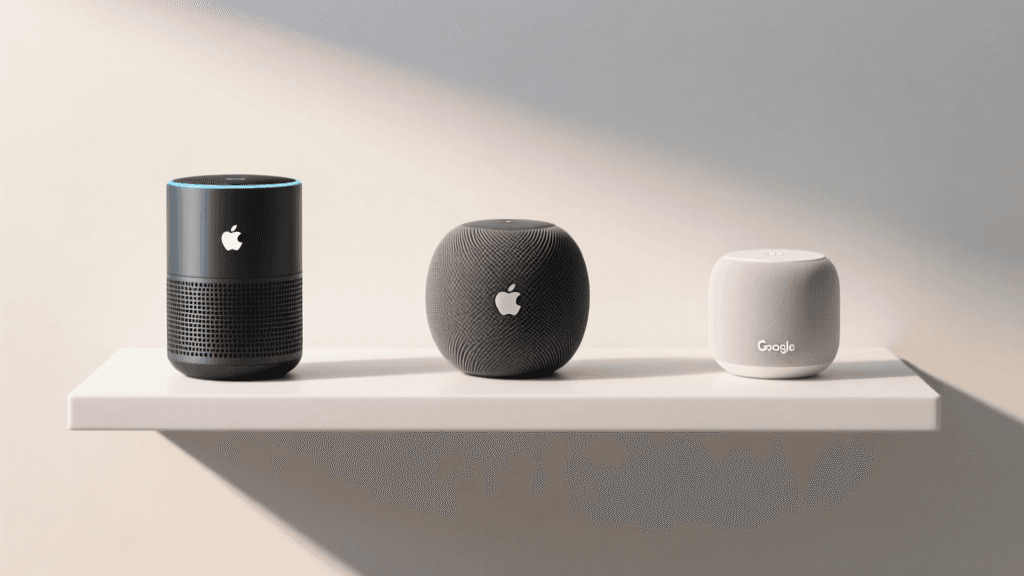
The Echo Studio is the largest and most imposing of the trio. Standing over 8 inches tall, it features a cylindrical design wrapped in a dark fabric mesh. The top houses the signature Alexa LED light ring, which provides clear visual feedback for volume levels, listening states, and notifications. While its size allows for a massive internal acoustic chamber, it can be difficult to place on smaller shelves or crowded kitchen counters. The build quality is solid, but the utilitarian design leans more toward function than high-end decor.
Google Nest Audio
Google took a minimalist, Scandinavian-inspired approach with the Nest Audio. Its pill-shaped design is wrapped in recycled fabric and comes in a variety of muted, earthy tones like chalk, charcoal, and sage. The front features subtle LED dots that illuminate only when the assistant is active or adjusting volume. It is compact enough to fit almost anywhere, and the angled back allows it to sit flush against a wall or shelf. The tactile volume buttons on the top are a welcome addition for quick, silent adjustments.
Apple HomePod (2nd Gen)
Apple’s HomePod is undeniably a piece of premium hardware. Its compact, spherical-top design is wrapped in a seamless acoustically transparent mesh. The top surface is a fully interactive touch panel that glows with a mesmerizing, multi-colored waveform when Siri is engaged. Despite its smaller footprint compared to the Echo Studio, it is remarkably dense and heavy, which helps eliminate unwanted vibrations at high volumes. It is designed to disappear into a room while sounding significantly larger than its physical dimensions suggest.
Audio Performance and Acoustic Engineering
Sound quality is where these premium speakers justify their price tags over their budget counterparts like the Echo Dot or Nest Mini.
Amazon Echo Studio: The Home Theater Powerhouse
The Echo Studio is engineered for audiophiles and home theater enthusiasts. It boasts a five-speaker array, including a powerful downward-firing woofer, three mid-range drivers, and an upward-firing tweeter. This configuration allows it to decode and play Dolby Atmos and Sony 360 Reality Audio, creating a convincing 3D spatial audio effect. Furthermore, its built-in microphone continuously analyzes the room's acoustics and automatically fine-tunes playback for optimal sound. According to extensive acoustic testing by audio experts at RTINGS, the Echo Studio delivers a remarkably neutral sound profile out of the box, making it exceptional for both bass-heavy music and cinematic dialogue.
Google Nest Audio: The Balanced Everyday Listener
The Nest Audio utilizes a 75mm mid-woofer and a 19mm tweeter. While it lacks the upward-firing drivers of the Echo Studio, Google’s software tuning is exceptional. It features Media EQ, which adjusts the sound profile based on what you are listening to (e.g., boosting vocals for podcasts and enhancing bass for music). It also uses Ambient IQ to adjust the volume based on the background noise in your room. The sound is warm, clear, and fills a medium-sized room effortlessly, though it struggles with deep sub-bass frequencies compared to the Echo Studio.
Apple HomePod: The Spatial Audio Maestro
The 2nd Generation HomePod features a custom-engineered 4-inch high-excursion woofer and an array of five beamforming tweeters around the base. Apple’s computational audio is the star here. Using its built-in microphones, the HomePod listens to the reflections of the sound off your walls and adjusts the audio output in real-time to ensure the sweet spot covers the entire room. Its support for Dolby Atmos spatial audio via Apple Music is breathtaking, offering precise instrument separation and a wide soundstage. For pure musicality and room-filling presence, the HomePod edges out the competition, provided you are streaming from Apple Music.
Smart Home Ecosystems and Hub Capabilities
A smart speaker is the brain of your connected home. The protocols they support dictate which smart locks, lights, and thermostats you can buy in the future.
The transition to the Matter protocol means that the hub you choose today will dictate how seamlessly your future devices communicate, regardless of the brand on the box.
Amazon Alexa: The Compatibility King
The Echo Studio serves as a robust smart home hub. It includes a built-in Zigbee hub, allowing you to connect compatible sensors and bulbs directly to the speaker without needing a third-party bridge. Furthermore, it supports Amazon Sidewalk for extended low-bandwidth outdoor coverage and acts as a Matter controller. Alexa’s ecosystem is the most expansive on the market, supporting hundreds of thousands of third-party devices and complex routines that can trigger based on location, time, or sensor data.
Google Assistant: The Thread Pioneer
The Nest Audio acts as a Thread border router. Thread is a low-power, mesh-networking protocol that is foundational to the new Matter smart home standard. While it lacks Zigbee, its Thread capability ensures it is future-proof for the next generation of smart home devices. The newly revamped Google Home app offers a much more intuitive dashboard for managing devices, though Google’s ecosystem is slightly more curated and restrictive than Amazon’s wild-west approach.
Apple Siri and HomeKit: The Secure Fortress
The HomePod is a powerhouse for Apple HomeKit. Like the Nest Audio, it serves as a Thread border router and a Matter controller. However, Apple’s ecosystem prioritizes security and local processing above all else. HomeKit Secure Video allows you to route security camera footage directly through the HomePod and into your encrypted iCloud storage. The trade-off is that HomeKit-compatible devices are often more expensive and less abundant than Alexa-compatible ones. You can view the full lineup of supported accessories on the official Apple HomePod product page, which highlights its seamless integration with the broader Apple ecosystem.
Voice Assistant Intelligence: Alexa vs. Google vs. Siri
Beyond playing music, how well do these assistants actually understand you?
- Alexa: Excels at executing complex, multi-step routines and managing smart home commands. It has the largest library of third-party Skills and integrates deeply with Amazon shopping and services. However, its conversational AI can sometimes feel rigid compared to Google.
- Google Assistant: Widely regarded as the most natural and conversational AI. It leverages Google’s vast search index to answer obscure trivia, understand context in follow-up questions, and manage calendar or email integrations flawlessly. It is the superior choice for information retrieval and family organization.
- Siri: Historically the weakest in general knowledge, Siri has improved significantly with on-device processing and iOS updates. It excels at ecosystem continuity—such as using Intercom to broadcast messages from your iPhone to the HomePod, or handing off audio seamlessly from your AirPods. It is less of a search engine and more of a personal home concierge.
Privacy and Security Paradigms
Privacy is a major concern when placing always-listening microphones in your home.
Apple markets the HomePod on its privacy-first architecture. Most Siri requests are processed on-device or anonymized before hitting Apple servers. The HomePod does not build an advertising profile based on your voice commands.
Amazon and Google rely on cloud-based processing for complex requests, which allows for more advanced AI features but requires sending audio snippets to their servers. Both companies have introduced robust privacy dashboards, physical microphone mute buttons, and options to auto-delete voice history, but their business models are still inherently tied to data collection and targeted services.
Specification and Pricing Breakdown
| Feature | Amazon Echo Studio | Google Nest Audio | Apple HomePod (2nd Gen) |
|---|---|---|---|
| MSRP | $199.99 | $99.99 | $299.00 |
| Audio Drivers | 1x Tweeter, 3x Mid, 1x Woofer | 19mm Tweeter, 75mm Woofer | 5x Beamforming Tweeters, 1x Woofer |
| Spatial Audio | Yes (Dolby Atmos) | No | Yes (Dolby Atmos / Spatial Audio) |
| Smart Home Hub | Zigbee, Matter, Sidewalk | Thread, Matter | Thread, Matter, HomeKit Hub |
| Temperature Sensor | Yes | No | Yes |
| Lossless Audio | No (Hi-Res via Tidal/Amazon) | No | Yes (Apple Music) |
Visualizing the Smart Speaker Experience
The Final Verdict: Which Speaker is Right for You?
Choosing between the Echo Studio, Nest Audio, and HomePod is rarely about which device is objectively best in a vacuum; it is about which device best fits your existing digital life.
Buy the Amazon Echo Studio If:
You are an Alexa power user building a complex smart home with Zigbee sensors, or you want an affordable entry point into Dolby Atmos home theater audio. It offers the most raw hardware for the price and dominates in third-party device compatibility. You can explore its full feature set and current availability on the official Amazon Echo Studio store page.
Buy the Google Nest Audio If:
You live in a Google-centric household. If you rely on Google Calendar, Gmail, and Google Search, the Nest Audio provides the most frictionless experience. It is also the best value proposition of the three, offering excellent room-filling sound and Thread capabilities for under a hundred dollars.
Buy the Apple HomePod If:
You are deeply entrenched in the Apple ecosystem, prioritize lossless audio and spatial music experiences, and demand strict privacy controls. The HomePod is a luxury device that rewards Apple Music subscribers and HomeKit users with an unparalleled, secure, and aesthetically pleasing smart home experience.