The New Smart Home Battleground
The smart home landscape has evolved far beyond simple voice commands for playing music or setting kitchen timers. Today, the central smart speaker acts as the nerve center of your home, dictating how seamlessly your lights, locks, thermostats, and cameras interact. In the ongoing ecosystem wars, three titans dominate the space: Amazon Alexa, Google Home, and Apple HomeKit. While the recent introduction of the Matter smart home standard has promised interoperability, the underlying ecosystem you choose still fundamentally shapes your daily user experience, privacy footprint, and automation capabilities.
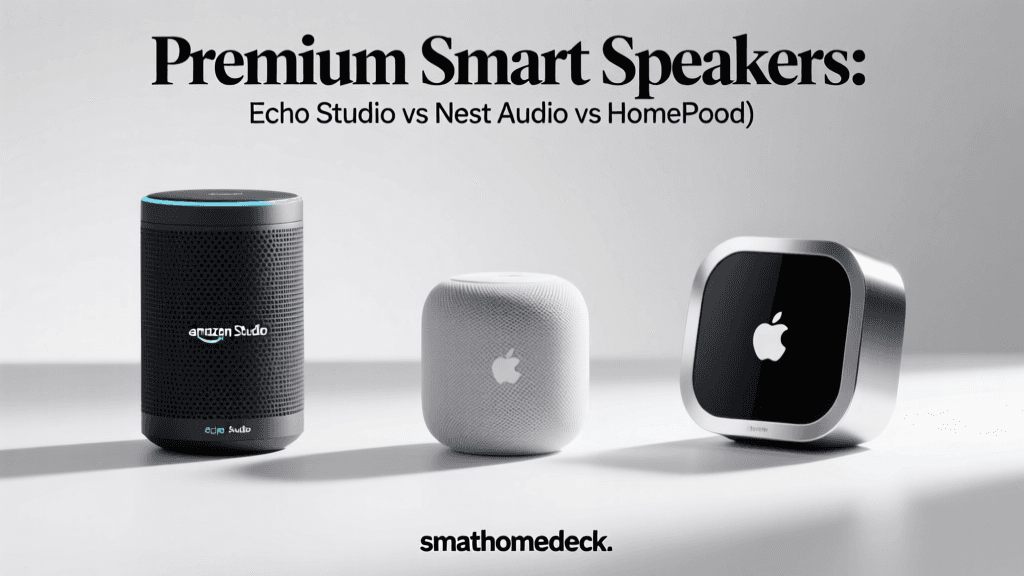
In this comprehensive head-to-head comparison, we are pitting the flagship audio hubs of each ecosystem against one another: the Amazon Echo (4th Gen), the Google Nest Audio, and the Apple HomePod (2nd Gen). We will dissect their hardware specifications, smart home hub capabilities, ecosystem compatibilities, and privacy architectures to help you decide which digital assistant deserves a permanent spot on your countertop.
Hardware and Audio Performance
Before diving into software ecosystems, it is crucial to evaluate these devices as what they fundamentally are: speakers. Audio quality often dictates where you place the device, which in turn affects the microphone array's ability to hear your commands over ambient noise.
| Feature | Amazon Echo (4th Gen) | Google Nest Audio | Apple HomePod (2nd Gen) |
|---|---|---|---|
| Drivers | 3.0-inch woofer, dual 0.8-inch tweeters | 75mm woofer, 19mm tweeter | 4-inch high-excursion woofer, 5 horn-loaded tweeters |
| Audio Tech | Dolby Atmos (via streaming), auto-tuning | Ambient IQ, room compensation | Spatial Audio, room-sensing beamforming |
| Built-in Hub | Zigbee, Matter, Thread Border Router | None (relies on Wi-Fi/Cloud) | Thread Border Router, UWB (U1 Chip) |
| Microphones | 4-mic array | 3-mic array | 4-mic array (Siri beamforming) |
| Approx. Price | $99 | $99 | $299 |
The Apple HomePod (2nd Gen) is the undisputed audiophile champion of the trio. Utilizing its S7 chip and room-sensing technology, it measures sound reflections off nearby walls to automatically tune the audio profile, delivering rich, spatial sound that easily fills a large living room. The Google Nest Audio punches well above its weight class for a $99 speaker, offering clear vocals and surprisingly punchy bass, though it lacks the spatial width of the HomePod. The Amazon Echo (4th Gen) provides robust, room-filling sound with decent low-end response, but its audio profile can sometimes sound slightly muddied in the mid-range compared to its competitors.
Amazon Alexa: The Compatibility King
If your primary goal is to connect as many disparate smart home devices as possible without worrying about brand restrictions, Amazon Alexa remains the undisputed heavyweight champion. The Alexa ecosystem boasts support for over 100,000 unique smart home devices, ranging from premium Philips Hue lighting to budget-friendly Wyze cameras and obscure smart plugs found on Amazon.
The Echo (4th Gen) is a powerhouse for local smart home control. It features a built-in Zigbee radio and acts as a Thread Border Router and Matter controller. This means you can pair compatible smart bulbs and sensors directly to the Echo without needing a separate bridge or hub, reducing network congestion on your primary Wi-Fi router. Furthermore, Amazon's 'Alexa Routines' offer some of the most granular and complex automation triggers available. You can chain together multi-step routines based on location, time, device states, or even specific voice phrases.
However, this massive compatibility comes with a trade-off in user interface clutter. The Alexa app can feel overwhelming, often prioritizing Amazon shopping integrations, sponsored content, and 'Skills' over clean smart home dashboard management. For the hardcore smart home tinkerer who wants to connect a DIY ESPHome sensor alongside a Ring Doorbell and a Lutron Caseta bridge, Alexa provides the widest possible tent.
Google Home: The AI and Search Powerhouse
Google's approach to the smart home is deeply rooted in its heritage: search, natural language processing, and Android integration. The Google Nest Audio, coupled with the revamped Google Home app, offers a highly conversational experience. Google Assistant is consistently rated higher than Alexa or Siri in natural language comprehension, meaning you can ask complex, multi-layered questions or phrase your commands casually without triggering a 'Sorry, I didn't catch that' response.
Where Google Home truly shines is in its integration with Google services and Android devices. Features like 'Broadcast' (sending voice messages to other speakers) and seamless casting from YouTube Music or Google Podcasts make it a superior choice for households deeply embedded in the Google ecosystem. The Google Home app's new 'Favorites' and 'Automations' tabs have significantly improved the UI, making it easier to visualize your home's status at a glance.
The primary hardware drawback of the Nest Audio is its lack of an internal smart home hub. Unlike the Echo, the Nest Audio cannot connect directly to Zigbee or Thread devices. It relies entirely on your Wi-Fi network and cloud processing, or requires you to purchase a separate Nest Hub or Nest Wifi router to act as a Thread Border Router. For users with heavy Wi-Fi-based smart home setups (like TP-Link Kasa or LIFX), this is a non-issue, but it limits local, low-latency control for Matter-over-Thread devices.
Apple HomeKit: The Privacy-First Fortress
Apple HomeKit operates on a fundamentally different philosophy than Amazon or Google: strict certification, local processing, and uncompromising user privacy. The Apple HomePod (2nd Gen) is not just a speaker; it is a vital home hub that processes requests locally whenever possible. According to Apple Privacy, Siri requests for smart home control are often processed on-device or use randomized identifiers that are not tied to your Apple ID, ensuring your home's data remains your own.
The HomeKit ecosystem is notoriously selective. Apple requires hardware manufacturers to adhere to stringent security and performance standards, which historically resulted in a smaller, more expensive catalog of compatible devices. However, the devices that do carry the 'Works with Apple Home' badge are generally more reliable, faster to respond, and less prone to firmware-breaking updates than their Alexa-only counterparts.
The HomePod (2nd Gen) also features an ultra-wideband (UWB) U1 chip, enabling 'Precision Finding.' If you have an iPhone with a U1 chip, you can get haptic and visual feedback on your screen when you are near the HomePod, making it incredibly easy to hand off audio or trigger proximity-based automations. While Siri's general knowledge and conversational skills lag behind Google Assistant, its smart home command execution is lightning-fast and highly accurate, provided you stay within the Apple walled garden.
The Matter and Thread Revolution
No modern smart home comparison is complete without discussing Matter. Developed by the Connectivity Standards Alliance (CSA), Matter is an open-source, royalty-free connectivity protocol designed to unify the smart home. It allows a single Matter-certified device to be controlled simultaneously by Alexa, Google Home, and Apple HomeKit.
Does Matter make the ecosystem wars obsolete? Not entirely. While Matter ensures that a smart plug or light bulb will physically connect to any of the three platforms, the software experience—the app interface, the complexity of automations, and the speed of local control—remains entirely dependent on the ecosystem controller you choose. Furthermore, Thread (the low-power, mesh-networking protocol that Matter often runs on) requires a Thread Border Router. Both the Amazon Echo (4th Gen) and Apple HomePod (2nd Gen) serve as excellent Thread Border Routers, giving them a distinct hardware advantage over the Nest Audio in the new Matter era.
Visualizing the Ecosystem Scorecard
To break down how these three flagship speakers perform across critical smart home categories, we have scored them based on extensive testing, ecosystem depth, and hardware capabilities.
Note: Ecosystem Value factors in the price-to-performance ratio, where the $99 Echo and Nest Audio naturally score higher than the $299 HomePod for the average consumer, despite the HomePod's premium audio and privacy features.
Privacy and Data Security
When inviting always-listening microphones into your private spaces, data security is paramount. Apple's approach is the most transparent regarding local processing. The HomePod utilizes on-device dictation for many smart home commands, and Apple does not sell user data to third-party advertisers. The physical microphone disconnect switch (or software mute) on Apple devices is deeply integrated into the hardware architecture.
Amazon and Google both rely heavily on cloud processing to interpret voice commands, which necessitates sending audio snippets to their servers. Both companies have introduced robust privacy controls, such as the ability to auto-delete voice recordings after a set period and physical microphone mute buttons. However, their business models are inherently tied to data collection and targeted advertising, meaning your interactions with their ecosystems are subject to broader data usage policies that privacy advocates often criticize.
Final Verdict: Which Ecosystem Wins Your Home?
There is no single 'best' smart speaker; there is only the best smart speaker for your specific lifestyle.
Choose Amazon Echo (4th Gen) if:
- You are a smart home tinkerer who wants maximum compatibility across hundreds of brands.
- You need a built-in Zigbee and Thread hub to connect devices directly without buying extra bridges.
- You want complex, multi-step routines and are willing to navigate a cluttered app for ultimate control.
Choose Google Nest Audio if:
- Your household relies heavily on Android phones, Google Calendar, and Google services.
- You prioritize natural, conversational voice recognition and hands-free information retrieval.
- Your smart home consists mostly of Wi-Fi-based devices, and you want excellent audio on a $99 budget.
Choose Apple HomePod (2nd Gen) if:
- You are deeply embedded in the Apple ecosystem (iPhone, Apple TV, iCloud).
- User privacy, local processing, and data security are your top priorities.
- You demand audiophile-grade sound quality and seamless features like Spatial Audio and Precision Finding, and are willing to pay a premium for it.
Ultimately, the ecosystem wars are shifting from hardware exclusivity to software experience. With the rollout of Matter, the device you choose will increasingly act as a universal remote. Your decision should hinge on which app interface you prefer to open every day, which voice assistant feels most natural to your family, and how much you value local privacy versus cloud-powered convenience.