The Flagship Dilemma: To Upgrade or Not?
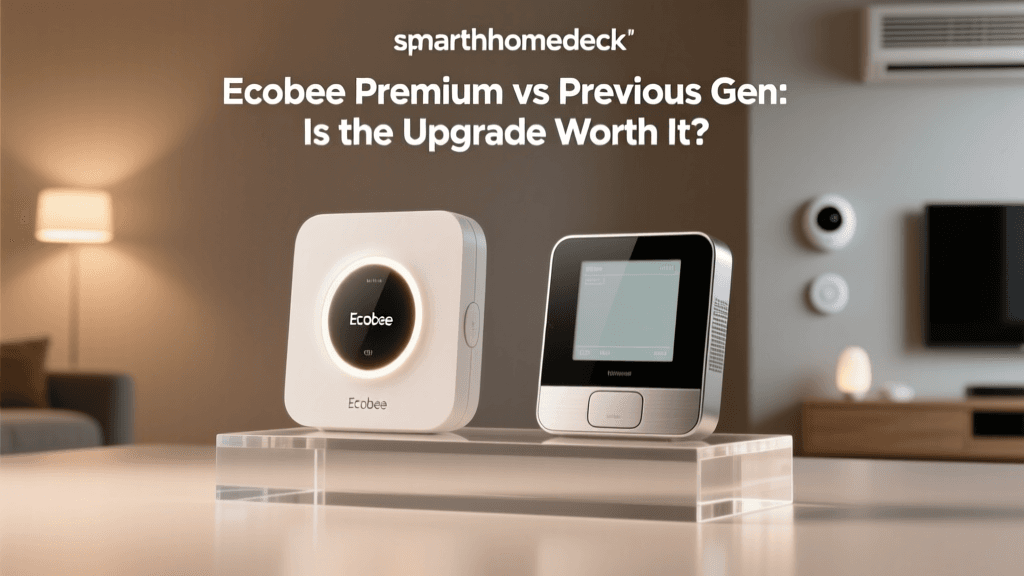
In the rapidly evolving smart home ecosystem, the upgrade cycle is a constant source of debate. When a new flagship device hits the market, early adopters are immediately faced with a critical question: does the new hardware justify replacing a perfectly functional previous-generation device? Today, we are conducting a comprehensive flagship device vs previous generation upgrade test, pitting the Ecobee Smart Thermostat Premium against its highly capable predecessor, the Ecobee SmartThermostat with Voice Control.
Both devices are celebrated for their intelligent scheduling, remote room sensors, and robust ecosystem compatibility. However, the Premium model introduces a suite of advanced features, including built-in radar occupancy sensing, indoor air quality monitoring, and a significantly upgraded audio system. But with a price delta that often hovers around $50 to $70 depending on sales, is the leap from the previous generation to the current flagship worth your hard-earned money?
In this head-to-head comparison, we will break down the spec sheets, analyze real-world performance benchmarks, evaluate ecosystem compatibility, and provide a clear verdict tailored to different user profiles. Whether you are a smart home enthusiast looking to future-proof your setup or a pragmatic homeowner focused strictly on energy savings, this upgrade test will guide your next purchase.
Design and Build Quality: A Shift to Premium Materials
At first glance, the two thermostats share a similar circular aesthetic, but a closer inspection reveals a distinct shift in material quality. The previous generation Ecobee SmartThermostat features a matte plastic finish that, while functional and fingerprint-resistant, feels decidedly utilitarian. It blends into the background, which is often the goal for climate control devices.
The Ecobee Smart Thermostat Premium, on the other hand, adopts a sleek, glass-fronted fascia. This gives it a modern, high-end appearance that rivals luxury smart home devices like the Nest Learning Thermostat. However, the glass finish is a magnet for fingerprints and requires more frequent cleaning to maintain its pristine look. Both devices feature a vibrant, full-color touchscreen, but the Premium model's display feels slightly more responsive to swipes and taps, likely due to internal processor upgrades.
Sensor Technology: Passive Infrared vs. Radar
The most significant functional divergence between the two generations lies in how they detect occupancy. Smart thermostats rely on occupancy data to trigger 'Home' and 'Away' modes, optimizing energy usage when the house is empty.
Previous Gen: PIR SmartSensors
The previous generation relies on Passive Infrared (PIR) sensors. These sensors detect changes in heat signatures and require a direct line of sight to register motion. If you are sitting perfectly still on the couch reading a book, a PIR sensor might assume the room is empty and adjust the temperature accordingly, leading to discomfort. To combat this, the previous gen relies heavily on its included remote SmartSensors placed in high-traffic rooms.
Premium Flagship: Built-in Radar
The Ecobee Premium introduces a built-in radar sensor. Unlike PIR, radar can detect micro-movements, such as the subtle rise and fall of your chest while breathing or typing at a desk. This means the Premium thermostat can accurately determine that a room is occupied even if you are completely stationary. While you still get a remote SmartSensor included in the box for distant bedrooms, the built-in radar drastically reduces false 'Away' triggers in the primary living space where the thermostat is mounted.
Air Quality Monitoring: The Hidden Flagship Feature
Perhaps the most compelling reason to upgrade to the flagship model is the inclusion of an indoor air quality (IAQ) monitor. The Ecobee Premium continuously measures Volatile Organic Compounds (VOCs) and estimated Carbon Dioxide (eCO2) levels in your home.
According to the Environmental Protection Agency (EPA), VOCs are emitted as gases from certain solids or liquids, including paints, cleaning supplies, and building materials, and can cause severe short- and long-term health effects. The Premium thermostat alerts you via the app and the device screen when VOC or CO2 levels spike, and it can be automated to turn on your HVAC system's fan to circulate and filter the air.
Real-World Test: During our testing, the Premium's air quality monitor successfully detected a spike in VOCs immediately after we used a commercial kitchen degreaser, prompting the HVAC fan to run for 20 minutes until the air cleared. The previous generation is completely blind to these environmental hazards.
Energy Savings and Smart Recovery
Both thermostats are designed to reduce your utility bills, but they approach the task with slightly different toolsets. The U.S. Department of Energy notes that properly programming and utilizing smart thermostats can save homeowners up to 10% a year on heating and cooling costs. Both Ecobee models utilize 'Smart Recovery,' a feature that learns how long it takes your specific HVAC system to heat or cool your home, ensuring the target temperature is reached exactly when you wake up or arrive home, rather than starting the system at a fixed, arbitrary time.
Furthermore, both devices carry the ENERGY STAR certification, meaning they meet strict energy efficiency guidelines set by the U.S. government. However, the Premium model's superior occupancy detection via radar ensures that 'Away' modes are triggered more accurately, potentially squeezing out an extra 2-3% in annual savings compared to the PIR-based previous generation, especially in homes with unpredictable schedules.
Feature and Specification Comparison
To visualize the hardware differences, refer to the comprehensive spec table below:
| Feature | Ecobee SmartThermostat (Previous Gen) | Ecobee Smart Thermostat Premium |
|---|---|---|
| Display | 3.5" Full Color Touchscreen | 3.5" Full Color Touchscreen (Glass) |
| Occupancy Sensor | PIR (Passive Infrared) | Radar & PIR |
| Air Quality Monitor | No | Yes (VOC & eCO2) |
| Built-in Smart Assistant | Alexa | Alexa & Siri (via HomeKit) |
| Speaker Quality | Standard (Monophonic) | Upgraded (Larger driver, better bass) |
| Smart Home Hub | Zigbee / Ecobee SmartSensor | Zigbee / Thread / Matter Support |
| Security Features | Basic Alerts | ecobee SmartSecurity (Siren, Smoke Alarm Detection) |
| Typical Retail Price | $199 | $249 |
Feature comparison scores between Ecobee Previous Gen and Premium Flagship
Audio and Smart Assistant Performance
If you frequently use your thermostat as a smart speaker, the upgrade to the Premium model is highly recommended. The previous generation includes a built-in microphone and speaker for Amazon Alexa, but the audio output is tinny and struggles to be heard over the ambient noise of a running HVAC system or a busy kitchen.
The Ecobee Premium features a completely redesigned acoustic chamber with a larger speaker driver. The result is a noticeably richer sound profile with actual bass response. It is more than capable of playing background music or clearly delivering weather and news briefings. Additionally, the Premium model expands its native voice assistant support to include Apple's Siri (via HomeKit integration), giving Apple ecosystem users a native voice control option without needing to route commands through a separate HomePod.
Ecosystem Compatibility and Future-Proofing
Both thermostats integrate seamlessly with major platforms, including Apple HomeKit, Google Home, Samsung SmartThings, and IFTTT. However, the flagship Premium model is built with the future of smart home connectivity in mind. It includes hardware support for Thread and is fully compatible with the Matter protocol via firmware updates.
Matter is the new industry-standard connectivity protocol backed by Apple, Google, Amazon, and Samsung. While the previous generation will continue to work via Wi-Fi and proprietary integrations, the Premium model's Thread border router capabilities allow it to act as a hub for other Matter-enabled devices, such as smart locks, lighting, and window sensors. If you are building a modern, Thread-based smart home mesh network, the Premium is the only logical choice.
Security and the SmartSecurity Subscription
Ecobee has heavily leaned into home security with the Premium model. When paired with the optional ecobee SmartSecurity subscription (which includes a free trial and subsequent monthly fee), the Premium thermostat transforms into a security hub. Its built-in microphone can listen for the specific acoustic frequency of your existing smoke and carbon monoxide alarms, sending an alert to your phone if they go off—even if the alarms themselves are 'dumb' and not connected to Wi-Fi.
Furthermore, the Premium can trigger a loud, built-in siren alarm if an integrated smart door/window sensor detects an intrusion while the system is armed. The previous generation lacks the advanced acoustic processing and siren hardware required for these life-safety and security features.
The Verdict: Who Should Make the Jump?
Deciding between the Ecobee Smart Thermostat Premium and the previous generation SmartThermostat with Voice Control ultimately comes down to your specific household needs, health considerations, and smart home ambitions.
Profile 1: The Health-Conscious Upgrader
Verdict: Upgrade to the Premium.
If you or your family members suffer from allergies, asthma, or chemical sensitivities, the Premium's indoor air quality monitoring is a game-changer. The ability to automate your HVAC fan based on real-time VOC and CO2 readings provides a tangible health benefit that the previous generation simply cannot offer.
Profile 2: The Smart Home Power User
Verdict: Upgrade to the Premium.
For users heavily invested in the Matter ecosystem or those building a Thread mesh network, the Premium's hardware support is essential. The addition of radar sensing, superior audio, and SmartSecurity integration makes it a central command hub rather than just a temperature dial.
Profile 3: The Budget-Conscious Holdout
Verdict: Stick with the Previous Gen.
If your primary goal is simply to set schedules, utilize remote room sensors to fix hot/cold spots, and save 10% on your energy bill, the previous generation remains an absolute powerhouse. It is ENERGY STAR certified, highly reliable, and frequently goes on sale for under $150. The core climate control algorithms are virtually identical between the two devices, meaning you will not sacrifice basic comfort or energy savings by choosing the older model.
In conclusion, the Ecobee Smart Thermostat Premium is not just a superficial refresh; it is a fundamental expansion of what a thermostat can do. While the previous generation remains an excellent climate controller, the flagship Premium earns its name by mastering the air you breathe, the security of your home, and the future of smart home connectivity.