The Smart Thermostat Triumvirate
When it comes to upgrading your home's climate control, the market is dominated by three major players: Google Nest, Ecobee, and Honeywell Home (now Resideo). While budget options exist, premium smart thermostats offer advanced machine learning, multi-room sensor ecosystems, and deep smart home integrations that translate directly into lower utility bills and superior comfort. But with flagship models hovering around the $200 to $250 mark, which one deserves a spot on your wall?
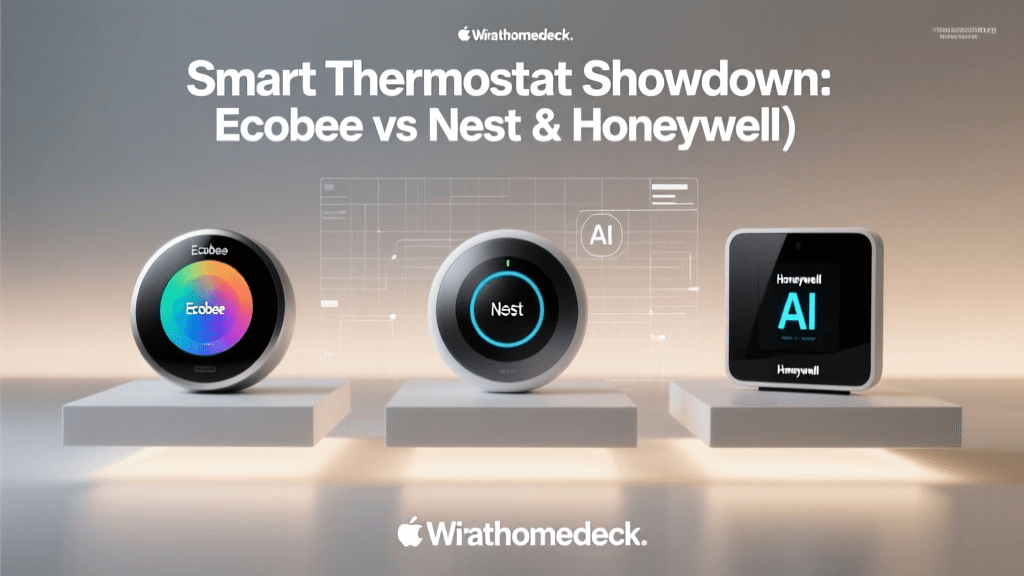
In this comprehensive head-to-head comparison, we break down the Google Nest Learning Thermostat, the Ecobee SmartThermostat with Voice Control, and the Honeywell Home T9. We will analyze their sensor capabilities, HVAC compatibility, installation requirements, and long-term energy savings to help you make the definitive choice for your specific home layout and smart home ecosystem.
Contender Profiles: Flagship Models Compared
Google Nest Learning Thermostat (3rd & 4th Gen)
The Nest Learning Thermostat is the pioneer of the smart climate category. Famous for its iconic circular design, heavy stainless-steel housing, and mirrored glass display, it is widely considered the most aesthetically pleasing thermostat on the market. Its core selling point is its 'auto-schedule' algorithm. Instead of forcing you to program a rigid 7-day schedule, the Nest monitors your manual adjustments over a week and builds a custom heating and cooling profile automatically. Combined with 'Farsight' (which wakes the display when you enter the room) and 'Home/Away Assist' via built-in GPS and Wi-Fi geofencing, the Nest is a fire-and-forget device designed for users who want the thermostat to think for itself.
Ecobee SmartThermostat with Voice Control
Ecobee has built its reputation on solving the 'multi-room' problem. While the Nest relies primarily on the temperature of the hallway where it is installed, the Ecobee SmartThermostat comes bundled with a SmartSensor that you can place in a frequently used room, like a bedroom or living room, ensuring the spaces you actually occupy are comfortable. The Ecobee also features a built-in Alexa speaker, transforming the thermostat into a fully functional smart speaker capable of playing Spotify, setting timers, and controlling other smart devices. Its interface is a sleek, matte-black glass square with a capacitive touch strip, appealing to users who prefer manual scheduling and granular control over algorithmic learning.
Honeywell Home T9 Smart Thermostat
Backed by Resideo's decades of HVAC manufacturing experience, the Honeywell Home T9 bridges the gap between traditional reliability and modern smart features. The T9's standout feature is its dual-purpose Smart Room Sensors, which detect both temperature and occupancy. Unlike competitors that average the temperature of occupied rooms, the T9 allows you to prioritize specific rooms based on occupancy in real-time. The T9 features a more traditional rectangular shape with a bright, easy-to-read touchscreen. It is often the preferred choice for homeowners with complex, multi-stage HVAC systems who want robust geofencing and app-based control without the premium price tag of the Nest or Ecobee.
Head-to-Head Specifications
| Feature | Nest Learning Thermostat | Ecobee SmartThermostat | Honeywell Home T9 |
|---|---|---|---|
| Display | 2.08" Circular LCD (Farsight) | 3.5" Square Capacitive Touch | 3.5" Rectangular Touchscreen |
| Built-in Voice | No (Requires Nest Hub) | Yes (Alexa built-in) | No (External speaker required) |
| Included Sensors | None (Sold separately) | 1 SmartSensor included | 1 Smart Room Sensor included |
| Sensor Battery | 2x AAA (Lasts ~2 years) | CR2032 Coin Cell (Lasts ~5 years) | 2x AAA (Lasts ~1 year) |
| Geofencing | Phone GPS + Wi-Fi + Nest Sensors | Phone GPS + Ecobee Sensors | App-based GPS Geofencing |
| C-Wire Required | No (Power Connector included) | No (PEK adapter included) | Yes (or included adapter) |
| Average Base Price | $249 | $249 | $179 |
The Sensor Ecosystem: Solving the Multi-Room Dilemma
The biggest flaw in traditional smart thermostats is their location. Most thermostats are installed in central hallways, which are rarely the rooms where people spend their time. This leads to the classic problem: the hallway reaches 72°F, so the AC shuts off, but the sun-drenched living room remains at 78°F.
Nest Temperature Sensors
Google's Nest Temperature Sensors are small, minimalist pucks that communicate via Bluetooth Low Energy (BLE) to the main thermostat. You can set schedules to prioritize specific sensors at specific times (e.g., prioritize the bedroom sensor at night, and the living room sensor during the day). However, Nest sensors only measure temperature; they lack occupancy detection. Furthermore, they are sold separately, meaning a multi-story home can quickly see the total ecosystem cost rise above $350.
Ecobee SmartSensors
Ecobee's SmartSensors are widely considered the gold standard in the industry. They utilize Passive Infrared (PIR) technology to detect occupancy. If a room is occupied, the Ecobee factors that room's temperature into its heating/cooling algorithm. The SmartSensor runs on a CR2032 coin cell battery that reliably lasts up to five years, significantly reducing maintenance compared to AAA batteries. Because one sensor is included in the box, Ecobee offers immediate multi-room value out of the gate.
Honeywell T9 Smart Room Sensors
Honeywell's sensors are unique because they combine both temperature and humidity monitoring alongside PIR occupancy detection. The T9's 'Smart Room' feature allows the thermostat to automatically switch its focus to whichever room is currently occupied. If you walk from the bedroom to the home office, the T9 adjusts its target temperature to ensure the office is comfortable. While highly effective, the T9 sensors have a shorter battery life and a bulkier physical footprint than Ecobee's offerings.
Voice Assistants and Smart Home Integration
Your choice of thermostat will heavily depend on your existing smart home ecosystem. If you are deeply invested in Google Home, the Nest Learning Thermostat is the undisputed champion. It integrates natively with Google Assistant routines, allowing you to trigger HVAC adjustments based on other Nest devices, such as Nest Cams or Nest Doorbells. However, the Nest unit itself lacks a microphone and speaker; you must issue voice commands to a separate Nest Hub or Mini speaker.
Conversely, the Ecobee SmartThermostat is a dream for Amazon Alexa users. With far-field microphones and a premium speaker built directly into the wall unit, it doubles as an Echo Dot. You can ask for the weather, adjust the temperature, listen to Spotify, or even use the 'Drop In' intercom feature without buying an additional smart speaker. Ecobee also supports Apple HomeKit, making it the most versatile option for households with mixed iOS and Android users.
The Honeywell T9 plays nicely with both Alexa and Google Assistant, as well as IFTTT, but it requires external hardware to process voice commands. Its app, however, is highly rated for its straightforward geofencing and utility rebate portal integrations, making it a favorite for pragmatists who care more about app reliability than voice control.
HVAC Compatibility and the C-Wire Debate
Before purchasing any smart thermostat, you must understand the 'C-wire' (common wire). Smart thermostats require continuous 24V power to run their Wi-Fi radios and bright displays. Older homes often lack a C-wire, relying instead on 'power stealing' from the heating/cooling relays, which can cause Wi-Fi drops or even damage HVAC control boards.
According to HVAC professionals, while power-stealing adapters exist, running a dedicated C-wire or using a hardwired 24V adapter at the furnace is always the safest method to protect expensive multi-stage HVAC control boards from voltage fluctuations.
- Google Nest: Claims it can operate without a C-wire in most systems using its internal battery and power-stealing algorithms. For problematic systems, Google includes a 'Nest Power Connector' in the box, which wires into your furnace's control board to simulate a C-wire.
- Ecobee: Includes a Power Extender Kit (PEK). If you lack a C-wire, the PEK wires into your HVAC control board and multiplexes the signals over the existing wires to provide continuous power to the thermostat. It is highly reliable and favored by DIYers.
- Honeywell T9: Strictly requires a C-wire for proper operation. If your home lacks one, Honeywell includes a C-wire power adapter that plugs into a standard wall outlet near the furnace and runs a thin wire up to the thermostat. It is foolproof but requires a nearby outlet.
Energy Savings and Long-Term ROI
The primary justification for a $250 smart thermostat is energy savings. The U.S. Department of Energy notes that you can save as much as 10% a year on heating and cooling by simply turning your thermostat back 7°-10°F for 8 hours a day from its normal setting. Smart thermostats automate this process via geofencing and eco-modes.
Furthermore, the EPA's ENERGY STAR program certifies smart thermostats that have been independently verified to deliver measurable energy savings based on real-world field data, rather than just lab simulations. Both Nest and Ecobee carry ENERGY STAR certifications, meaning they qualify for local utility rebates, which can sometimes cover up to 50% to 100% of the purchase price.
When calculating your Return on Investment (ROI), you must factor in the cost of the sensors required to make your specific home comfortable. Below is a visualization of the average upfront ecosystem cost when outfitting a standard 3-bedroom home with a base unit and two additional room sensors.
As the chart illustrates, the Honeywell T9 offers the most aggressive entry price for a multi-room sensor setup, making it highly attractive for budget-conscious homeowners who still demand premium features. Ecobee and Nest are nearly identical in price, but Ecobee's inclusion of a sensor in the base box provides slightly better immediate value.
Final Verdict: Which Thermostat Wins?
Choose the Google Nest Learning Thermostat if:
You prioritize aesthetics, own a Google-centric smart home, and prefer a 'set it and forget it' algorithmic approach. The Nest is perfect for single-story homes or open-concept layouts where a single central sensor accurately reflects the home's overall temperature. Its premium build quality makes it a piece of wall art rather than just a utility device.
Choose the Ecobee SmartThermostat if:
You live in a multi-story home with significant temperature variations between rooms, or if you are an avid Amazon Alexa user. The inclusion of the PIR-enabled SmartSensor, the built-in speaker, and Apple HomeKit compatibility make the Ecobee the most versatile and technically capable thermostat on the market. It is the ultimate choice for power users who want granular control over their HVAC scheduling.
Choose the Honeywell Home T9 if:
You want premium multi-room sensor capabilities without paying the $250 premium tax. The T9 is the undisputed value champion, offering occupancy-based room prioritization, robust geofencing, and excellent compatibility with complex multi-stage HVAC systems. It is the ideal pick for pragmatists, landlords, and families who want reliable, room-by-room comfort on a sensible budget.