The Long Reign of the 3rd Generation
For nearly a decade, the Google Nest Learning Thermostat (3rd Gen) has been the undisputed heavyweight champion of smart climate control. Released back in 2015, it defined what a smart thermostat could be: a beautiful, wall-mounted piece of hardware that learned your habits, saved energy, and looked good doing it. But in the fast-moving world of smart home technology, a nine-year product cycle is an eternity. In 2024, Google finally introduced the Nest Learning Thermostat (4th Gen), bringing a host of modernized sensors, updated software algorithms, and crucial smart home protocol support to the table.
For existing Nest users, the pressing question is one of upgrade worthiness. If your 3rd Gen is still spinning its iconic stainless steel ring and keeping your home comfortable, is it worth dropping $279 on the new model? Or should you wait until your current unit finally bites the dust? In this comprehensive head-to-head comparison, we break down the design, sensor technology, energy savings, and ecosystem compatibility to help you decide if the new generation is truly worth the investment.
Design and Display: A Refined Evolution
At first glance, the 4th Gen looks remarkably similar to its predecessor. Google has retained the circular, puck-like aesthetic that has become synonymous with the Nest brand. However, the similarities are largely superficial. The 3rd Gen features a 3.3-inch LCD screen with a resolution of 240 x 240 pixels, surrounded by a physical, rotating stainless steel ring that users turn to adjust the temperature. It is a tactile, mechanical joy to use, but it is also a relic of an older hardware era.
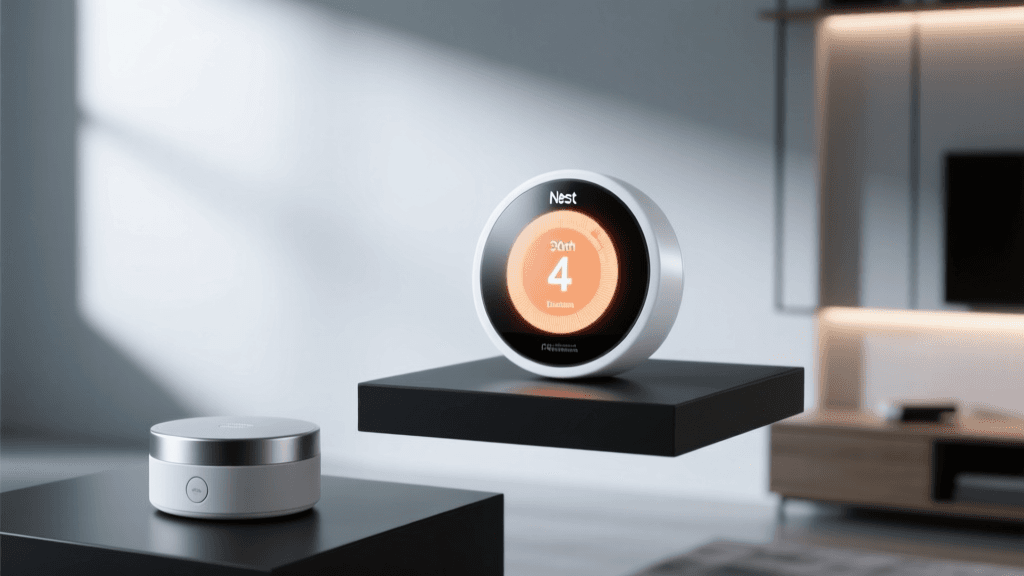
The 4th Gen ditches the mechanical rotating ring. Instead, it features a fixed, sleek bezel and relies on a highly responsive, edge-to-edge touchscreen interface paired with swipe gestures on the glass. The display itself has been upgraded to a larger active area with a higher pixel density and a new matte, anti-glare finish. This matte coating is a massive practical improvement; while the 3rd Gen acted like a mirror in sunlit hallways, the 4th Gen remains perfectly readable even when mounted opposite a bright window. The removal of moving parts also means there is less physical wear and tear over the lifespan of the device.
The Soli Sensor: True Presence Detection
The most significant hardware leap in the 4th Gen is hidden beneath the glass: the integration of Google’s Soli radar sensor. The 3rd Gen relies on a traditional PIR (Passive Infrared) sensor to detect motion. PIR sensors are great at catching a person walking down a hallway, but they are notoriously blind to stationary presence. If you are sitting on the couch reading a book or working at a desk, the 3rd Gen assumes the house is empty and may adjust the temperature, leaving you shivering or sweating.
The Soli sensor operates on a 60GHz radar frequency capable of detecting sub-millimeter movements, including the subtle rise and fall of your chest as you breathe or the micro-movements of your fingers typing on a keyboard. This means the 4th Gen possesses true, continuous presence detection. It knows you are home even when you are perfectly still. This translates directly to comfort and efficiency, as the thermostat will not prematurely trigger 'Away' mode while you are relaxing in the living room.
The transition from mechanical PIR sensors to solid-state radar represents the most significant leap in smart home presence detection in the last decade, effectively solving the 'stationary occupant' problem that has plagued smart thermostats for years.
Energy Efficiency and Adaptive Eco
Both thermostats carry the ENERGY STAR certification, a program backed by the EPA that ensures products meet strict energy efficiency guidelines. According to ENERGY STAR certified smart thermostats, properly programmed smart devices can save users roughly 8% on heating and 10% on cooling bills annually. However, the 4th Gen pushes these savings further with a new software feature called Adaptive Eco.
While the 3rd Gen uses 'Auto-Schedule' to learn your preferred temperatures and 'Home/Away Assist' to turn down the HVAC when you leave, the 4th Gen’s Adaptive Eco algorithm is far more aggressive and intelligent. It calculates the exact thermal decay rate of your specific home, factors in real-time outdoor weather forecasts, and learns how quickly your HVAC system can recover. When you leave, it pushes the temperature further out of your comfort zone to maximize savings, but it calculates the precise moment to kick the system back on so that your home is perfectly comfortable the second you walk through the door. Google claims this can yield up to 20% more energy savings compared to older learning algorithms.
The U.S. Department of Energy's guidelines on thermostat savings emphasize that the ability to automatically adjust temperatures based on real-time occupancy and external weather conditions is the primary driver of long-term utility savings. The 4th Gen’s combination of Soli presence tracking and Adaptive Eco makes it vastly superior in this regard.
Spec-by-Spec Comparison Table
| Feature | Nest Learning Thermostat (3rd Gen) | Nest Learning Thermostat (4th Gen) |
|---|---|---|
| Release Year | 2015 | 2024 |
| Display | 3.3' LCD (240x240), Glossy | 3.3' LCD (Higher Res), Matte Anti-Glare |
| Interface | Mechanical Rotating Ring | Touchscreen & Swipe Gestures |
| Presence Sensor | PIR (Passive Infrared) | Soli Radar (60GHz) |
| Smart Scheduling | Auto-Schedule & Home/Away | Adaptive Eco & Advanced Learning |
| Smart Home Protocol | Wi-Fi, Thread, Bluetooth, Proprietary | Wi-Fi, Thread, Bluetooth, Matter |
| HVAC Monitoring | Basic Filter Reminders | Advanced System Health & Predictive Alerts |
| MSRP | $249 (Often on sale for ~$199) | $279 |
Smart Home Ecosystem and Matter Support
If you are deeply embedded in the Google Home ecosystem, the 3rd Gen still functions perfectly well. However, the smart home landscape has shifted dramatically since 2015 with the introduction of the Matter protocol. The 3rd Gen does not support Matter, and due to hardware limitations, it is highly unlikely to ever receive a firmware update enabling it. It remains locked to Google's proprietary Weave and Thread implementations.
The 4th Gen, on the other hand, is built with Matter support out of the box. It acts as both a Matter end-device and a Matter controller. This is a game-changer for users who utilize Apple HomeKit, Samsung SmartThings, or Home Assistant. You can now seamlessly integrate the Nest Learning Thermostat into non-Google ecosystems, enabling local processing, faster response times, and unified automations without relying on clunky third-party cloud bridges. If you are building a multi-platform smart home, the 4th Gen’s Matter compatibility alone makes the upgrade justifiable.
HVAC Health Monitoring and Predictive Alerts
Your HVAC system is one of the most expensive appliances in your home, and unexpected failures during a heatwave or blizzard can be disastrous. The 3rd Gen offers basic maintenance reminders, such as prompting you to change your air filter based on system runtime. The 4th Gen takes this a massive step forward with advanced HVAC health monitoring.
By continuously analyzing the electrical draw, startup delays, and runtime efficiency of your heating and cooling equipment, the 4th Gen can detect anomalies. If your AC compressor is taking three seconds longer to engage than it did last month, or if your furnace is short-cycling, the Nest app will send you a predictive alert. This allows you to schedule preventative maintenance with an HVAC technician before a minor issue turns into a catastrophic, thousands-of-dollars system failure.
Installation and Compatibility
One of the biggest concerns when upgrading a wired smart home device is whether the new unit will work with the existing wall wiring. Fortunately, Google has maintained backward compatibility for the vast majority of users. The 4th Gen works with the same standard low-voltage HVAC wiring as the 3rd Gen. In most cases, you can pop the 3rd Gen off its baseplate, wire the new 4th Gen baseplate, and snap the new display into place.
However, there is a catch regarding the C-wire (Common wire). While the 3rd Gen could sometimes 'steal' power from the heating and cooling wires to charge its internal battery if a C-wire was absent, the 4th Gen’s power-hungry Soli sensor and brighter display make a dedicated C-wire practically mandatory for reliable operation. If your home’s thermostat wiring does not include a C-wire, you will need to install the included Nest Power Connector or hire an electrician to run a new wire before upgrading. Furthermore, the physical baseplate footprint is slightly different, meaning you may need to touch up the paint on your wall if the old 3rd Gen left a faded ring or unpainted drywall exposed.
Is the Upgrade Worth the Cost?
From a purely financial perspective, the math requires a long-term view. The 4th Gen retails for $279, while the 3rd Gen can frequently be found on clearance or sale for around $199. That $80 price delta is significant. However, the 4th Gen’s Adaptive Eco and superior presence detection claim to save an additional 10% to 15% on annual climate control costs compared to older smart thermostats. For a large home in a region with extreme summers and winters, the 4th Gen could easily pay for its price premium within three to four years through reduced utility bills.
Beyond raw energy savings, you are paying for modernized hardware. The anti-glare screen, the elimination of mechanical moving parts, and the predictive HVAC health monitoring provide a level of peace of mind and usability that the aging 3rd Gen simply cannot match.
Final Verdict: Who Should Upgrade?
Upgrade to the 4th Gen if:
- You are an Apple HomeKit, Samsung SmartThings, or Home Assistant user who requires Matter support for local, unified smart home control.
- Your 3rd Gen frequently changes the temperature while you are sitting still on the couch (the Soli sensor will permanently fix this PIR blind spot).
- Your current thermostat is mounted in a high-glare area where the glossy 3rd Gen screen is unreadable.
- You want proactive, predictive alerts regarding the health of your expensive HVAC equipment.
- Your 3rd Gen has physically broken, the rotating ring is stuck, or the battery is failing to hold a charge.
Stick with the 3rd Gen if:
- You are on a strict budget and can find the 3rd Gen on deep discount.
- You exclusively use the Google Home app and have no interest in the Matter protocol.
- Your current 3rd Gen is working perfectly, your home's layout allows the PIR sensor to easily catch your motion, and you are satisfied with your current energy bills.
- You do not have a C-wire and do not want to deal with the hassle of installing a Nest Power Connector.
Ultimately, the Nest Learning Thermostat (4th Gen) is not just a minor spec bump; it is a fundamental modernization of the smart thermostat category. While the 3rd Gen remains a capable device for basic scheduling, the 4th Gen’s radar sensing and Matter integration make it the definitive upgrade for the modern, multi-ecosystem smart home.