The Smart Home Dilemma: When to Upgrade a Working Device?
In the smart home industry, the cycle of planned obsolescence moves at a breakneck pace. Yet, some devices become so deeply embedded in our daily routines and home infrastructure that replacing them feels unnecessary. The Google Nest Learning Thermostat (3rd Generation) is the poster child for this phenomenon. Released years ago, its iconic stainless steel ring and reliable learning algorithms have made it a staple in millions of homes. It works, it saves energy, and it looks great. So, when Google introduced the completely revamped Nest Learning Thermostat (4th Generation), a collective question echoed through the smart home community: If the 3rd Gen isn't broken, why fix it?
This head-to-head comparison dives deep into the 'Upgrade Worthiness' of the new 4th Generation. We will dissect the hardware leaps, the introduction of the Soli radar sensor, native Matter support, and the AI-driven HVAC monitoring to determine if the premium price tag of the new generation is justified for your specific home ecosystem.
Design and Display: Classic Steel vs. Domed Glass
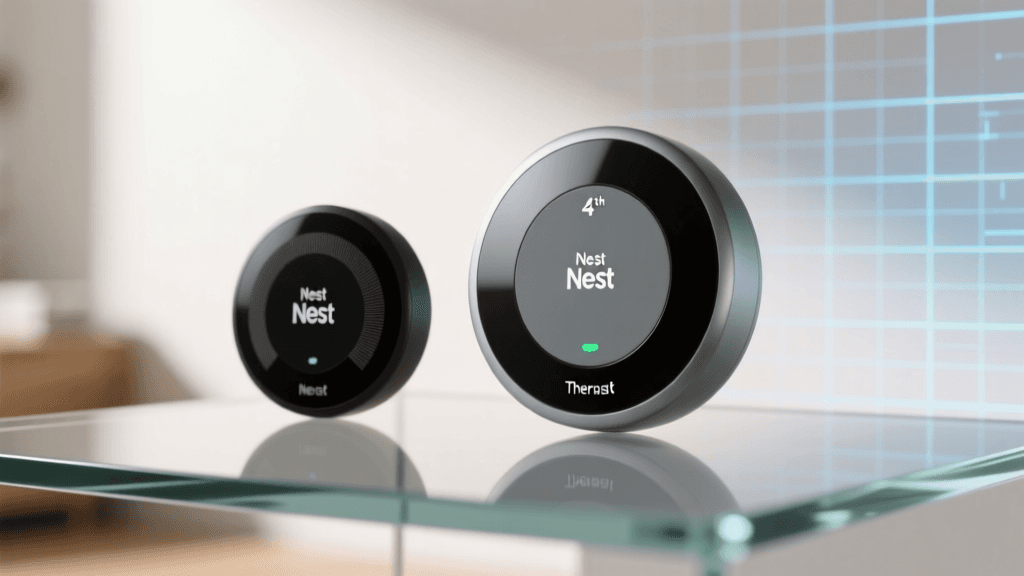
The 3rd Gen Nest Thermostat is widely considered a masterpiece of industrial design. Its 3.25-inch circular display, surrounded by a rotating stainless steel ring, set the standard for what a smart home device should look like. It blends into almost any interior decor, acting more like a premium clock than a piece of tech.
The 4th Gen, however, takes a radically different approach. Google has abandoned the physical rotating ring in favor of a sleek, domed glass face with a hidden, touch-sensitive haptic dial around the perimeter. The display itself is slightly smaller at 3.2 inches but boasts a significantly higher resolution (640x640 compared to the 3rd Gen's 480x480). The result is a sharper, more vibrant screen that uses edge-to-edge glass to create a floating, jewel-like aesthetic on your wall.
Design Verdict: The 3rd Gen wins on tactile satisfaction with its physical, clicking dial. The 4th Gen wins on modern minimalism and screen clarity, though the lack of a physical ring may alienate purists who loved the original's mechanical feel.
The Sensor Paradigm Shift: PIR vs. Soli Radar
The most significant functional upgrade in the 4th Gen is not something you can easily see; it is how the device perceives your presence. The 3rd Gen relies on a traditional Passive Infrared (PIR) sensor. PIR sensors detect changes in infrared radiation, meaning they require actual movement to register occupancy. If you are sitting perfectly still on the couch reading a book or sleeping, the 3rd Gen might assume the house is empty and adjust the temperature accordingly, leading to the infamous 'false away' mode.
The 4th Gen integrates Google's Soli sensor technology. Soli uses millimeter-wave radar to detect micro-movements, such as the subtle rise and fall of your chest while breathing or the slight shift of your fingers typing on a keyboard. This means the 4th Gen knows you are home, even if you are completely stationary. Furthermore, the Soli sensor enables a new 'Dynamic Farsight' feature that senses your approach from across the room, waking the display and showing you the exact information you need before you even raise your hand.
Ecosystem Compatibility and the Matter Protocol
For smart home enthusiasts, the protocol war is real. The 3rd Gen Nest relies on Wi-Fi and proprietary Google ecosystems, with limited integration into broader, open standards. It does not support Matter, and given its aging internal hardware, it is highly unlikely to receive a firmware update to support it.
The 4th Gen is built with the future in mind, featuring native support for Matter over Thread. This is a massive leap for upgrade worthiness. With Matter, the 4th Gen can communicate locally with your Apple HomeKit, Amazon Alexa, and Samsung SmartThings hubs without relying solely on cloud servers. This results in faster response times, reduced latency, and a more resilient smart home network that doesn't crash when your internet goes down.
Spec Comparison Table
| Feature | Nest Learning Thermostat (3rd Gen) | Nest Learning Thermostat (4th Gen) |
|---|---|---|
| Display | 3.25' LCD (480x480) | 3.2' Domed Glass (640x640) |
| Occupancy Sensor | Passive Infrared (PIR) | Soli Millimeter-Wave Radar |
| Smart Protocols | Wi-Fi, Bluetooth, 802.15.4 | Wi-Fi, Bluetooth, Thread, Matter |
| Physical Controls | Rotating Stainless Steel Ring | Touch-Sensitive Haptic Edge Dial |
| HVAC Monitoring | Basic Alerts | Advanced AI Predictive Maintenance |
| Typical Retail Price | $150 - $229 | $279 |
Performance and Feature Benchmark
To visualize the generational leap, we have scored both devices across five critical smart home categories on a scale of 1 to 10. While the 3rd Gen holds up remarkably well in basic functionality, the 4th Gen's integration of modern protocols and advanced sensors creates a wide gap in future-proofing.
Energy Efficiency and HVAC Health Monitoring
According to the U.S. Department of Energy, you can save as much as 10% a year on heating and cooling by simply turning your thermostat back 7°-10°F for 8 hours a day from its normal setting. Smart thermostats automate this process, but the 4th Gen takes it a step further with AI-driven predictive maintenance.
While both models are Energy Star certified—a designation that the EPA notes ensures rigorous third-party testing for energy savings—the 4th Gen continuously monitors the acoustic and electrical signatures of your HVAC system. It doesn't just tell you when the filter is dirty; it can detect anomalies in the blower motor or compressor performance, alerting you to potential system failures before your AC dies in the middle of a July heatwave. For homeowners with aging HVAC systems, this feature alone can offset the $279 price tag by preventing catastrophic repair bills.
Installation and Compatibility
One area where the upgrade worthiness might face a hurdle is installation. Both generations require a C-wire (common wire) for reliable power delivery, though Google includes a Nest Power Connector in the box for homes lacking a dedicated C-wire. However, the 4th Gen's advanced Soli sensor and brighter display draw slightly more power, making a stable C-wire connection highly recommended over the Power Connector workaround.
Both units support multi-stage heating and cooling, heat pumps, and radiant systems. If you are upgrading from a 3rd Gen to a 4th Gen, the backplate wiring is nearly identical, making the physical swap a literal five-minute job. The Google Home app will recognize the new device and migrate your historical learning data and schedules seamlessly.
Frequently Asked Questions
Will the 3rd Gen receive Matter support via a software update?
No. The 3rd Gen lacks the necessary Thread radio hardware and processing overhead to support the Matter protocol natively. If Matter integration is a priority for your smart home hub, the 4th Gen is mandatory.
Is the Soli sensor worth it for small apartments?
In smaller spaces, traditional PIR sensors rarely struggle with 'false away' modes because movement is constant. However, if you work from home in a small office and sit still for hours, the Soli sensor's ability to detect breathing and micro-movements ensures your apartment won't mistakenly switch to Eco mode while you are working.
Does the 4th Gen work with Apple HomeKit?
Yes, thanks to Matter over Thread support. While the 3rd Gen requires complex third-party workarounds (like Starling Home Hub) to integrate with Apple, the 4th Gen pairs natively with Apple HomeKit via the Matter QR code on the back of the device.
Final Verdict: Is the 4th Gen Worth the Premium?
The decision to upgrade ultimately hinges on your current smart home ecosystem and your tolerance for aging technology. The Google Nest Learning Thermostat (4th Generation) is a triumph of modern sensor technology and open-standard connectivity, but it demands a premium that the heavily discounted 3rd Gen simply does not.
Who Should Stick with the 3rd Gen?
- The 'Set It and Forget It' User: If your current 3rd Gen is mounted on the wall, learning your schedule, and saving you money, there is no urgent need to replace it. The core function of temperature regulation is identical.
- Budget-Conscious Upgraders: If you are buying your very first smart thermostat, the 3rd Gen can often be found on sale for under $160. At that price point, it remains one of the best value propositions in the smart home market.
- Tactile Purists: If you love the heavy, mechanical click of the stainless steel rotating ring, the haptic glass dial of the 4th Gen may feel like a downgrade in physical satisfaction.
Who Should Upgrade to the 4th Gen?
- Multi-Ecosystem Homes: If you use a mix of Apple HomeKit, Amazon Alexa, and Google Home, the 4th Gen's native Matter support is a game-changer that eliminates the need for third-party bridging hubs.
- Home Office Workers & Still Sleepers: The Soli radar sensor completely eliminates the frustration of the HVAC system shutting off while you are sitting still at your desk or reading in bed.
- Homeowners with Aging HVAC Systems: The advanced AI acoustic and electrical monitoring provides peace of mind, acting as an early warning system for expensive compressor or blower motor failures.
In conclusion, the 4th Gen is not just a cosmetic refresh; it is a fundamental reimagining of how a thermostat interacts with human biology and the broader smart home network. If your budget allows, the leap to Soli and Matter makes the 4th Gen a highly worthy investment for the next decade of smart home living.