The Smart Lock Landscape: Beyond the Hype
The transition from a traditional mechanical deadbolt to a premium smart lock is one of the most impactful upgrades a modern homeowner can make. It bridges the gap between physical security and digital convenience, allowing you to manage access, monitor entry logs, and integrate with broader home automation routines. However, the market is saturated with options, and choosing the wrong device can lead to connectivity dropouts, premature battery drain, or frustrating app experiences.
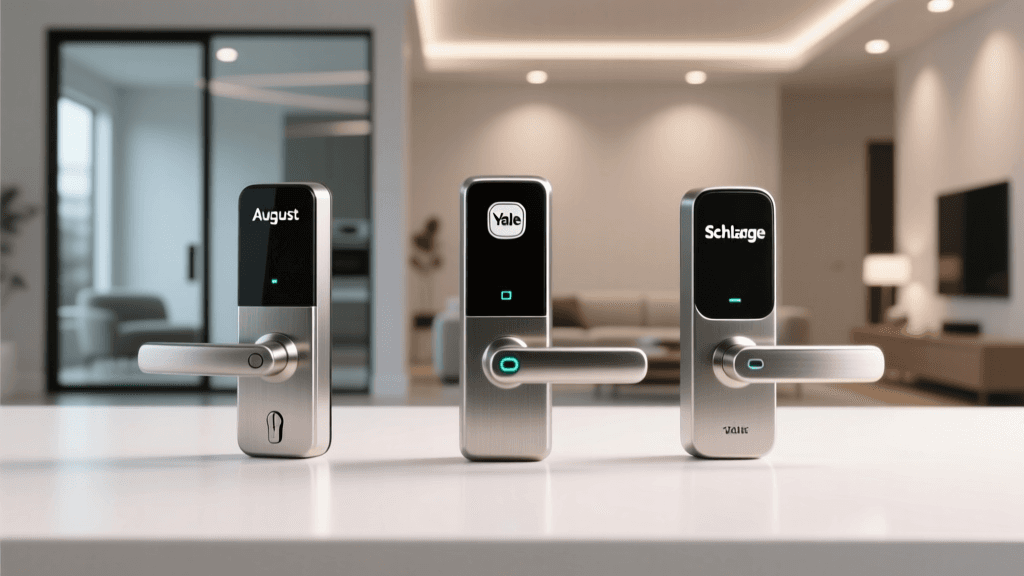
In this multi-product showdown, we are putting three of the most dominant premium smart locks head-to-head: the August Wi-Fi Smart Lock (4th Generation), the Schlage Encode Plus, and the Yale Assure Lock 2. Each of these devices represents a fundamentally different philosophy in smart home hardware design, from retrofit ingenuity to heavy-duty physical security and modular minimalism. By analyzing their installation requirements, ecosystem compatibility, physical security benchmarks, and long-term reliability, we will determine which lock deserves a spot on your front door.
Meet the Contenders
August Wi-Fi Smart Lock (4th Gen)
August, now owned by Assa Abloy, pioneered the retrofit smart lock category. The 4th Generation Wi-Fi model is designed to attach to the interior thumb-turn of your existing deadbolt, meaning you keep your original exterior hardware and keys. It features built-in Wi-Fi, Bluetooth, and August's proprietary DoorSense technology, which uses a magnetic sensor to detect whether the door is physically closed, not just locked.
Schlage Encode Plus
Schlage, an Allegion brand, is synonymous with heavy-duty physical security. The Encode Plus is a full deadbolt replacement that features built-in Wi-Fi and a capacitive touchscreen keypad. Its standout feature is native support for Apple Home Key, allowing users to tap their iPhone or Apple Watch to unlock the door via NFC, even if the device's battery is in power reserve mode. It is built like a tank and carries the highest residential security ratings available.
Yale Assure Lock 2
Yale, also part of the Assa Abloy family, focuses on sleek aesthetics and modularity. The Assure Lock 2 is available in both keypad and touchscreen variants and features a radically slim profile. Its defining characteristic is its modular smart cartridge system, allowing users to swap out the internal connectivity module (Wi-Fi, Z-Wave, or HomeKit) without replacing the entire lock. It is the go-to choice for design-conscious homeowners and those with custom or narrow-stile doors.
Head-to-Head Specification Table
| Feature | August Wi-Fi (4th Gen) | Schlage Encode Plus | Yale Assure Lock 2 |
|---|---|---|---|
| Installation Type | Retrofit (Interior Only) | Full Deadbolt Replacement | Full Deadbolt Replacement |
| ANSI/BHMA Grade | Unrated (Depends on existing bolt) | Grade 1 (Highest) | Grade 2 (Mid-Tier) |
| Exterior Keypad | Sold Separately | Built-in Touchscreen | Built-in (Keypad or Touch) |
| Connectivity | Wi-Fi / Bluetooth | Wi-Fi / Bluetooth / Thread | Modular (Wi-Fi / Z-Wave / HomeKit) |
| Apple Home Key | No | Yes | No (Standard HomeKit only) |
| Power Source | 2x CR123A Lithium | 4x AA Alkaline | 4x AA or Lithium Ion |
Installation and Hardware Design
The installation process is where these three locks diverge most dramatically. The August Wi-Fi Smart Lock is the undisputed champion of renter-friendly and low-effort installation. Because it only replaces the interior thumb-turn, the entire process takes roughly 10 to 15 minutes. You simply remove your existing interior hardware, attach the August mounting plate, and snap the device into place. The primary challenge is calibrating the DoorSense magnet, which requires drilling a small hole in your door frame to ensure accurate open/close reporting.
Conversely, both the Schlage Encode Plus and Yale Assure Lock 2 require a complete deadbolt replacement. This involves removing the existing interior and exterior hardware, extracting the latch assembly, and ensuring your door's backset (the distance from the edge of the door to the center of the bore hole) is correctly adjusted. Schlage's installation is generally straightforward, aided by an included alignment tool that helps prevent the bolt from binding against the strike plate. However, the Schlage unit is physically bulky, which can cause clearance issues if you have a storm door or a narrow door jamb.
The Yale Assure Lock 2 addresses the bulkiness issue with an incredibly slim profile. Its exterior is barely larger than a traditional keyhole, making it ideal for modern, minimalist aesthetics or doors with limited clearance. However, Yale's modular cartridge system adds a step to the installation process, as you must ensure the internal wiring harness is securely seated before snapping the connectivity module into place.
Smart Home Ecosystem and App Experience
A smart lock is only as good as the software that controls it. August's app remains the gold standard for geofencing and auto-unlock reliability. When you approach your home, the August app uses a combination of GPS and Bluetooth RSSI (Received Signal Strength Indicator) to wake the lock and prepare it for entry. This means the door typically unlocks the exact moment you pull on the handle, without requiring you to pull out your phone.
The Schlage Encode Plus leverages the Schlage Home app, which is functional but occasionally sluggish compared to August. However, Schlage dominates the Apple ecosystem. If you are deeply embedded in Apple HomeKit, the Encode Plus is a mandatory upgrade. The Apple Home Key feature stores a digital key in your Apple Wallet. Tapping your iPhone or Apple Watch to the lock uses NFC, providing a tactile, instantaneous unlock that feels vastly superior to waiting for Bluetooth geofencing to trigger.
The Yale Assure Lock 2 utilizes the Yale Access app, which is actually a rebranded version of the August app, meaning it shares the same excellent auto-unlock algorithms. However, Yale's ecosystem compatibility is dictated by the cartridge you purchase. If you buy the HomeKit module, you lose remote Wi-Fi access unless you have an Apple TV or HomePod acting as a hub. If you buy the Wi-Fi module, you gain remote access but lose native HomeKit support. This fragmentation can be frustrating for users who want both native Apple integration and direct cloud connectivity without relying on a hub.
The industry is slowly moving toward unification. The introduction of the Matter protocol, overseen by the Connectivity Standards Alliance (CSA), has begun to unify these fragmented ecosystems. While Thread support is slowly rolling out to newer iterations of these locks via firmware updates, buyers should verify current Matter compatibility on the packaging, as early production runs of these specific models relied heavily on proprietary cloud integrations.
Security Benchmarks and Network Safety
When evaluating physical security, industry professionals look to the Builders Hardware Manufacturers Association (BHMA) and ANSI grading standards. The Schlage Encode Plus boasts an ANSI Grade 1 rating, the highest available. It is tested to withstand 10 strikes of 75 pounds of force and 250,000 lock/unlock cycles. It also features a reinforced strike plate with 3-inch screws that anchor directly into the structural stud of your door frame, making it highly resistant to kick-in attacks.
The Yale Assure Lock 2 carries an ANSI Grade 2 rating, which is standard for premium residential locks. It survives 5 strikes of 75 pounds and 150,000 cycles. While slightly less robust than the Schlage, it is more than adequate for standard residential threats. The August Wi-Fi lock is unrated because it relies entirely on the physical deadbolt already installed in your door. If your existing deadbolt is a cheap, hollow builder-grade lock, August will not improve your physical security; it will only make it smart.
On the digital front, smart locks are IoT devices that require network security hygiene. To protect your network from potential vulnerabilities, the Federal Trade Commission (FTC) recommends isolating smart home devices on a guest network or a dedicated IoT VLAN. This ensures that if a vulnerability is exploited in the lock's Wi-Fi radio, attackers cannot pivot to your primary devices, such as laptops or NAS drives. All three locks utilize AES 128-bit or 256-bit encryption for Bluetooth and cloud communications, making digital interception highly unlikely.
Power Management and Battery Life
Battery life is the most common pain point for smart lock owners. The physical act of throwing a heavy brass deadbolt requires significant torque, which drains batteries rapidly.
The August Wi-Fi uses two CR123A lithium batteries. While lithium batteries offer excellent performance in extreme cold, the August's constant Wi-Fi polling and Bluetooth scanning typically drain these batteries in 3 to 5 months. Replacing them can be costly compared to standard alkaline cells.
The Schlage Encode Plus uses four standard AA alkaline batteries. Thanks to a more efficient power management chip and the fact that it relies on your home's Wi-Fi router for heavy lifting rather than maintaining a constant high-power state, it consistently achieves 6 to 9 months of battery life. Furthermore, AA batteries are cheap and easy to source in an emergency.
The Yale Assure Lock 2 also uses four AA batteries, but its slim design means the battery compartment is cramped. If you opt for the touchscreen version, the backlight and capacitive grid draw extra power, often reducing battery life to just 3 to 6 months. Yale does offer an optional rechargeable lithium-ion battery pack, which is highly recommended to reduce waste and ensure consistent voltage output.
Pricing and Long-Term Value
Premium smart locks are a significant investment. The August Wi-Fi Smart Lock typically retails between $180 and $230. However, if you want exterior keypad access, you must purchase the August Smart Keypad separately, pushing the total cost closer to $280.
The Schlage Encode Plus is the most expensive of the trio, frequently hovering around the $299 mark. You are paying for the ANSI Grade 1 hardware, the built-in touchscreen, and the Apple Home Key licensing. Given its durability and all-in-one packaging, it offers excellent long-term value for homeowners planning to stay in their homes for a decade or more.
The Yale Assure Lock 2 pricing varies based on the chosen module and finish. The keypad version starts around $239, while the touchscreen version can reach $279. Upgrading to the rechargeable battery kit or purchasing specialized smart cartridges later can increase the total cost of ownership, but its aesthetic appeal justifies the premium for design-focused buyers.
Final Verdict: Which Lock Should You Buy?
There is no single 'best' smart lock; the right choice depends entirely on your living situation, ecosystem preferences, and design requirements.
- Choose the August Wi-Fi Smart Lock if: You are a renter, you want to keep your existing exterior hardware, or you prioritize the most reliable Bluetooth geofencing and auto-unlock experience on the market. It is the ultimate retrofit solution.
- Choose the Schlage Encode Plus if: You are an Apple user who wants the magic of Apple Home Key, you demand the highest possible physical security (ANSI Grade 1), and you prefer the convenience of an all-in-one package with a built-in keypad and standard AA batteries.
- Choose the Yale Assure Lock 2 if: You have a custom door, narrow jambs, or storm doors where bulky locks will not fit. It is the best choice for minimalists who prioritize sleek aesthetics and want the flexibility to change their smart home connectivity module in the future.
By aligning your purchase with your specific hardware constraints and digital ecosystem, any of these three premium locks will drastically elevate your home's security and daily convenience.