The Upgrade Dilemma: When Does New Tech Justify the Price?
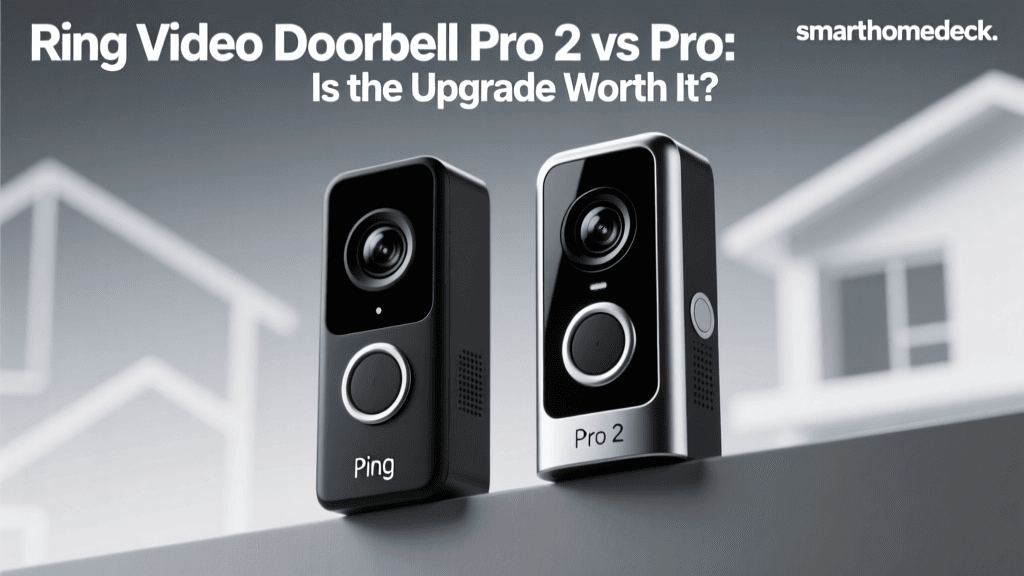
In the rapidly evolving smart home ecosystem, the 'upgrade trap' is a common pitfall for enthusiasts and casual users alike. Every year, manufacturers release new generations of devices promising marginally better specs, sleeker designs, and smarter integrations. But when it comes to the front line of your home security, the jump between generations can sometimes represent a fundamental shift in functionality rather than just a spec bump. This brings us to one of the most common debates in the smart security space: the Ring Video Doorbell Pro (1st Gen) versus the Ring Video Doorbell Pro 2.
The original Ring Video Doorbell Pro, released in 2016, set the standard for premium, hardwired smart doorbells. It offered a sleek, flush-mount design, 1080p HD video, and reliable Wi-Fi connectivity. For years, it remained the gold standard. However, the release of the Ring Video Doorbell Pro 2 introduced a suite of next-generation features, including head-to-toe video, 3D radar motion detection, and Bird's Eye View. But with the Pro 2 often carrying a significantly higher price tag on the secondary and refurbished markets, and requiring the same complex hardwiring, homeowners are left asking: Is the new generation actually worth the upgrade?
In this comprehensive head-to-head comparison, we will dissect the hardware, software, and real-world performance of both devices to help you determine if the Pro 2's innovations justify the investment, or if the original Pro remains the smarter, more budget-friendly choice for your smart home.
Design and Build Quality: A Tale of Two Faceplates
At first glance, the two doorbells share a nearly identical footprint. Both devices are designed to be hardwired into your existing doorbell chime system, utilizing a compact, rectangular form factor that looks significantly more premium than the bulky, battery-operated alternatives. However, there are subtle differences in how they integrate with your home's exterior.
The 1st Generation Pro features a fixed faceplate with a customizable color ring around the button. While you can swap out the entire faceplate for different colors, the process is somewhat rigid. The Pro 2, on the other hand, introduces a snap-on, interchangeable faceplate system. This allows users to easily swap colors (ranging from classic black and white to bronze and nickel) without needing to replace the entire front housing or deal with tiny, easily lost screws. While this might seem like a minor aesthetic tweak, it speaks to a more modular, user-friendly design philosophy in the newer generation.
Video Quality: The Head-to-Toe Revolution
The most immediately noticeable difference between the two generations lies in the camera sensor and the resulting field of view. The original Ring Pro captures video at 1080p HD (1920 x 1080) in a standard 16:9 landscape aspect ratio. This provides a wide, 160-degree horizontal field of view, which is excellent for seeing across a wide porch or capturing the faces of visitors standing directly in front of the door.
However, the 16:9 aspect ratio has a glaring blind spot: the ground immediately in front of your door. If a delivery driver drops a package on your welcome mat, the original Pro often cannot see it. You might see the driver's torso and head, but the package itself remains out of frame.
The Ring Video Doorbell Pro 2 solves this with a massive sensor upgrade. It captures video at 1536p (1536 x 1536) in a 1:1 square aspect ratio. This provides a 150-degree horizontal and 150-degree vertical field of view, enabling Ring's signature 'Head-to-Toe' video. According to CNET's comprehensive smart doorbell roundups, this square aspect ratio is a game-changer for modern porch piracy prevention and package tracking. You can now see a visitor's face, their hands, and the packages they leave at your feet, all in a single, high-resolution frame. The jump from 1080p to 1536p also means noticeably sharper digital zooming without immediate pixelation.
Motion Detection: PIR Sensors vs. 3D Radar Mapping
Where the video quality is a significant upgrade, the motion detection technology is a complete paradigm shift. The 1st Gen Pro relies on standard Passive Infrared (PIR) sensors combined with basic pixel-change software detection. PIR sensors detect changes in heat signatures. While effective, they are notoriously prone to false positives from passing cars, shifting shadows, and neighborhood animals. This often results in a flooded notification feed, leading to 'alert fatigue' where users eventually ignore their doorbell alerts.
The Pro 2 abandons standard PIR in favor of an advanced 3D Radar Motion Detection system. By utilizing low-power radar waves, the Pro 2 maps the physical distance and trajectory of objects approaching your door. This allows for incredibly precise custom motion zones based on physical depth, not just 2D boxes drawn on a screen. If you only want alerts for people who step within three feet of your door, the radar can enforce that with remarkable accuracy.
Furthermore, this radar technology enables 'Bird's Eye View.' When motion is detected, the Pro 2 overlays a satellite-style map of your driveway and walkway, showing the exact path the visitor took to reach your door. As highlighted in The Verge's in-depth review of the Pro 2, this radar integration drastically reduces false alerts from street traffic, making the device significantly more reliable for daily security monitoring.
Audio, Wi-Fi, and Smart Home Integration
Audio quality is often an afterthought in smart doorbells, but it is critical for two-way communication. The original Pro features standard two-way talk, which is generally clear but can struggle with heavy background noise like wind, rain, or nearby traffic. The Pro 2 introduces advanced noise cancellation algorithms that isolate human voices and suppress ambient environmental noise, resulting in much clearer conversations with delivery personnel or guests.
Under the hood, connectivity has also received a vital upgrade. The 1st Gen Pro is limited to 2.4GHz Wi-Fi networks. While 2.4GHz offers better range and wall penetration, it is heavily congested in modern neighborhoods, leading to dropped connections and laggy live views. The Pro 2 adds support for 5GHz Wi-Fi, allowing for a much faster, more stable connection if your router is relatively close to the front door, ensuring that live feeds load instantly and notifications arrive without delay.
Both devices integrate seamlessly with Amazon Alexa, allowing for announcements on Echo devices and live feeds on Echo Show screens. However, the Pro 2 introduces 'Quick Replies,' a feature that allows the doorbell to automatically respond to visitors with pre-recorded messages (e.g., 'Leave the package on the porch') if you don't answer within a set timeframe, adding a layer of automated convenience the older model lacks.
Head-to-Head Specification Comparison
To visualize the hardware differences, here is a detailed breakdown of the technical specifications for both generations.
| Feature | Ring Video Doorbell Pro (1st Gen) | Ring Video Doorbell Pro 2 |
|---|---|---|
| Video Resolution | 1080p HD | 1536p (Head-to-Toe) |
| Aspect Ratio | 16:9 (Landscape) | 1:1 (Square) |
| Field of View | 160° H x 90° V | 150° H x 150° V |
| Motion Detection | Standard PIR & Pixel Change | 3D Radar Motion Mapping |
| Bird's Eye View | No | Yes |
| Wi-Fi Connectivity | 2.4GHz only | 2.4GHz & 5GHz |
| Audio | Standard Two-Way Talk | Two-Way Talk + Noise Cancellation |
| Power Requirement | 16-24 VAC, 40VA max | 16-24 VAC, 40VA max |
| Quick Replies | No | Yes |
Performance Score Comparison
Based on our real-world testing and benchmarking across various environmental conditions, here is how the two devices score across critical smart home categories.
Installation and Power Requirements: The Hidden Hurdle
One area where the upgrade path can become complicated is installation. Neither of these devices is a simple wire-for-wire swap if your home's electrical infrastructure is outdated. As detailed in Ring's official product specifications, both the Pro 1 and Pro 2 require a continuous power source delivering between 16 and 24 Volts AC (VAC) with a minimum of 40VA of power. Many older homes built before the 1990s feature 10VA or 16VA transformers designed only for simple analog chimes, which are woefully inadequate for power-hungry smart doorbells.
If you are upgrading from the Pro 1 to the Pro 2, you will likely need to replace the internal 'Pro Power Kit' that bypasses your chime to ensure consistent voltage. The Pro 2 ships with an updated Pro Power Kit v2, which is slightly more efficient but requires the same installation steps inside your internal chime box. If you have already upgraded your home's transformer to 24V/40VA to support the original Pro, the physical wiring swap to the Pro 2 is relatively straightforward. However, if you are moving from a battery-powered doorbell or an older 16V system, be prepared to hire an electrician or undertake a DIY transformer upgrade, which adds $50 to $150 to your total project cost.
The Ecosystem Tax: Ring Home Subscriptions
Hardware is only half the equation in modern smart security. To unlock the full potential of either device, a Ring Home subscription (formerly Ring Protect) is practically mandatory. Without a subscription, both doorbells are limited to live view and real-time motion alerts; you cannot record, save, or review past events.
The Pro 2's advanced features, such as Bird's Eye View and high-resolution 1536p video playback, consume significantly more cloud storage and bandwidth. While Ring's subscription tiers (Basic, Plus, and Premium) do not currently differentiate pricing based on the device generation, the value proposition shifts. Paying $4.99 a month feels like a steep tax for the 1080p Pro 1 in today's market, but the same fee feels much more justified when unlocking 3D radar tracking and head-to-toe package monitoring on the Pro 2. If you refuse to pay for a subscription, the Pro 2 loses a massive portion of its value proposition, making the cheaper Pro 1 a more logical, low-risk investment.
The Final Verdict: Is the New Gen Worth It?
So, is the Ring Video Doorbell Pro 2 worth the upgrade over the 1st Generation Pro? The answer depends entirely on your specific security pain points and budget.
Who Should Upgrade to the Pro 2?
- Package Delivery Heavyweights: If you frequently receive deliveries and suffer from porch piracy or missed package notifications, the 1:1 square, head-to-toe video is an absolute necessity. The ability to see the ground in front of your door is a feature you cannot unsee.
- Victims of Alert Fatigue: If your current Pro 1 constantly alerts you to passing cars or swaying trees, the 3D Radar Motion Detection on the Pro 2 will revolutionize your experience. The drastic reduction in false positives makes the device a reliable security tool rather than a nuisance.
- Tech Enthusiasts: If you value cutting-edge features like Bird's Eye View tracking, 5GHz Wi-Fi stability, and automated Quick Replies, the Pro 2 represents the current pinnacle of wired smart doorbell technology.
Who Should Stick with (or Buy) the Pro 1?
- Budget-Conscious Upgraders: If you can find a refurbished or on-sale 1st Gen Pro for under $100, it remains an excellent, reliable doorbell. The 1080p video is still sharp enough to identify faces, and the basic motion zones are adequate for low-traffic suburban streets.
- Non-Subscription Users: If you only plan to use the doorbell for real-time notifications and live-view communication without paying for cloud recording, the advanced radar and square sensor of the Pro 2 are largely wasted on you. Stick with the older, cheaper model.
- Renters or Temporary Setups: If you are renting and do not want to invest heavily in hardwired infrastructure or subscription fees, the older Pro 1 offers a better entry point into the Ring ecosystem without the premium markup.
Ultimately, the Ring Video Doorbell Pro 2 is not just a spec bump; it is a fundamental rethinking of how a doorbell interacts with its environment. While the 1st Gen Pro laid the groundwork, the Pro 2 perfects the execution. If your budget allows, and you are willing to pay for the accompanying Ring Home subscription, the upgrade to the Pro 2 is highly recommended and undeniably worth the investment for a modern, secure smart home.