The Upgrade Dilemma: Flagship vs. Previous Generation
In the rapidly evolving smart home landscape, the upgrade cycle is a constant source of debate. When a manufacturer releases a new flagship device, existing owners are immediately faced with a critical question: Does the new hardware offer enough tangible improvements to justify the cost of replacing a perfectly functional previous-generation device? This is especially true for smart home security, where reliability and clarity are paramount.
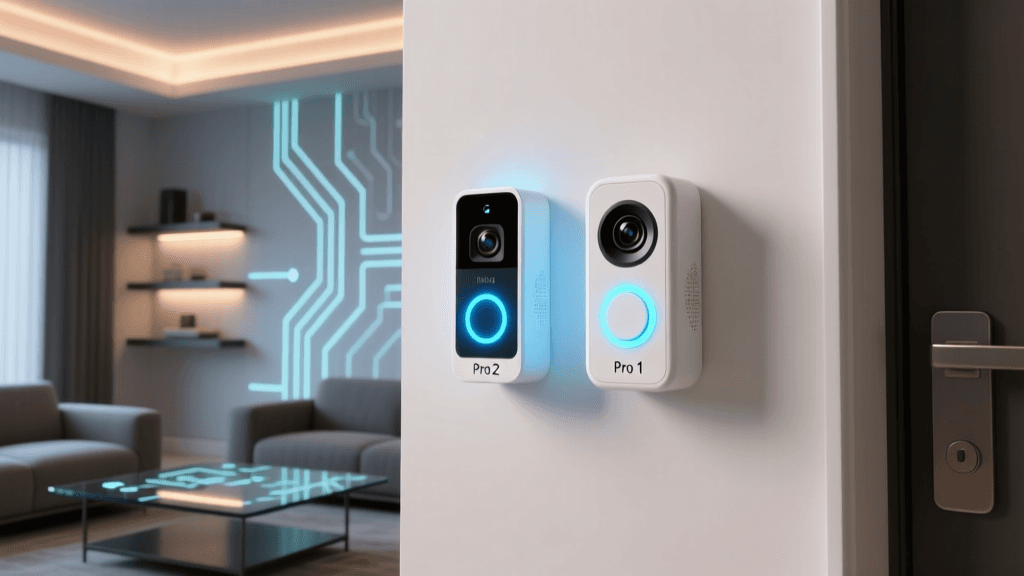
Today, we are putting the Ring Video Doorbell Pro 2 head-to-head against its predecessor, the Ring Video Doorbell Pro (1st Gen). The Pro line represents Ring’s premium, hardwired tier, aimed at enthusiasts who demand advanced features, continuous power, and deep ecosystem integration. But with the Pro 2 introducing radar-based 3D motion tracking and a radically different aspect ratio, we need to look beyond the marketing jargon. In this comprehensive upgrade test, we break down the real-world performance, installation quirks, and ecosystem compatibility to help you decide if it is time to swap out your existing doorbell.
Testing Methodology: A Side-by-Side Gauntlet
To ensure a fair and rigorous comparison, we mounted both the Ring Pro 2 and the original Ring Pro side-by-side on a test rig positioned at a standard residential entryway. Over a 30-day testing period, we subjected both devices to varying weather conditions, extreme lighting shifts, and deliberate motion triggers. We measured network latency, evaluated false-positive motion alerts, and tested the two-way audio quality against environmental noise like passing traffic and wind. Our goal was to move past spec sheets and determine how these flagship devices perform in the unpredictable real world.
Video Quality: The Shift to 1536p HD+ and Head-to-Toe Viewing
The most immediate visual difference between the two generations is the aspect ratio and resolution. The original Ring Pro utilizes a traditional 16:9 aspect ratio at 1080p HD (1920x1080). While this provides a wide, cinematic view of your front yard, it suffers from a critical blind spot: the ground immediately in front of the door. If a delivery driver places a package close to the welcome mat, the original Pro often only captures the top of their head and the top of the box.
The Ring Pro 2 completely reimagines the field of view by adopting a 1:1 square aspect ratio at 1536p HD+ (1536x1536). This 'head-to-toe' video is a massive functional upgrade for package monitoring. You can now see the delivery driver's face, their entire body, and the package resting on the mat in a single frame. Furthermore, the upgraded sensor on the Pro 2 delivers noticeably better High Dynamic Range (HDR) performance. When a delivery truck with bright headlights pulls into the driveway at dusk, the Pro 2 balances the exposure far better than the Gen 1, preventing the license plate from being washed out by lens flare.
Motion Detection: Bird’s Eye View vs. Traditional Pixel Analysis
This is where the flagship Pro 2 truly separates itself from the previous generation. The original Ring Pro relies on software-based pixel differentiation and basic PIR (Passive Infrared) heuristics to detect motion. While effective, it is prone to false positives from swaying tree branches, shadows, and passing cars, requiring users to meticulously draw 2D motion zones to mitigate spam alerts.
The Pro 2 introduces a built-in radar chip that enables 3D Motion Detection and the highly touted Bird’s Eye View. Instead of just telling you that motion occurred in a specific zone, the Pro 2 maps your property in 3D space. When a person walks up your driveway, the Ring app displays an aerial map with a dotted line showing their exact path. More importantly, the radar understands depth and object classification natively. It knows the difference between a car driving past on the street and a person walking up the path, drastically reducing false alerts without the need for complex software masking.
Pro Tip: To utilize the Bird's Eye View mapping feature effectively, the Pro 2 requires an unobstructed view of your property during the initial setup phase to calibrate its radar boundaries. Ensure your entryway does not have heavy overhead obstructions that might interfere with the radar's spatial mapping.
Hardware, Power, and Installation Realities
Both devices require hardwiring, which immediately disqualifies renters or homeowners without existing doorbell chime wiring. Both the Pro 1 and Pro 2 require a transformer delivering between 16-24 VAC and at least 30VA of power. However, the internal power management has been refined in the Pro 2.
The original Pro relies on the 'Pro Power Kit' (a small module installed at your indoor chime to bypass the circuit and ensure constant voltage). The Pro 2 ships with an updated Pro Power Kit v2, which is slightly easier to wire and features improved diagnostic LEDs. If you are upgrading from the original Pro, you will likely need to swap out the indoor power kit as well to ensure compatibility with the Pro 2's advanced features and local storage capabilities.
Spec Comparison Table
| Feature | Ring Video Doorbell Pro 2 (Flagship) | Ring Video Doorbell Pro (Previous Gen) |
|---|---|---|
| Resolution & Aspect Ratio | 1536p HD+ (1:1 Square) | 1080p HD (16:9 Widescreen) |
| Motion Technology | 3D Radar + Bird's Eye View | Standard Pixel/PIR Detection |
| Night Vision | Color Night Vision | Infrared (B&W) / Basic Color |
| Field of View | 150° (Head-to-Toe) | 160° (Wide, but cropped vertically) |
| Power Requirements | 16-24 VAC, 30VA (Hardwired) | 16-24 VAC, 30VA (Hardwired) |
| Wi-Fi Connectivity | Dual-Band (2.4 / 5 GHz) | Dual-Band (2.4 / 5 GHz) |
| Local Storage Support | Yes (Ring Edge with Home Base) | Yes (Ring Edge with Home Base) |
| Approximate Retail Price | $249.99 | $199.99 (Often discounted) |
Performance Benchmark Visualization
Based on our 30-day testing gauntlet, we scored both devices across five critical performance metrics. The chart below illustrates the generational leap in motion accuracy and video clarity.
Ecosystem Compatibility and Smart Home Integration
When investing in a flagship smart home device, ecosystem lock-in is a major consideration. Both the Pro 1 and Pro 2 are deeply integrated into the Amazon Alexa ecosystem. You can view live feeds on Echo Show devices, use Alexa routines to trigger smart lights when motion is detected, and utilize the built-in Alexa microphone on the doorbell itself for quick voice commands.
However, native Apple HomeKit support remains absent on both devices. For users heavily invested in the Apple ecosystem, integrating either Ring Pro requires third-party bridging solutions like Homebridge or Scrypted. As the industry slowly moves toward unified standards, it is worth noting that while Matter protocol adoption is expanding across the smart home industry, Ring's premium video doorbells have not yet natively embraced Matter for local, cross-platform video streaming, keeping them tethered primarily to the Ring and Alexa apps.
On the network front, both devices support dual-band Wi-Fi. We highly recommend connecting the Pro 2 to a 5GHz network if your router is within 20 feet of the doorbell. The increased bandwidth of 5GHz significantly reduces the latency when answering live rings, ensuring you don't miss a delivery driver walking back to their truck.
The Hidden Costs: Subscriptions and Network Requirements
The hardware cost is only the entry fee. To unlock the true potential of either device, a Ring Home subscription is practically mandatory. Without a subscription, you are limited to live viewing and basic motion alerts; you lose access to historical video playback, rich notifications (which show a snapshot of the motion event on your lock screen), and the ability to save clips.
- Ring Home Basic ($4.99/mo): Covers a single device with 180 days of history.
- Ring Home Plus ($10/mo): Covers all devices at one address and includes 24/7 recording capabilities (though 24/7 recording is highly dependent on continuous power and Wi-Fi stability).
- Ring Home Pro ($20/mo): Adds professional monitoring and eero Secure features.
For power users who despise cloud subscriptions, both the Pro 1 and Pro 2 support Ring Edge local storage, but only if you own a Ring Home Base or Ring Alarm Pro. This allows video to be stored locally on a microSD card, though it requires a Ring Home Plus subscription to initially activate the local storage feature—a frustrating caveat that potential upgraders must factor into their long-term cost analysis.
The Final Verdict: Should You Upgrade?
Deciding whether to upgrade from the original Ring Video Doorbell Pro to the flagship Pro 2 depends entirely on your specific pain points and security priorities. Here is our breakdown for different user profiles:
1. The Package Theft Victim (Highly Recommended to Upgrade)
If your primary motivation for a video doorbell is monitoring deliveries and deterring porch pirates, the Pro 2 is a mandatory upgrade. The 1:1 square aspect ratio ensures you actually see the packages on the ground, and the 3D Bird's Eye View provides undeniable proof of which direction a thief fled after grabbing a box. The original Pro simply cannot compete in package-level situational awareness.
2. The Tech Enthusiast (Recommended to Upgrade)
If you love granular data, spatial mapping, and cutting-edge radar technology, the Pro 2 will satisfy your urge for innovation. The radar-based motion detection feels like a genuine leap forward in smart home AI, reducing the frustration of false alerts from passing traffic.
3. The Budget-Conscious General User (Hold Off on Upgrading)
If your original Ring Pro is working well, you only care about seeing who is at the door when the bell rings, and you aren't overly concerned with ground-level package monitoring, the $50+ upgrade cost (plus potential electrician fees if your transformer needs upgrading) is hard to justify. The 1080p video on the original Pro is still highly competent for basic facial recognition and two-way communication.
Ultimately, the Ring Video Doorbell Pro 2 is not just an iterative spec bump; it is a fundamental rethinking of how a doorbell perceives its environment. By shifting from reactive pixel-detection to proactive 3D spatial mapping, Ring has solidified the Pro 2's position as the premier flagship doorbell on the market, leaving the previous generation feeling distinctly outdated in the realm of automated security.