The Battle for Your Wall Plate
Upgrading to a smart thermostat is one of the most impactful home automation decisions you can make. According to the U.S. Department of Energy, heating and cooling account for nearly half of the average home's energy consumption. A premium smart thermostat does not just offer remote control via your smartphone; it actively learns your habits, utilizes geofencing, and leverages room sensors to optimize your HVAC system, ultimately reducing your carbon footprint and utility bills.
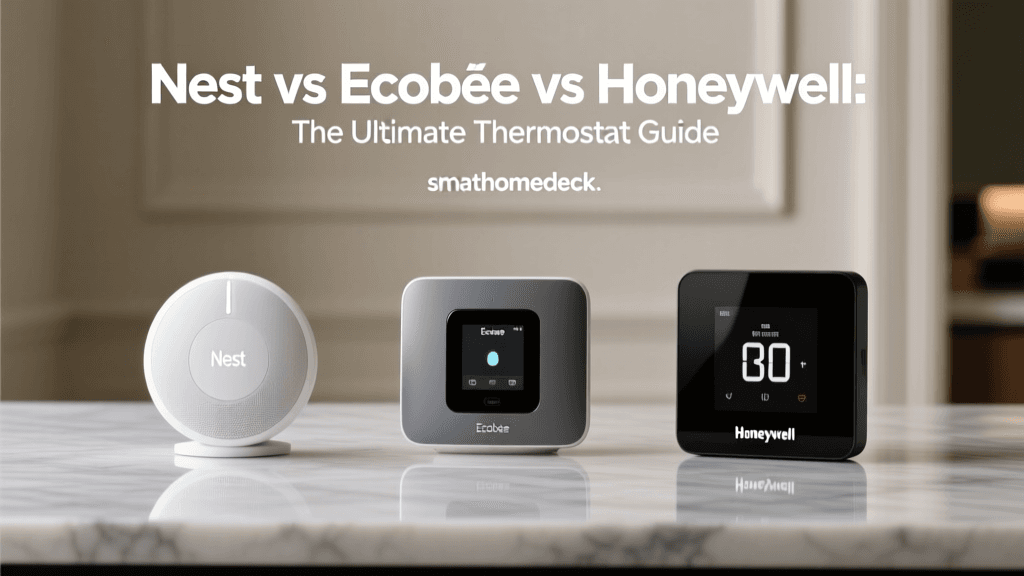
However, the market is dominated by three distinct philosophies, each championed by a legacy brand. In this multi-product showdown, we are putting the industry titans head-to-head: the Google Nest Learning Thermostat, the Ecobee SmartThermostat Premium, and the Honeywell Home T9. Whether you are deeply embedded in the Apple HomeKit ecosystem, a Google Home purist, or a homeowner struggling with multi-zone temperature imbalances, this comprehensive comparison will help you decide which device deserves a spot on your wall.
Meet the Contenders
Google Nest Learning Thermostat
The device that started the smart home revolution. The Nest Learning Thermostat is famous for its iconic circular design, premium materials, and its signature 'auto-schedule' feature. It relies heavily on machine learning to observe your manual adjustments over a week or two, eventually building a custom heating and cooling schedule that runs on autopilot. It is the undisputed king of aesthetic integration and passive automation.
Ecobee SmartThermostat Premium
Ecobee has long been the favorite among smart home enthusiasts who prioritize granular control and broad ecosystem compatibility. The Premium model is a powerhouse that doubles as a high-fidelity smart speaker with Alexa built directly into the wall unit. It relies on a network of external room sensors that detect both temperature and occupancy to ensure the rooms you are actually using are the ones being conditioned.
Honeywell Home T9
Honeywell brings decades of traditional HVAC expertise to the smart home space. The T9 is designed with a more utilitarian, rectangular aesthetic, but its true strength lies in its advanced multi-room prioritization. It allows users to set specific rooms to 'priority' based on occupancy or a fixed schedule, making it a formidable choice for large, multi-story homes with chronic hot and cold spots.
Design, Display, and Build Quality
When it comes to physical hardware, the three brands take drastically different approaches to industrial design.
The Nest Learning Thermostat is a masterpiece of minimalism. Featuring a heavy stainless steel outer ring that doubles as a physical dial, it feels incredibly premium. The glass face houses a vibrant, full-color LCD screen. Nest's 'Farsight' feature detects when you walk into the room and illuminates the display with your target temperature, the current weather, or an analog clock face. It is designed to be a piece of jewelry for your wall.
The Ecobee SmartThermostat Premium opts for a modern 'squircle' (square-circle) shape with a glossy black glass front. It lacks physical moving parts, relying entirely on a responsive capacitive touchscreen and a side-mounted volume dial for its smart speaker functions. While it looks sleek and modern, the glossy black finish is a magnet for fingerprints and dust, requiring more frequent cleaning than the Nest.
The Honeywell Home T9 embraces a traditional, rectangular thermostat footprint. It features a matte white finish with a crisp, full-color touchscreen. It is intentionally unobtrusive, designed to blend into the background rather than stand out. While it may lack the wow-factor of the Nest's metal dial, its familiar shape makes it an easy psychological transition for users upgrading from older, programmable Honeywell units.
Smart Home Ecosystem Compatibility
A smart thermostat is only as good as the ecosystem it lives in. Here is how the three devices handle voice assistants and smart home protocols:
- Google Nest: Unsurprisingly, the Nest is deeply integrated with Google Home and Google Assistant. It supports Matter, ensuring future-proofing, but it lacks native support for Apple HomeKit. While workarounds like Homebridge exist, Apple purists will find the Nest frustrating to integrate into their primary automation routines.
- Ecobee Premium: The most versatile of the trio. It features native support for Apple HomeKit, Google Assistant, and Amazon Alexa (which is also built directly into the hardware). It also supports IFTTT and SmartThings, making it the ultimate hub-agnostic device. Matter support is available via firmware updates.
- Honeywell T9: Works seamlessly with Amazon Alexa and Google Assistant. However, like the Nest, it lacks native Apple HomeKit support. It integrates well with Honeywell's broader home security and air quality lineups but feels slightly more closed-off than the Ecobee.
Energy Savings and Algorithmic Efficiency
All three thermostats carry the EPA Energy Star certification, meaning they meet strict criteria for energy efficiency. However, their methods for achieving these savings differ significantly.
Nest uses its 'Auto-Schedule' and 'Home/Away Assist' (leveraging phone GPS and built-in radar) to aggressively turn off the HVAC system when the house is empty. Ecobee uses its 'eco+' software, which factors in local utility time-of-use rates, weather forecasts, and home insulation data to shift heating and cooling to off-peak hours. Honeywell relies heavily on geofencing and its smart sensors to ensure energy is not wasted on empty rooms.
Based on aggregated user data and Energy Star averages for smart thermostat categories, here is how they compare in estimated annual HVAC energy savings:
The Sensor Showdown: Multi-Zone Comfort
The thermostat in your hallway might read 72°F, but your upstairs bedroom could be sweltering at 78°F. This is where external room sensors become the most critical feature of a modern smart thermostat. The hardware capabilities of the sensors included with (or sold for) these units vary wildly.
| Feature | Nest Temperature Sensor | Ecobee SmartSensor | Honeywell T9 Smart Sensor |
|---|---|---|---|
| Temperature Detection | Yes | Yes | Yes |
| Occupancy Detection | No (Relies on schedule) | Yes (PIR Sensor) | Yes (PIR Sensor) |
| Humidity Detection | No | No | Yes |
| Battery Life | ~2 Years (CR2) | ~5 Years (CR2032) | ~1 Year (CR2032) |
| Multi-Room Priority | Schedule-based only | Occupancy & Schedule | Occupancy & Priority Rules |
Analysis: The Ecobee SmartSensor is the gold standard for daily use. Because it detects occupancy, it knows when you enter a room and immediately tells the thermostat to prioritize that space, regardless of the time of day. The Honeywell T9 sensor is incredibly advanced, adding humidity monitoring which is vital for homes in extreme climates. The Nest Temperature Sensor is the weakest of the three; it lacks occupancy detection, meaning you must manually program a schedule telling the Nest which room to prioritize at which time of day.
Installation and the Dreaded C-Wire
Before purchasing any smart thermostat, you must check your wall wiring for a C-Wire (Common Wire), which provides continuous 24V power to the device's Wi-Fi radio and display.
Nest advertises that it can operate without a C-Wire by 'power stealing' from the heating and cooling wires. However, this often leads to short-cycling issues with modern HVAC systems. Google now sells a separate Nest Power Connector to solve this, adding to the overall cost and installation complexity.
Ecobee includes a Power Extender Kit (PEK) in the box. If you lack a C-Wire, the PEK plugs into your HVAC control board and multiplexes the signal over existing wires. It is a brilliant, cost-saving inclusion that makes Ecobee the most reliable choice for older homes.
Honeywell is strict: the T9 requires a C-Wire for proper operation. While it includes a C-Wire adapter in the box, the installation process at the furnace control board is generally considered more complex and less forgiving than Ecobee's PEK.
Pricing and Long-Term Value
When evaluating cost, you must look beyond the base unit and consider the price of expanding the sensor network.
The base units for all three thermostats generally hover in the premium $200 to $250 range, though frequent sales can drop the Nest and Ecobee closer to $180. The real cost divergence happens when you buy additional sensors.
- Nest: Sensors are sold in packs of three for roughly $100. Given their lack of occupancy sensors, the value proposition drops significantly for larger homes.
- Ecobee: Sensors are sold in packs of two for roughly $80. Considering they include occupancy detection and boast a five-year battery life, they offer excellent long-term value.
- Honeywell: Sensors are sold in packs of one or two, typically ranging from $40 to $70. The inclusion of humidity sensors justifies the price, but the shorter battery life means higher maintenance over time.
Final Verdict: Which Should You Choose?
There is no single 'best' thermostat; there is only the best thermostat for your specific home and digital lifestyle.
Choose the Google Nest Learning Thermostat if:
You are heavily invested in the Google Home ecosystem, you prioritize stunning industrial design, and you prefer a 'set it and forget it' approach where the machine learning algorithm handles the scheduling for you. It is best suited for smaller homes or open-concept layouts where a single sensor is enough to manage the climate.
Choose the Ecobee SmartThermostat Premium if:
You want maximum ecosystem flexibility (especially if you use Apple HomeKit), you want the convenience of an Alexa smart speaker built into the wall, and you need reliable occupancy-based room sensors to manage a home with distinct hot and cold zones. The inclusion of the PEK for C-Wire issues makes it the safest bet for older homes.
Choose the Honeywell Home T9 if:
You live in a large, multi-story home where humidity control is just as important as temperature. The T9's advanced prioritization rules and humidity-sensing room sensors make it the ultimate tool for micro-managing the climate in sprawling properties, provided you have the C-Wire infrastructure to support it.