The Promise of Matter: True Interoperability
For over a decade, the smart home industry has been plagued by fragmentation. Consumers were forced to choose sides: Apple HomeKit, Google Home, Amazon Alexa, or Samsung SmartThings. If you bought a Zigbee bulb, it might not work with your Wi-Fi hub. If you bought a camera, it might be locked to a proprietary app. This era of walled gardens created friction, stifled innovation, and ultimately slowed down the widespread adoption of smart home technology. Enter Matter.
Developed by the Connectivity Standards Alliance (CSA), Matter is an open-source, IP-based connectivity protocol designed to unify the smart home. Built on the same foundational technology as the internet (IPv6), Matter ensures that certified devices can communicate seamlessly regardless of the ecosystem you use to control them. Whether you are an avid Apple user, a dedicated Google Home fan, or an Alexa power user, Matter-compatible devices will work right out of the box, often simultaneously across multiple platforms.
In this comprehensive buyer's guide, we break down the best Matter-compatible devices across essential categories: hubs, lighting, smart plugs, and sensors. We will also dive deep into the underlying protocols—specifically Thread versus Wi-Fi—to help you build a robust, future-proof smart home network.
Quick Comparison: Top Matter-Compatible Devices
Before diving into detailed reviews, here is a quick snapshot of our top picks for building a Matter-based smart home. This table highlights the primary protocol used by each device and its ideal use case.
| Device | Category | Protocol | Approx. Price | Best For |
|---|---|---|---|---|
| Apple TV 4K (Ethernet) | Hub / Border Router | Wi-Fi / Thread | $149 | Apple ecosystem & Thread routing |
| Amazon Echo Hub | Hub / Controller | Wi-Fi / Zigbee / Thread | $179 | Wall-mounted control & Alexa |
| SwitchBot Hub 2 | Hub / IR Blaster | Wi-Fi / Thread | $99 | Integrating legacy IR devices |
| Nanoleaf Essentials A19 | Smart Lighting | Thread | $29 | Vibrant colors & mesh networking |
| Eve Energy | Smart Plug | Thread | $49 | Privacy & energy monitoring |
| Aqara Door/Window Sensor P2 | Sensor | Thread | $39 | Ultra-fast automation triggers |
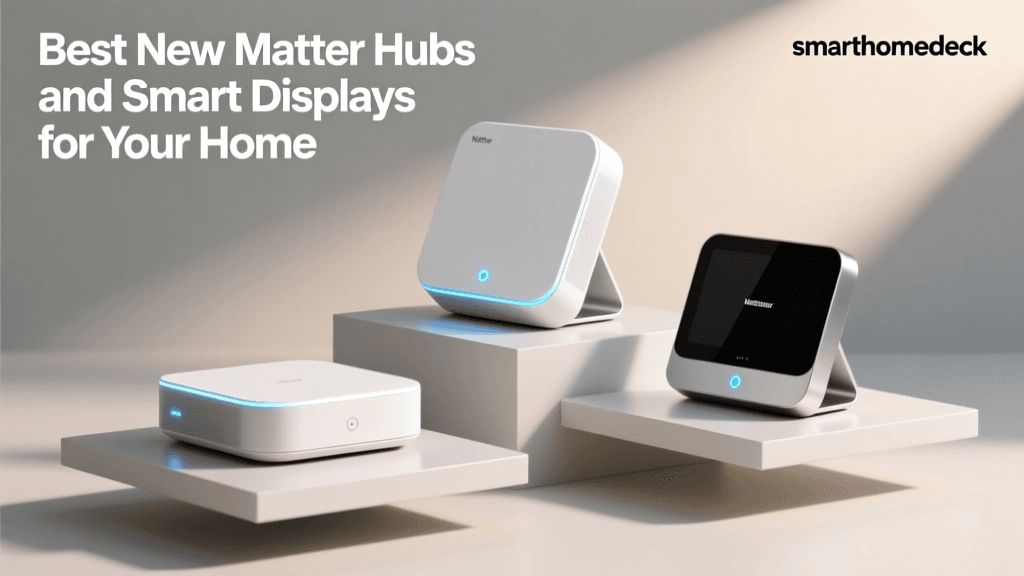
Best Matter Hubs and Border Routers
While Matter is designed to be decentralized, you still need a central point of control to manage automations, remote access, and act as a 'Border Router' for Thread devices. A Thread Border Router bridges your low-power mesh network to your home's Wi-Fi and the broader internet.
1. Apple TV 4K (Ethernet Model)
The Apple TV 4K (specifically the 128GB Ethernet model) remains one of the most powerful and reliable Matter controllers and Thread Border Routers available. By connecting directly to your router via Ethernet, it frees up Wi-Fi bandwidth and provides a rock-solid backbone for your Thread mesh network. It supports Matter natively, allowing you to pair third-party devices directly into the Apple Home app using a simple QR code scan.
- Pros: Incredible processing power, native Thread Border Router, seamless HomeKit/Matter integration, doubles as a premium streaming device.
- Cons: The Wi-Fi-only model lacks Thread routing capabilities; premium price point.
2. Amazon Echo Hub
Amazon's Echo Hub is designed to be the ultimate wall-mounted smart home control panel. It features an 8-inch adaptive display that adjusts its interface based on your proximity. Crucially, it acts as a Matter controller and includes built-in radios for Zigbee, Thread, and Wi-Fi. This makes it an incredible bridge for users transitioning from older Zigbee devices to the new Matter standard while maintaining a sleek, centralized control point.
- Pros: Beautiful wall-mountable design, supports multiple protocols (Zigbee, Thread, Matter), adaptive display.
- Cons: Requires a wired power connection or specialized wall mount; heavily tied to the Alexa ecosystem.
3. SwitchBot Hub 2
SwitchBot carved out a niche by bridging the gap between modern smart home tech and legacy appliances. The Hub 2 is a Matter-over-Thread border router that also features a built-in IR blaster and temperature/humidity sensors. This means you can expose your 'dumb' air conditioner or TV to Apple Home, Google Home, or Alexa via Matter, while simultaneously using the Hub 2 to route Thread signals for your smart bulbs and sensors.
- Pros: Built-in IR learning, smart IR-to-Matter bridging, compact design, includes environmental sensors.
- Cons: App interface can be cluttered; requires USB-C power.
Chart: Price vs. Protocol Support in Matter Hubs
Best Matter-Over-Thread Lighting
Lighting is the most popular entry point into the smart home. With Matter-over-Thread, smart bulbs no longer clog up your Wi-Fi router, and they respond to commands almost instantaneously.
1. Nanoleaf Essentials A19 (Thread)
Nanoleaf was one of the first manufacturers to fully embrace the Thread protocol. The Essentials A19 bulb delivers up to 800 lumens of brightness and features an impressive color gamut. Because it uses Thread, adding the bulb to your network actually strengthens the mesh, improving the reliability of other Thread devices in your home. The color tuning is smooth, and the 'Circadian Lighting' features mimic the natural progression of sunlight to support your sleep cycle.
- Pros: Excellent color accuracy, Thread mesh networking, affordable price point, works natively with Apple and Google.
- Cons: Requires a Thread Border Router for full functionality; physical bulb design is slightly bulky.
2. Philips Hue (via Matter Bridge)
While Philips Hue bulbs natively use Zigbee, the Philips Hue Bridge received a firmware update that allows it to act as a Matter bridge. This means your entire existing Hue ecosystem—including hundreds of bulbs, light strips, and outdoor fixtures—can be exposed to Matter-compatible platforms. The reliability of the Hue system remains unmatched, and bridging it via Matter allows you to control your premium lighting setup from any platform without sacrificing the advanced features like dynamic scenes and entertainment sync.
- Pros: Unmatched reliability, massive ecosystem, premium light quality, bridges existing Zigbee devices to Matter.
- Cons: Requires the $60 Hue Bridge; higher cost per bulb compared to competitors.
Best Matter Smart Plugs for Energy Monitoring
Smart plugs are the easiest way to make 'dumb' appliances smart. Matter-compatible plugs offer the added benefit of local control, meaning they will still function even if your internet connection drops.
1. Eve Energy
Eve has long been a champion of privacy and the Apple ecosystem, and the Eve Energy plug is their flagship Thread device. It features built-in energy monitoring, allowing you to track the voltage, amperage, and wattage of connected devices in real-time. Because Eve does not rely on cloud servers, your energy usage data stays strictly on your device. With Matter support, you can now view this data and control the plug from Google Home or Alexa as well.
- Pros: Privacy-first architecture, detailed energy monitoring, robust Thread connectivity, premium build quality.
- Cons: Expensive; energy monitoring features are most robust within the Eve or Apple Home apps.
2. TP-Link Tapo P125M
For budget-conscious consumers, the Tapo P125M is a revelation. It is a compact Matter-over-Thread smart plug that won't block adjacent outlets. It offers reliable energy monitoring and a physical button for manual override. TP-Link's transition to Matter ensures that Tapo devices are no longer siloed into the Tapo app, making them highly versatile for mixed-ecosystem homes.
- Pros: Very affordable, compact design, energy monitoring included, easy setup.
- Cons: App experience is less polished than Eve's; build quality feels slightly more plasticky.
Best Matter Sensors for Automation
Sensors are the eyes and ears of your smart home. Matter significantly reduces the latency between a sensor detecting motion and a light turning on.
1. Aqara Door and Window Sensor P2
The Aqara P2 is a Thread-based contact sensor that boasts an incredibly long battery life (up to two years on a single CR2032 coin cell). It is highly responsive, making it perfect for automations like turning on the hallway lights the exact millisecond you open the front door at night. The Matter implementation ensures that this speed is maintained regardless of whether you are using Apple Home, Google Home, or Alexa.
- Pros: Exceptional battery life, ultra-low latency, compact and discreet design.
- Cons: Adhesive backing can struggle on certain textured surfaces.
2. Eve Motion
Eve Motion is a Thread-based PIR (Passive Infrared) motion sensor that allows for highly granular adjustments. You can tweak the motion sensitivity and the exact duration of the 'blind time' (how long it waits before triggering again). Its Matter compatibility means you can use it to trigger complex automations across different platforms without relying on cloud processing.
- Pros: Adjustable sensitivity and blind time, IPX3 water resistance for humid rooms, privacy-focused.
- Cons: Larger footprint than some competitors; lacks ambient light sensing in this specific model.
Matter Buying Guide: Thread vs. Wi-Fi
When shopping for Matter devices, you will notice they primarily use one of two underlying transport protocols: Wi-Fi or Thread. Understanding the difference is crucial for building a stable network. As detailed in The Verge's comprehensive Matter explainer, the choice between Thread and Wi-Fi dictates how your devices communicate and how much strain they put on your home network.
When to Choose Thread
Thread is a low-power, mesh-networking protocol designed specifically for IoT devices. Unlike Wi-Fi, where every device connects directly to your router, Thread devices connect to each other, forming a 'mesh.' If one device is far from the hub, it can pass its signal through other Thread devices to reach its destination. This makes Thread ideal for battery-powered sensors, smart bulbs, and smart locks. The more Thread devices you add, the stronger and more reliable your network becomes. However, Thread requires a 'Border Router' (like the Apple TV 4K or SwitchBot Hub 2) to bridge the mesh network to your Wi-Fi and the internet.
When to Choose Wi-Fi
Matter-over-Wi-Fi is best suited for devices that require high bandwidth or are already plugged into mains power. Smart displays, cameras, and high-fidelity audio devices rely on Wi-Fi. For simple smart plugs or wall switches, Wi-Fi is perfectly acceptable and doesn't require a separate Border Router, as they connect directly to your existing wireless network. However, adding dozens of Wi-Fi smart plugs can congest a standard consumer router, leading to dropped connections.
The Magic of Multi-Admin
One of the most revolutionary features of Matter is 'Multi-Admin.' In the pre-Matter era, if you wanted to use a smart plug with both Apple HomeKit and Google Home, you often had to buy two separate versions of the same plug, or rely on clunky third-party cloud integrations like IFTTT. According to Apple's official Matter support documentation, Multi-Admin allows a single Matter device to be paired to multiple ecosystems simultaneously.
This means you can scan the Matter QR code with your iPhone to add a smart bulb to Apple Home, and then immediately scan that same QR code with your Android tablet to add it to Google Home. Both platforms have full, local control over the device. If a family member prefers Alexa while you prefer Apple Home, Matter ensures everyone is happy without compromising on security or speed.
Setup and Network Requirements
While Matter promises ease of use, setting up your first Matter network requires some preparation. First, ensure your smartphone and the device you are pairing are on the exact same Wi-Fi network and VLAN (Virtual Local Area Network). Many modern mesh routers create separate 2.4GHz and 5GHz bands; while Matter handles the handoff well, temporary network hiccups during pairing are common if your phone is on 5GHz and the smart plug is trying to connect to 2.4GHz.
Second, invest in a dedicated Thread Border Router. While Wi-Fi Matter devices will work immediately, the true magic of low-latency, mesh-reliability comes from Thread. Start your smart home journey with a hub that supports Thread, and prioritize buying Thread-compatible bulbs and sensors. This will create an invisible, self-healing mesh network that ensures your smart home responds instantly, every single time.
Final Verdict
The transition to Matter is the most significant leap forward in smart home history. By breaking down walled gardens, it empowers consumers to buy the best hardware for their needs, rather than the best hardware for their specific software ecosystem. Whether you start with a versatile SwitchBot Hub 2, illuminate your home with Nanoleaf Thread bulbs, or monitor your energy usage with an Eve plug, building a Matter-compatible home guarantees longevity, interoperability, and a vastly superior user experience.