The Hidden Flaw in Cloud-Dependent Smart Homes
Imagine returning home after a long day, only to find that a neighborhood internet outage has turned your smart home into a dumb one. The lights won't respond to voice commands, the smart lock is stuck in an unresponsive state, and your automated climate control has reverted to factory defaults. This is the hidden flaw of cloud-dependent ecosystems like Amazon Alexa and Google Home. While they offer incredible convenience and broad device compatibility, their reliance on remote servers means that a severed Wide Area Network (WAN) connection instantly cripples your home's automation.
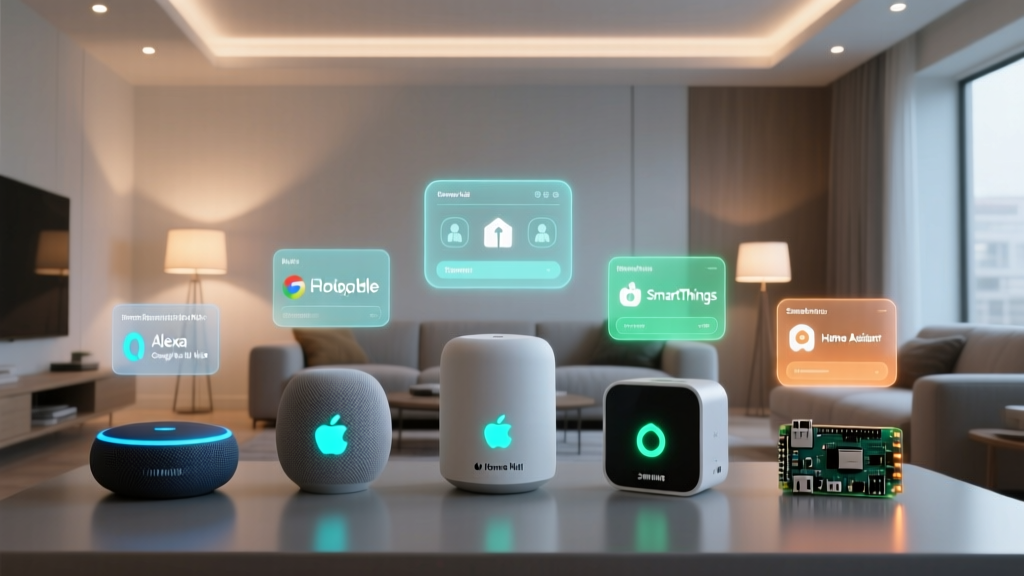
For smart home enthusiasts and practical homeowners alike, ecosystem reliability and offline functionality are not just luxury features; they are fundamental requirements. A truly intelligent home should not require a connection to a server farm hundreds of miles away to execute a simple Local Area Network (LAN) command, such as turning on a living room lamp when a motion sensor is triggered. In this comprehensive guide, we evaluate the major smart home platforms through the lens of local control, latency, and offline survivability, pitting the open-source powerhouse Home Assistant against Apple's premium HomeKit, while also examining Samsung SmartThings and the emerging Matter/Thread standards.
Why Local Control Matters for Ecosystem Reliability
Local control refers to the ability of a smart home hub to process automations and device commands entirely within your home's network, without sending data to the cloud and waiting for a response. The benefits of local processing are threefold:
- Speed and Latency: Cloud commands typically incur a latency of 200ms to 500ms, depending on your internet speed and the provider's server load. Local commands execute in 10ms to 30ms, making physical switch replacements feel instantaneous.
- Privacy and Security: Data regarding your daily routines, occupancy, and camera feeds never leaves your premises. As highlighted by cybersecurity experts, minimizing external data transmission drastically reduces your attack surface.
- Offline Survivability: When your Internet Service Provider (ISP) experiences downtime, or a severe storm knocks out local infrastructure, a local hub continues to run your automations flawlessly.
Home Assistant: The Undisputed King of Offline Functionality
When it comes to pure, unadulterated offline reliability, Home Assistant is the gold standard. Built on an open-source architecture, Home Assistant is designed from the ground up to prioritize local execution. The platform's core philosophy dictates that the cloud should only be used as a fallback or for specific integrations that inherently require it (like fetching weather data or controlling a cloud-only Wi-Fi bulb).
Hardware and Cost Breakdown
To achieve maximum offline reliability with Home Assistant, you need dedicated local hardware. The Home Assistant Green (priced around $99) is the official entry point, offering a plug-and-play local server. For advanced users requiring built-in Zigbee and Thread radios, the Home Assistant Yellow (starting around $199, plus the cost of a Raspberry Pi Compute Module) is the ultimate edge device.
For wireless protocols, Home Assistant utilizes the Zigbee Home Automation (ZHA) integration or Z-Wave JS. By plugging a $60 Sonoff Zigbee 3.0 USB Dongle Plus or an Aeotec Z-Stick 7 into your hub, you create a robust, localized mesh network. These protocols do not rely on your home's Wi-Fi bandwidth, ensuring that a congested router won't delay your smart switches.
Offline Automation Capabilities
Home Assistant's automation engine is entirely local. If your internet goes down, a motion sensor triggering a Zigbee bulb will still execute in under 20 milliseconds. Furthermore, Home Assistant allows you to write complex, multi-condition automations using YAML or the visual editor, all of which are processed on the device's local CPU. The only limitation during an outage is the inability to use cloud-based text-to-speech or external webhooks.
Apple HomeKit: The Premium Local-Control Contender
For users who prefer a polished, consumer-friendly ecosystem over the DIY nature of Home Assistant, Apple HomeKit offers the best offline reliability in the mainstream market. Apple has long championed local processing, requiring HomeKit-certified accessories to support local network communication via Wi-Fi, Thread, or Bluetooth.
The Hub Requirement
To achieve offline automation in HomeKit, you must designate a local hub. The Apple TV 4K ($129) or the HomePod mini ($99) serve as these edge controllers. When you create an automation in the Apple Home App, the logic is downloaded to the hub. If the internet drops, the Apple TV 4K will continue to run time-based and sensor-based automations locally.
Thread and Matter Integration
Apple's aggressive adoption of Thread—a low-power, self-healing mesh networking protocol—has vastly improved HomeKit's offline resilience. Thread devices communicate directly with one another and route through Thread Border Routers (like the HomePod mini). Because Thread operates on the 2.4 GHz spectrum independently of your Wi-Fi network's data load, it provides enterprise-grade reliability for offline sensor networks.
Note on HomeKit Limitations: While HomeKit is excellent for local execution, it has a known quirk. If the Apple TV hub reboots during an internet outage, it may fail to authenticate with iCloud and will refuse to execute automations until a WAN connection is re-established. Therefore, pairing your hub with an Uninterruptible Power Supply (UPS) is critical.
Samsung SmartThings: Bridging the Cloud-Local Gap
Samsung SmartThings has historically been a cloud-first ecosystem, leading to severe reliability complaints during AWS server outages. However, Samsung has recently pivoted toward local execution with the introduction of SmartThings Edge Drivers and the SmartThings Hub v3 (and the newer SmartThings Station).
Edge Drivers allow the hub to process Zigbee, Z-Wave, and select LAN devices locally. If you use native SmartThings sensors and compatible local hubs like the Philips Hue Bridge (connected via LAN), your basic lighting and security automations will survive an internet outage. However, complex routines involving virtual switches, external API calls, or Wi-Fi devices that lack local LAN protocols will immediately fail when the WAN drops. SmartThings is a hybrid; it is more reliable than Alexa, but less bulletproof than Home Assistant.
The Role of Matter and Thread in Local Reliability
The Connectivity Standards Alliance (CSA) has introduced Matter and Thread to solve the fragmentation and cloud-reliance issues of the smart home industry. Matter is an application layer protocol that mandates local IP-based control. If a device is Matter-certified, it must support local execution over your LAN.
When paired with Thread, which provides the underlying transport layer, Matter devices form a resilient mesh. If one node fails or a router goes down, the Thread network dynamically reroutes data packets through neighboring devices. For offline reliability, purchasing Matter-over-Thread devices is currently the most future-proof strategy, as they are natively designed to operate independently of cloud servers.
Feature Comparison Table
| Ecosystem | Local Processing | Offline Automations | Primary Protocols | Estimated Hub Cost | Reliability Score |
|---|---|---|---|---|---|
| Home Assistant | 100% Native | Flawless (Edge-only) | Zigbee, Z-Wave, Thread, LAN | $99 - $199 | 10/10 |
| Apple HomeKit | High (with Hub) | Excellent (Minor reboot bug) | Thread, Wi-Fi, BLE | $99 - $129 | 8.5/10 |
| SmartThings | Moderate (Edge Drivers) | Good (Zigbee/Z-Wave only) | Zigbee, Z-Wave, LAN | $69 - $99 | 6.5/10 |
| Amazon Alexa | Very Low | Poor (Cloud-dependent) | Wi-Fi, Zigbee (Echo hubs) | $99 - $149 | 3/10 |
| Google Home | Very Low | Poor (Cloud-dependent) | Wi-Fi, Thread (Nest Hubs) | $99 - $129 | 3/10 |
Ecosystem Offline Automation Success Rate
Ecosystem Offline Automation Success Rate
Actionable Advice: Building a Fail-Safe Network Infrastructure
Choosing a local ecosystem like Home Assistant or HomeKit is only half the battle. If your home's power grid fails, or your router crashes, your local hub is just as useless as a cloud server. To achieve true 99.9% offline reliability, you must fortify your physical infrastructure.
1. Implement Power Redundancy (UPS)
You must place your modem, router, and smart home hub on an Uninterruptible Power Supply (UPS). A CyberPower CP1500PFCLCD (approx. $200) or an APC Back-UPS Pro (approx. $150) will keep your core network and automation brain alive during rolling blackouts or severe weather events. Ensure your hub is connected via Ethernet, not Wi-Fi, to the router to eliminate wireless interference during power fluctuations.
2. Optimize Zigbee and Wi-Fi Channels
One of the most common causes of "offline" failures is actually local RF interference. Zigbee and Wi-Fi both operate on the 2.4 GHz spectrum. If your Wi-Fi router is broadcasting on Channel 1 or 6, and your Zigbee network is on Channel 11, they will overlap, causing packet loss and delayed automations.
- Set your 2.4 GHz Wi-Fi to Channel 1, 6, or 11.
- Set your Zigbee coordinator to Channel 15, 20, or 25 to completely avoid Wi-Fi overlap.
3. Utilize Power over Ethernet (PoE)
For advanced users, deploying a PoE switch (like the TP-Link TL-SG1005P, approx. $60) allows you to run Ethernet cables to ceiling-mounted Thread Border Routers or Zigbee coordinators. This eliminates the need for local power bricks, allowing a single centralized UPS in your server rack to power your entire smart home mesh network during an outage.
Conclusion
If offline reliability and local control are your primary concerns, Home Assistant is the undisputed champion, offering unparalleled flexibility, zero cloud dependency, and instantaneous execution. However, it requires a willingness to learn and maintain a DIY server environment. For those seeking a premium, zero-configuration experience that still respects local execution, Apple HomeKit (especially when leveraging Thread devices) is the finest consumer choice. Mainstream ecosystems like Alexa and Google Home, while excellent for voice queries and media consumption, fundamentally fail the offline reliability test. By pairing a local-first ecosystem with a robust, battery-backed network infrastructure, you can build a smart home that remains intelligent, responsive, and secure—even when the rest of the world goes dark.