The modern home is no longer just a passive shelter; it is an active, responsive participant in your daily life. While early smart home technology was largely defined by novelty—like turning on a lightbulb from a smartphone—today's ecosystem is driven by seamless automation. By leveraging sensors, geofencing, and advanced scheduling, smart home technology fundamentally alters how we wake up, work, relax, and sleep. This comprehensive guide explores the physiological and practical impacts of daily automation routines, providing actionable blueprints, specific product recommendations, and protocol comparisons to help you transform your living space.
The Psychology and Physiology of Automated Living
Decision fatigue is a well-documented psychological phenomenon where the quality of your decisions deteriorates after a long session of decision making. A fully automated home reduces cognitive load by handling micro-tasks: adjusting the thermostat, locking doors, dimming lights, and managing window treatments. Instead of manually interacting with dozens of switches and dials, your environment adapts to your presence and schedule.
According to environmental psychologists, an optimized, automated living space reduces baseline stress levels by removing friction from repetitive daily tasks, allowing residents to focus on high-value activities and genuine relaxation.
From a physiological standpoint, automation plays a critical role in regulating circadian rhythms. By automating light color temperatures and intensity throughout the day, you can signal to your brain when it is time to be alert and when it is time to produce melatonin for sleep.
The Morning Routine: Waking Up Optimized
Abrupt alarm clocks and cold, dark rooms trigger a cortisol spike that can leave you feeling groggy. An automated morning routine gently transitions your body into wakefulness.
Circadian Lighting Automation
Smart lighting is the cornerstone of morning automation. Instead of turning on harsh, cool-white overhead lights, an automated routine gradually increases brightness and shifts color temperature over 30 minutes.
- Product Recommendation: Philips Hue White and Color Ambiance or LIFX Mini Color.
- Technical Specs: Set your automation to start at 2000K (warm amber) at 10% brightness, transitioning to 5000K (cool daylight) at 80% brightness by the time you get out of bed.
- Cost Range: $45 to $120 per bulb.
Climate Pre-Conditioning
Heating or cooling an empty house is inefficient, but waking up to a freezing or stifling room is uncomfortable. Smart thermostats use your phone's GPS (geofencing) or dedicated room sensors to detect when you are waking up or heading home.
- Product Recommendation: Ecobee SmartThermostat Premium or Google Nest Learning Thermostat.
- Efficiency Impact: According to the EPA Energy Star program, certified smart thermostats can save users an average of 8% on heating and cooling bills annually by optimizing run-times based on occupancy and sleep schedules.
- Cost Range: $150 to $250.
Automated Window Treatments
Natural sunlight is the most effective circadian trigger. Smart blinds can be programmed to open gradually as the sun rises, utilizing free solar heat gain in the winter to reduce HVAC loads.
- Product Recommendation: SwitchBot Curtain Rod 2 (budget-friendly retrofit) or Lutron Serena (premium integrated solution).
- Cost Range: $100 for retrofit motors; $600+ for custom Lutron installations.
The Workday: Efficiency on Autopilot
When you leave for work, your home should shift into an energy-saving, high-security state without you having to flip a single switch.
Geofencing and Occupancy Sensors
Geofencing creates a virtual perimeter (usually a 150-meter radius) around your home. When the last registered smartphone leaves the perimeter, the smart home hub triggers an 'Away' routine. However, GPS can sometimes be inaccurate. To solve this, advanced automations now use millimeter-wave (mmWave) presence sensors.
- Product Recommendation: Aqara Presence Sensor FP2.
- How it Works: Unlike traditional Passive Infrared (PIR) sensors that require motion to detect occupancy, mmWave sensors detect microscopic movements like breathing. This ensures your lights and HVAC don't turn off while you are sitting still and reading or working from home.
- Cost Range: $70 to $90 per sensor.
Appliance and Energy Monitoring
Smart plugs and whole-home energy monitors can automate the shutdown of 'vampire' devices—electronics that draw power even when turned off.
- Product Recommendation: Sense Energy Monitor or TP-Link Kasa Smart Plugs.
- Automation Logic: If the home is in 'Away' mode, cut power to the entertainment center and coffee maker smart plugs to eliminate phantom energy drain.
The Evening Routine: Winding Down and Security
As the sun sets, your home should transition into a secure, relaxing environment that promotes restful sleep.
Lighting Transitions for Melatonin Production
Exposure to blue light in the evening suppresses melatonin. An evening automation routine should systematically eliminate cool light sources.
- Automation Logic: At sunset, all interior lights shift to 2700K or lower. By 9:00 PM, brightness drops to 20%, and overhead lights turn off, leaving only low-level accent and floor lamps illuminated.
Security and Access Automation
Securing the home is a multi-step process that is easily forgotten when you are tired. Automation ensures your perimeter is locked down every single night.
- Product Recommendation: Yale Assure Lock 2 or August Wi-Fi Smart Lock.
- Automation Logic: At 11:00 PM, or when the master bedroom motion sensor is triggered, the hub commands all smart locks to engage, closes the garage door, arms the security system, and turns off exterior cameras' privacy zones to begin recording.
- Cost Range: $180 to $280 per lock.
Ecosystem Compatibility and Protocol Guide
For automations to run reliably, your devices must communicate effectively. Choosing the right protocol and ecosystem is critical for minimizing latency and ensuring devices work together.
| Protocol | Range & Mesh | Power Consumption | Best Use Case | Key Ecosystem Support |
|---|---|---|---|---|
| Matter (over Thread) | Medium (Mesh) | Very Low | Future-proofing, cross-brand compatibility, sensors | Apple, Amazon, Google, Samsung |
| Zigbee | Medium (Mesh) | Low | Lighting, basic sensors, budget setups | Amazon (Echo Plus), SmartThings, Home Assistant |
| Z-Wave | Long (Mesh) | Low | Security, locks, large properties | SmartThings, Hubitat, Home Assistant |
| Wi-Fi | Short/Medium | High | High-bandwidth devices (cameras, displays) | Universal (Router dependent) |
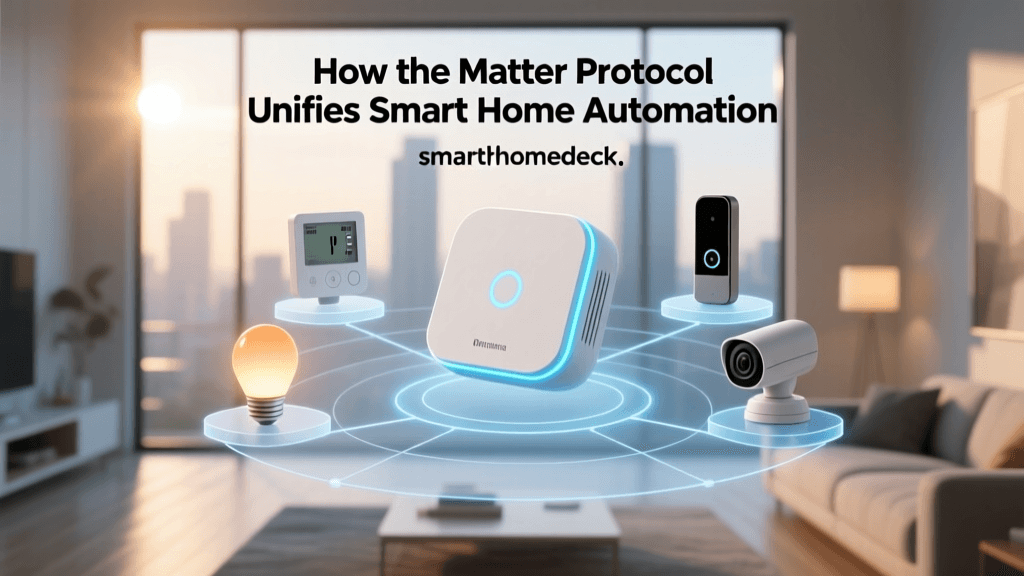
The introduction of the Matter standard has been a game-changer for daily automation. As detailed by the Connectivity Standards Alliance (CSA), Matter allows devices from different manufacturers to communicate locally without relying on cloud servers. This means your morning lighting routine will trigger instantly, even if your home internet connection is temporarily down.
Visualizing the Impact: Time and Energy Saved
How much time does automation actually save? While individual actions take only seconds, the cumulative effect over a week is substantial. The chart below illustrates the average weekly hours saved across different smart home categories based on typical household automation routines.
As the data suggests, automated cleaning (like scheduled robot vacuums that run while you are at work) and climate control (which eliminates the need to manually adjust thermostats and check vents) offer the highest return on time invested. Furthermore, the U.S. Department of Energy notes that automated HVAC scheduling not only saves time but significantly reduces annual energy consumption by preventing the conditioning of unoccupied spaces.
Step-by-Step Guide to Building Your First Routine
If you are new to smart home automation, the sheer number of options can be overwhelming. Follow this structured approach to build a reliable, frictionless environment.
Step 1: Audit Your Friction Points
Do not buy technology just for the sake of it. Identify the tasks that annoy you daily. Do you always forget to turn off the porch light? Do you hate getting out of bed to check if the front door is locked? Write down your top three friction points and solve those first.
Step 2: Choose a Primary Hub and Ecosystem
Consistency is key to reliable automation. Choose one primary ecosystem to act as the 'brain' of your home.
- Apple HomeKit / Apple Home: Best for iPhone users who prioritize privacy and local processing. Excellent interface, but hardware tends to be more expensive.
- Amazon Alexa: Best for budget-conscious users and wide device compatibility. Huge library of third-party 'Skills' and routines.
- Google Home: Best for households heavily invested in Google services, Nest products, and voice-assistant accuracy.
- Home Assistant: Best for tech enthusiasts, tinkerers, and those who want 100% local control without cloud dependencies. Requires a Raspberry Pi or dedicated mini-PC.
Step 3: Start with High-Impact, Low-Cost Devices
Begin your automation journey with smart plugs and smart bulbs. A $15 smart plug can automate a dumb coffee maker or a standing lamp, providing immediate gratification and proving the concept of automation before you invest hundreds of dollars in smart blinds or advanced HVAC controls.
Step 4: Layer in Sensors for Proactive Automation
Once you are comfortable with time-based schedules (e.g., 'turn on lights at 7:00 AM'), upgrade to sensor-based automations (e.g., 'turn on lights when motion is detected AND lux levels are below 50'). This transitions your home from a programmable environment to a truly smart, reactive one.
Conclusion
Smart home automation is not about replacing human interaction with your living space; it is about elevating it. By thoughtfully designing morning, workday, and evening routines, you align your home's environment with your biological needs and daily schedule. Whether you are utilizing Matter-compatible devices for local reliability or leveraging mmWave sensors for flawless occupancy detection, the ultimate goal remains the same: creating a home that works quietly in the background, giving you back your time, your energy, and your peace of mind.