The Shift from Wearables to Ambient Computing
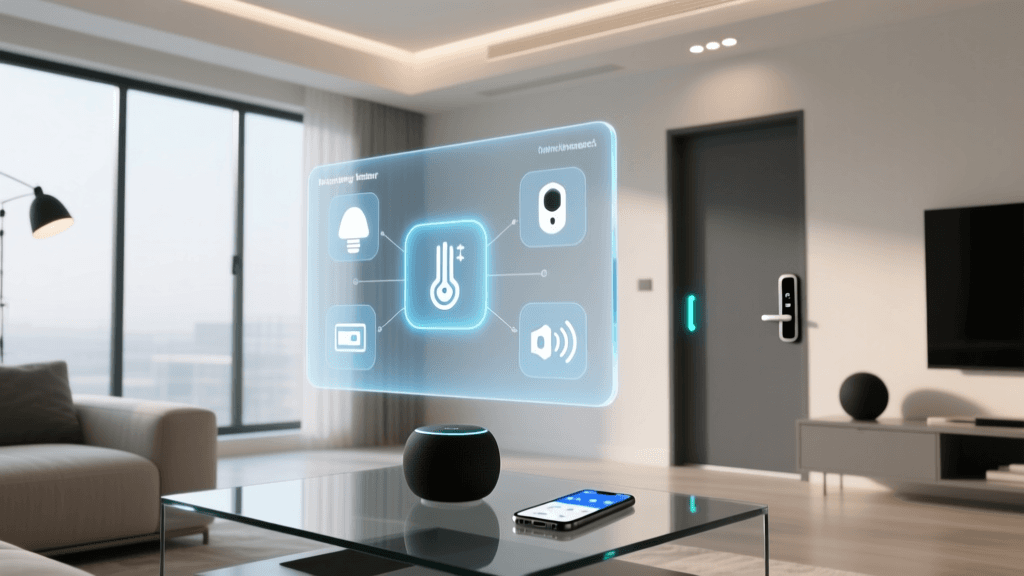
For the past decade, the smart home has been defined by the devices we can see, touch, and interact with. From glowing smart speakers to optical security cameras and wrist-worn fitness trackers, our homes have become cluttered with hardware that demands our attention and requires us to actively participate in data collection. However, a massive paradigm shift is currently underway in the smart home basics and education space: the transition toward ambient computing. Ambient computing refers to technology that operates seamlessly in the background, sensing and reacting to human presence without requiring wearables, cameras, or manual inputs.
The future of the smart home is invisible. Instead of strapping on a smartwatch to track your sleep or installing an intrusive optical camera in a hallway to monitor an elderly relative, emerging smart home categories are utilizing radio frequencies (RF) and millimeter-wave (mmWave) radar to map environments, track vitals, and detect anomalies. This guide explores the foundational science behind ambient sensing, the emerging device categories leading the charge, and how you can prepare your home network for the invisible era.
What is Wi-Fi Sensing and Ambient Radar?
At the core of the ambient smart home is the ability to 'see' without lenses. This is achieved through two primary technologies: Wi-Fi Sensing (utilizing Channel State Information) and Millimeter-Wave (mmWave) Radar. Both rely on the behavior of electromagnetic waves as they bounce off human bodies, which are largely composed of water and highly effective at absorbing and reflecting RF signals.
Channel State Information (CSI) Explained
Wi-Fi sensing leverages the existing wireless network in your home. Every time a Wi-Fi signal travels from a router to a connected device (like a smartphone or smart TV), it bounces off walls, furniture, and people. Channel State Information (CSI) is a granular metric that describes how these signals scatter, attenuate, and shift in phase as they travel through a space. When a person walks through a room or even just breathes while sleeping, they alter the CSI profile of the Wi-Fi signals in that room. By applying machine learning algorithms to these micro-fluctuations, AI can determine occupancy, count people, and even monitor respiratory rates without a single camera. The Wi-Fi Alliance has officially recognized Wi-Fi Sensing as a foundational technology for the future of connected environments, standardizing how devices interpret RF disruptions.
Millimeter-Wave (mmWave) Radar
While Wi-Fi sensing uses existing network infrastructure, mmWave radar utilizes dedicated, low-power chips that emit high-frequency radio waves (typically in the 60 GHz range). These waves have very short wavelengths, allowing them to detect sub-millimeter movements. This makes mmWave radar exceptionally accurate for static presence detection (knowing you are sitting perfectly still on the couch) and vital sign monitoring (detecting the subtle rise and fall of a chest cavity). Unlike Passive Infrared (PIR) sensors, which only detect moving heat signatures and turn off the lights when you sit still to read, mmWave radar knows you are still there.
Emerging Device Categories Using Invisible Tech
As these technologies mature, they are giving birth to entirely new smart home categories focused on health, elder care, and advanced energy management.
1. Non-Contact Elder Care and Fall Detection
One of the most critical applications of ambient radar is in elder care. Optical cameras are a massive privacy violation in bedrooms and bathrooms, yet these are the exact locations where falls are most likely to occur. Devices like the Vayyar Care wall-mounted sensor utilize 3D mmWave radar to map a room and detect falls with high accuracy. Priced around $150 to $200, Vayyar's sensors can differentiate between a person lying down in bed and a person who has fallen on the floor, automatically triggering alerts to caregivers or emergency services. According to Vayyar's smart home division, their radar chips are now being integrated directly into smart thermostats and lighting panels, making the hardware completely indistinguishable from standard home fixtures.
2. Sleep and Vitals Monitoring
Wearable sleep trackers can be uncomfortable and disrupt the very sleep they aim to measure. Emerging ambient devices sit on the nightstand or mount to the wall, using RF to track sleep stages, heart rate, and breathing. The Withings Sleep Analyzer (a pneumatic pad placed under the mattress) has paved the way, but newer iterations are moving entirely to under-bed radar and Wi-Fi CSI to track biometrics without any physical contact. These devices integrate with ecosystems like Apple HomeKit and Home Assistant to adjust the smart thermostat if the user's core temperature or sleep stage indicates they are entering deep REM sleep.
3. Mesh Network Motion Routing
Companies like Origin Wireless have partnered with major router manufacturers to turn entire mesh Wi-Fi networks into motion sensors. Linksys Aware, powered by Origin Wireless' cognitive AI, uses the CSI data passing between mesh nodes to detect intruders or monitor occupancy. As detailed in coverage by The Verge, this approach requires no extra hardware if you already own a compatible mesh system, though it typically operates on a subscription model of $3 to $5 per month for the AI processing layer.
Network Topology and Setup Requirements
Integrating ambient sensing into your smart home requires specific network considerations. If you plan to utilize Wi-Fi CSI for presence detection, your network topology must be optimized for RF analysis.
- Band Selection: Wi-Fi sensing performs best on the 5 GHz and 6 GHz bands. The 2.4 GHz band has longer wavelengths that are less sensitive to the micro-movements of human breathing and are highly susceptible to interference from microwaves and Bluetooth devices.
- Node Placement: For CSI triangulation, you need at least two Wi-Fi nodes (a transmitter and a receiver) with a clear line of sight across the target area. Placing nodes in hallways or central living spaces maximizes the 'sensing cone'.
- Edge Processing vs. Cloud: Due to the massive bandwidth required to stream raw CSI data, the most secure and efficient ambient systems process the RF data locally on the router's edge chip, sending only simple MQTT payloads (e.g., 'Room: Occupied') to your smart home hub.
Privacy, Security, and the 'Creep' Factor
The primary selling point of ambient radar is privacy. Unlike optical cameras that capture facial features, clothing, and intimate visual details, Wi-Fi and mmWave sensors only capture 'point clouds' and signal disruptions. A radar sensor cannot tell what you look like, what you are wearing, or who is in the room; it only knows that a biological mass of a certain size is present and moving. This makes ambient sensing highly compliant with strict privacy frameworks like GDPR and CCPA, as the data collected is generally not considered Personally Identifiable Information (PII). However, consumers must still ensure that the edge-processing devices they purchase do not upload raw RF maps to the cloud, which could theoretically be reverse-engineered to map the exact floor plan of a home.
Market Growth and Adoption Trends
The market for invisible smart home tech is growing exponentially as consumers experience 'camera fatigue' and wearable burnout. Below is a projection of market growth comparing traditional smart cameras with ambient radar and Wi-Fi sensing technologies over the next five years.
Projected Market Growth: Ambient Sensing vs Smart Cameras
Comparison Table: Camera vs. Wearable vs. Ambient Sensor
When designing a smart home security or health monitoring system, it is crucial to choose the right tool for the environment. The following table breaks down the practical differences between the three primary monitoring categories.
| Feature | Optical Cameras (e.g., Ring, Nest) | Wearables (e.g., Apple Watch, Fitbit) | Ambient Sensors (e.g., Vayyar, Wi-Fi CSI) |
|---|---|---|---|
| Privacy Level | Low (Captures video/audio) | Medium (Captures biometric data) | High (Captures RF disruptions only) |
| Installation | Visible mounting, wiring/charging | Worn on body, daily charging | Hidden in walls/fixtures, passive power |
| Fall Detection | Good (AI Vision), but blind spots exist | Excellent, but requires user to wear it | Excellent, covers entire room passively |
| Sleep Tracking | Not applicable / Intrusive | Good, but uncomfortable for some | Excellent, zero-contact vitals monitoring |
| Est. Cost | $50 - $250 per unit | $150 - $400+ per device | $100 - $200 per sensor / Mesh sub |
The Role of Matter and AI in Signal Processing
The adoption of ambient sensing is being accelerated by the Matter protocol. As Matter expands its device types beyond simple lights and locks to include advanced environmental sensors, ambient radar chips will be able to broadcast standardized 'occupancy' and 'vital' states directly to Apple Home, Google Home, and Samsung SmartThings without relying on proprietary cloud bridges. Furthermore, the AI models required to interpret CSI data are becoming highly localized. Modern mesh routers feature dedicated Neural Processing Units (NPUs) that can learn the specific acoustic and RF fingerprint of your home, filtering out the 'noise' of a swaying curtain or a rotating ceiling fan to focus exclusively on human biological signatures.
Conclusion: Preparing Your Home for the Invisible Era
The transition from active, screen-based smart home devices to passive, ambient computing is the most significant evolution in home automation since the introduction of Wi-Fi. By leveraging Wi-Fi sensing and mmWave radar, homeowners can achieve unprecedented levels of security, elder care, and energy efficiency without sacrificing privacy or interior aesthetics. To prepare your home for this future, begin by upgrading to a modern 5GHz/6GHz mesh network capable of CSI extraction, and consider replacing high-friction wearables and intrusive optical cameras in private spaces with dedicated ambient radar sensors. The smartest home of the future is the one you don't even realize is watching over you.