The End of the Walled Garden: Enter the Matter Protocol
For the past decade, the smart home industry has been defined by fragmentation. Consumers have been forced to choose sides—Apple HomeKit, Amazon Alexa, Google Home, or Samsung SmartThings—often resulting in a disjointed ecosystem where devices refuse to communicate without third-party workarounds. This era of frustration is rapidly coming to an end. The future of smart home basics and education hinges on a single, unifying standard: Matter.
Developed by the Connectivity Standards Alliance (CSA), Matter is an open-source, royalty-free connectivity protocol designed to ensure that smart home devices work seamlessly across all major ecosystems. According to the CSA-IoT Matter initiative, the protocol operates over existing technologies like Wi-Fi, Ethernet, and Thread, prioritizing local network communication over cloud-dependent routing. This means your smart lights will respond to your smart switches instantly, even if your internet connection goes down.
Understanding Thread: The Backbone of Matter
While Matter handles the language devices use to communicate, Thread is the low-power, mesh-networking highway that carries the signal. Unlike traditional Zigbee or Z-Wave networks that require proprietary hubs, Thread utilizes a decentralized mesh topology. Everyday devices like smart plugs and light bulbs act as routers, extending the network's range and self-healing if a node drops offline. The Thread Group emphasizes that this IEEE 802.15.4-based protocol is critical for the future of battery-operated sensors, offering latency as low as 20 milliseconds.
Actionable Advice: To future-proof your home today, invest in a Thread Border Router. Devices like the Apple TV 4K (3rd Gen, Wi-Fi + Ethernet model, approx. $149), the Google Nest Hub Pro ($99), or the Nanoleaf Shapes starter kits act as gateways, bridging your Thread mesh network to your home's Wi-Fi. When purchasing new sensors or smart locks, look explicitly for the "Matter over Thread" logo on the packaging.
Ambient Intelligence: From Reactive to Predictive
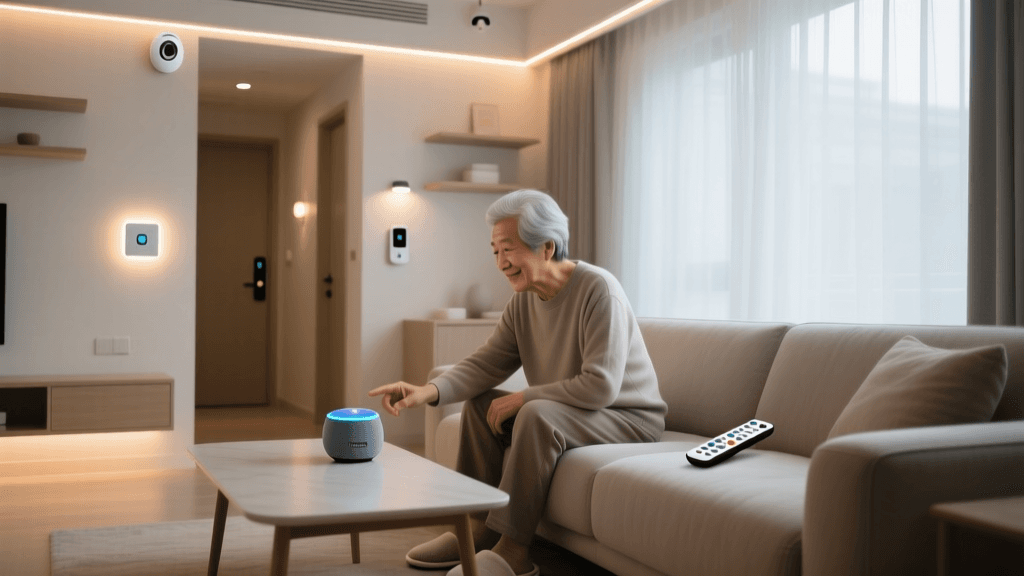
The current paradigm of smart home control is largely reactive. You issue a voice command, press a button, or trigger a basic geofenced routine. The next frontier is Ambient Intelligence (AmI)—homes that anticipate your needs without explicit commands. This shift is powered by advanced sensor fusion and edge-based AI processing.
The Rise of mmWave Presence Sensors
Traditional Passive Infrared (PIR) motion sensors are inherently flawed; they only detect macro-movements. If you sit still on the couch reading a book, a PIR sensor assumes the room is empty and turns off the lights. The future belongs to millimeter-wave (mmWave) radar sensors. Operating at 60GHz frequencies, mmWave sensors can detect micro-movements, including the subtle rise and fall of your chest as you breathe.
- Product Spotlight: The Aqara Presence Sensor FP2 (approx. $70) utilizes mmWave technology to divide a room into multiple customizable zones. It can detect if you are sitting at your desk versus lying in bed, triggering entirely different lighting and HVAC routines based on your exact posture and location.
- Installation Note: Unlike battery-powered PIR sensors, mmWave sensors require continuous power due to their high data-sampling rates. Plan for USB-C routing or hardwired 5V installations during your renovation or upgrade phase.
Average Network Latency and Power Consumption by Smart Home Protocol
Energy Autonomy and Virtual Power Plants (VPPs)
As global energy grids face increasing strain, the smart home of the future will not just consume energy; it will actively manage, store, and sell it back to the grid. This concept is known as a Virtual Power Plant (VPP). Through bi-directional communication protocols, utility companies can signal your home to discharge battery power during peak demand hours in exchange for financial credits.
To participate in the VPP economy, homeowners are upgrading from standard breaker boxes to intelligent electrical panels.
- Span Smart Panel: Priced between $3,000 and $5,000 (including professional installation), the Span panel replaces your traditional breaker box. It offers circuit-level control, allowing you to designate specific circuits (like the refrigerator or medical equipment) as "critical" during a grid outage, while automatically shedding high-draw loads like EV chargers or pool pumps.
- Lumin Smart Panel: A more accessible retrofit option ($500–$800 plus installation) that clamps onto your existing panel, providing granular, real-time energy monitoring and AI-driven alerts if an appliance begins drawing abnormal current, signaling impending failure.
Predictive Maintenance and Water Security
Ambient AI is also revolutionizing home protection. Water damage remains one of the most costly insurance claims for homeowners. Future smart homes will utilize acoustic AI and pressure-wave analysis to detect leaks before they become catastrophic.
Devices like the Flo by Moen or Phyn Plus (ranging from $500 to $700, plus plumbing installation) attach directly to your main water line. They use machine learning to map your home's unique water usage signature. If the AI detects a micro-leak—a running toilet or a pinhole drip behind a wall—it will alert your smartphone. If a catastrophic pipe burst is detected, the motorized ball valve will automatically shut off the home's water supply in seconds, preventing thousands of dollars in structural damage.
Edge Computing: Reclaiming Privacy and Speed
As homes become equipped with cameras, microphones, and predictive AI, privacy concerns naturally escalate. The industry's response is a massive shift toward Edge Computing—processing data locally on a home server rather than sending it to a cloud server for analysis.
The NIST Cybersecurity for IoT Program heavily advocates for localized data processing and strict network segmentation to mitigate vulnerabilities inherent in cloud-dependent IoT devices. By keeping your data local, you eliminate the risk of cloud-server breaches and ensure your home functions even during widespread internet outages.
Hardware Recommendation: The Home Assistant Green (approx. $99) is a plug-and-play local server that allows you to unify Matter, Zigbee, and Wi-Fi devices into a single, privacy-first dashboard. For advanced users, pairing this with a local AI vision processor like the Frigate NVR allows security cameras to perform human and vehicle recognition entirely on your local network, ensuring your video feeds never touch a third-party server.
Preparing Your Network Infrastructure
None of these future innovations are possible without a robust, enterprise-grade network backbone. The consumer-grade mesh routers of the past are insufficient for homes that may soon host over 150 concurrent IoT endpoints.
Pro Tip: The future smart home requires network segmentation. By creating a dedicated Virtual Local Area Network (VLAN) exclusively for IoT devices, you prevent a compromised $20 smart bulb from providing a hacker access to your personal computers or NAS drives.
When upgrading your infrastructure, look toward Wi-Fi 6E or Wi-Fi 7 access points, which utilize the uncongested 6GHz spectrum. Brands like Ubiquiti (UniFi line) or TP-Link (Omada line) offer PoE (Power over Ethernet) switches that can hardwire your ceiling-mounted access points and Thread border routers, ensuring maximum throughput and zero interference.
Actionable Guide: Future-Proofing Your Home Today
Transitioning to a next-generation smart home does not require tearing out your walls. It requires strategic purchasing and infrastructure planning. Use the table below as a checklist for your next upgrades.
| Category | Future-Proof Standard | Example Product | Estimated Cost |
|---|---|---|---|
| Smart Hub / Border Router | Thread / Matter | Apple TV 4K (Ethernet) / Home Assistant Green | $99 - $149 |
| Room Presence Sensing | 60GHz mmWave Radar | Aqara Presence Sensor FP2 | $69 |
| Lighting Control | Matter over Thread | Nanoleaf Essentials Bulbs / Eve Energy Plugs | $20 - $50 per unit |
| Energy Management | CT Clamp / Smart Breaker | Lumin Smart Panel / Span Panel | $500 - $4,000+ |
| Water Security | AI Pressure / Acoustic | Flo by Moen / Phyn Plus | $500 - $700 |
| Network Backbone | Wi-Fi 6E / PoE VLANs | Ubiquiti UniFi Dream Router | $199 - $299 |
Final Thoughts on the Smart Home Horizon
The future of the smart home is not about adding more screens or requiring more voice commands. It is about invisibility. As the Matter protocol unifies the hardware landscape and ambient AI refines the software logic, your home will transition from a collection of remote-controlled gadgets into a cohesive, predictive environment. By investing in Thread-compatible hardware, mmWave sensing, and local edge processing today, you are laying the foundation for a home that truly understands and adapts to your life.