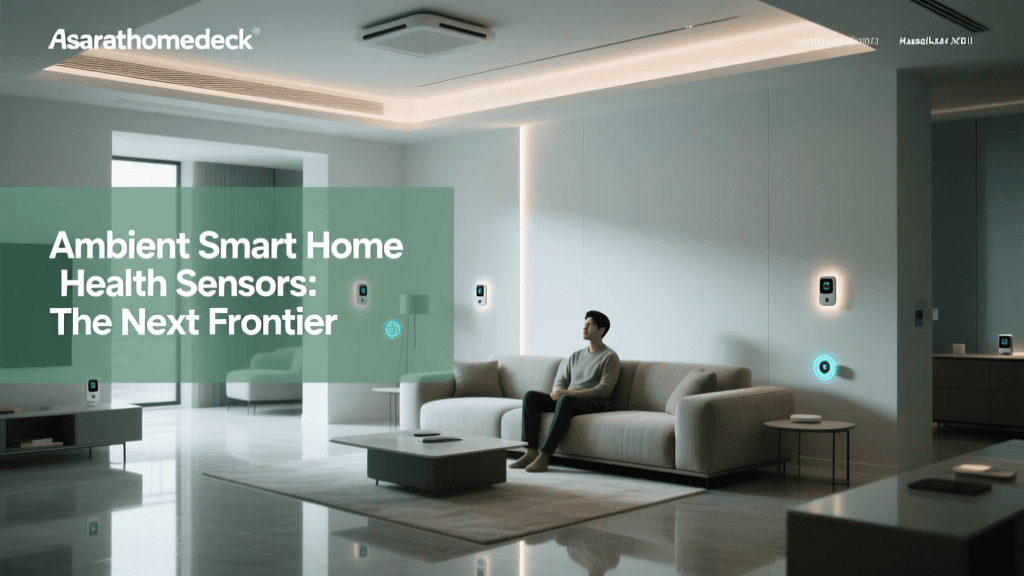
The Evolution of Smart Home Presence Detection
For over a decade, the smart home has relied almost exclusively on Passive Infrared (PIR) sensors to detect human presence. While PIR sensors are inexpensive and reliable for basic automation—like turning on a hallway light when you walk by—they suffer from a critical, fundamental flaw: they cannot detect static presence. If you sit still on the couch reading a book, or lie motionless in a bathtub, a PIR sensor will eventually assume the room is empty and turn off the lights. This limitation has long frustrated smart home enthusiasts and hindered the development of true ambient computing.
Enter millimeter-wave (mmWave) radar technology. Originally developed for automotive collision avoidance, military applications, and aerospace, mmWave radar is rapidly emerging as the most transformative category in smart home sensing. By bouncing high-frequency radio waves off objects and analyzing the returning signals, these sensors can detect not just macro-movements like walking, but micro-movements like the subtle rise and fall of a human chest during breathing. This leap from simple motion detection to continuous, high-fidelity presence sensing is fundamentally redefining how our homes interact with us.
Understanding mmWave Radar Technology
Millimeter-wave radar operates in the electromagnetic spectrum between 30 GHz and 300 GHz, corresponding to wavelengths between 10 millimeters and 1 millimeter. In the context of smart home devices, manufacturers typically utilize the 24 GHz or 60 GHz frequency bands. According to Texas Instruments, a pioneer in radar sensing, these high frequencies allow for extremely high-resolution spatial mapping and the ability to penetrate non-metallic materials like drywall, plastic, and clothing, while remaining completely harmless to human biology.
Modern smart home mmWave sensors utilize a technique called Frequency-Modulated Continuous Wave (FMCW) radar. Unlike traditional radar that sends out short pulses, FMCW continuously transmits a signal that varies in frequency over time. When this signal hits an object—such as a person sitting at a desk—and bounces back, the sensor compares the transmitted frequency with the received frequency. This difference, known as the beat frequency, allows the sensor to calculate the exact distance to the object with millimeter-level precision.
Furthermore, by leveraging the Doppler effect, mmWave sensors can measure the velocity of moving targets. This is how the sensor distinguishes between a stationary human (whose chest is moving at a few millimeters per second due to breathing) and a stationary piece of furniture. This combination of FMCW distance mapping and Doppler velocity tracking creates a highly detailed, real-time 3D point cloud of the room, enabling multi-person tracking, fall detection, and even vital sign monitoring without the need for optical cameras.
PIR vs. mmWave: A Comprehensive Comparison
To understand why the smart home industry is pivoting toward radar, it is essential to compare it directly with legacy PIR technology. Below is a structured comparison of the two sensing modalities.
| Feature | PIR Motion Sensors | mmWave Radar Sensors |
|---|---|---|
| Detection Method | Detects changes in infrared heat signatures. | Bounces radio waves to map distance and micro-movements. |
| Static Presence | Cannot detect stationary humans; lights turn off. | Accurately detects stationary humans via breathing. |
| Spatial Awareness | Binary (motion / no motion) with basic zones. | Highly granular; supports multi-zone mapping and exact coordinates. |
| Environmental Interference | Triggered by pets, HVAC vents, and sunlight changes. | Immune to light/heat; can filter out fans via Doppler mapping. |
| Material Penetration | Requires direct line-of-sight; blocked by walls. | Can penetrate drywall and plastic, allowing hidden installation. |
| Average Cost | $15 - $30 | $40 - $80 (Consumer), $15 - $25 (DIY Components) |
Transformative Use Cases in the Modern Home
The transition from binary motion detection to granular presence sensing unlocks automation scenarios that were previously impossible or highly unreliable.
1. Advanced Bathroom and Kitchen Automation
Bathrooms are notoriously difficult to automate with PIR sensors. When taking a long, relaxing bath, you are mostly submerged and motionless, causing PIR sensors to plunge the room into darkness. An mmWave sensor mounted on the ceiling easily detects the micro-movements of your breathing, keeping the lights and exhaust fans active for the entire duration of your bath, and only turning off when the room is genuinely vacant.
2. Non-Contact Sleep and Vital Sign Monitoring
Because 60 GHz mmWave radar can detect sub-millimeter movements, it is increasingly being used for sleep tracking. According to research published by the National Institutes of Health (NIH), mmWave radar can accurately monitor heart rate and respiration rate from a distance of up to two meters. Smart home devices placed on a nightstand can track sleep cycles, detect sleep apnea events, and adjust the smart thermostat based on your exact sleep phase, all without requiring you to wear a smartwatch or place pressure pads under the mattress.
3. Elderly Care and Fall Detection
Privacy is a massive concern when monitoring elderly relatives. Cameras are unacceptable in private spaces like bedrooms and bathrooms. mmWave radar provides a privacy-first alternative. Sensors like the Aqara FP2 can detect the sudden, rapid change in altitude and velocity associated with a fall, instantly sending an alert to a caregiver's smartphone. The radar only sees a point-cloud representation of the person, ensuring complete dignity and privacy.
Leading Devices and Ecosystem Compatibility
The market for consumer-grade mmWave sensors has exploded, with options ranging from polished, consumer-ready products to raw components for DIY enthusiasts.
Aqara Presence Sensor FP2
Retailing at approximately $65, the Aqara FP2 is currently the gold standard for consumer mmWave sensing. It features a 60 GHz radar chip capable of tracking up to three people simultaneously in a room up to 40 square meters. It divides the room into a 40x40 grid, allowing users to draw custom zones (e.g., a 'Desk Zone' and a 'Sofa Zone') via the Aqara app. The FP2 connects via Wi-Fi and supports Apple HomeKit, Amazon Alexa, and, crucially, the Matter protocol via an Aqara hub, ensuring seamless integration into modern, unified smart home ecosystems.
Everything Presence One (EP1)
Priced around $45, the EP1 is a collaboration between Everything Smart Home and Shelly, designed specifically for the Home Assistant community. It combines a 24 GHz mmWave radar with a traditional PIR sensor, an illuminance sensor, and a temperature/humidity sensor. Housed in a sleek, 3D-printed enclosure, the EP1 is pre-flashed with ESPHome, making it a plug-and-play powerhouse for advanced users who want local, cloud-free control and deep customization of the radar's sensitivity and gating parameters.
DFRobot SEN0395 (DIY Component)
For makers and those integrating radar into custom furniture, the DFRobot SEN0395 24GHz mmWave Human Presence Detection module costs just $15 to $20. It communicates via UART or I2C and can be easily wired into an ESP32 or Arduino. While it lacks the polished software of the FP2, it provides raw access to target distance, velocity, and presence states, allowing developers to write custom firmware for highly specialized applications, such as hidden under-desk occupancy sensors.
Installation, Calibration, and Interference Mitigation
While mmWave radar is incredibly powerful, its high sensitivity means it requires careful installation and calibration. Unlike PIR sensors, which you can simply stick to a wall and forget, mmWave sensors 'see' the entire room and will pick up unwanted movements if not configured correctly.
Common Interference Sources
- Ceiling Fans and HVAC Vents: The moving blades of a fan or the fluttering of a curtain near an AC vent create Doppler shifts that the radar might interpret as human movement.
- Pets: While advanced algorithms can filter out the mass of a cat or dog, a pet jumping onto a bed or sofa can trigger a presence event.
- Thin Walls: Because 24 GHz and 60 GHz waves can penetrate drywall, a sensor placed near a shared wall might detect a person walking in the adjacent room.
Best Practices for Calibration
To mitigate these issues, utilize the 'zone mapping' features available in advanced sensors like the Aqara FP2. During setup, you should identify static interference sources (like a ceiling fan) and draw an 'Exclusion Zone' or 'Disturbance Zone' over that specific coordinate grid. The sensor's firmware will then ignore any micro-movements originating from that exact spatial coordinate. Additionally, angle the sensor slightly downward toward the floor rather than parallel to the walls to minimize penetration into neighboring rooms. For rooms with heavy curtains, use the software sensitivity sliders to lower the detection threshold for 'minor movements' while keeping 'major movements' (walking) at maximum sensitivity.
Privacy by Design: The Camera Alternative
As smart homes become more pervasive, privacy fatigue is setting in. Consumers are increasingly wary of placing optical cameras in their living spaces due to the risks of hacking, data breaches, and unauthorized cloud recording. mmWave radar offers a concept known as 'Privacy by Design'.
A radar sensor does not capture light, color, or facial features. It cannot read text on a screen, identify who is in the room, or record compromising visual data. It only processes mathematical representations of distance and velocity. Even if a malicious actor were to intercept the raw data stream from an mmWave sensor, they would only see a cluster of geometric coordinates moving through space. This inherent hardware-level privacy makes radar the only acceptable solution for high-privacy areas like bathrooms, bedrooms, and assisted living facilities.
Market Trends and Future Outlook
The adoption of mmWave radar in residential environments is accelerating rapidly, driven by the decreasing cost of CMOS radar chips and the push toward Matter-compatible, ambient smart homes.
Looking toward the future, we expect mmWave radar to be integrated directly into other smart home appliances. Smart thermostats will feature built-in radar to map the exact location and body temperature of occupants to direct HVAC airflow dynamically. Smart televisions will use radar to detect if a viewer has fallen asleep, automatically pausing the content and turning off the screen. Furthermore, the combination of Wi-Fi sensing (using existing mesh router signals) and dedicated mmWave nodes will create a continuous, home-wide spatial computing grid. In this future, the concept of 'triggering' an automation will become obsolete; the home will simply exist in a state of continuous, intuitive awareness, adapting to your presence the moment you cross the threshold.