The Matter Milestone and the Perception Gap
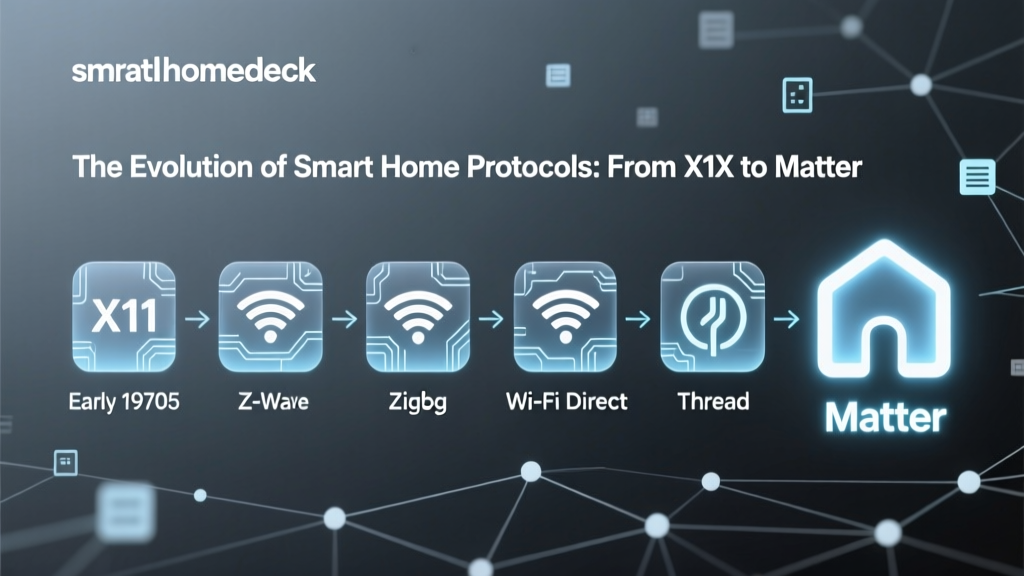
The ratification and subsequent rollout of the Matter standard was a watershed moment for the smart home industry. By uniting tech giants like Apple, Google, Amazon, and Samsung under the umbrella of the Connectivity Standards Alliance, Matter solved the industry's most glaring issue: fragmentation. Today, a Matter-certified smart plug can seamlessly communicate with an Apple HomePod, an Amazon Echo, and a Samsung SmartThings hub without requiring a proprietary cloud bridge.
However, Matter is fundamentally an application layer protocol designed for interoperability and secure messaging. It dictates how devices translate commands, but it does not inherently grant them spatial awareness. Matter can tell a smart light to turn on when a motion sensor is triggered, but it relies on rudimentary Passive Infrared (PIR) sensors or privacy-invasive optical cameras to detect that motion. It knows what a device is, but it struggles to understand where you are in the room or what you are doing without explicit, manual triggers.
So, what comes after Matter? The next frontier in smart home protocols is not about basic connectivity; it is about ambient computing and spatial perception. The industry is rapidly shifting toward two advanced wireless standards that promise to make homes truly context-aware: Ultra-Wideband (UWB) and Wi-Fi Sensing (IEEE 802.11bf).
Ultra-Wideband (UWB): Centimeter-Level Spatial Awareness
Ultra-Wideband (UWB), specifically governed by the IEEE 802.15.4z standard, is a low-power, short-range wireless protocol that transmits data across a wide spectrum of frequency bands. Unlike Bluetooth or Wi-Fi, which rely on signal strength (RSSI) to estimate distance, UWB uses Time of Flight (ToF) and Angle of Arrival (AoA) calculations. By measuring the exact time it takes for a radio pulse to travel between two devices, UWB can determine physical distance with an astonishing accuracy of 10 to 30 centimeters.
The FiRa Consortium, the leading body for UWB interoperability, has been instrumental in pushing UWB beyond automotive keyless entry and into the smart home ecosystem. Major semiconductor players like NXP Semiconductors are now producing cost-effective UWB chips (such as the SR150) designed specifically for IoT hubs, smart locks, and trackers.
How UWB Works in the Smart Home
Imagine walking up to your front door. With a traditional Bluetooth LE smart lock, the lock relies on RSSI to guess when you are close enough to unlock. This often results in "ghost unlocks" when you are just walking past the door, or frustrating delays while the lock tries to establish a secure handshake. UWB eliminates this ambiguity. Because it measures the exact time-of-flight of the radio waves, the smart lock knows precisely when you are standing two feet away, facing the door, and can unlock instantly and securely.
Furthermore, UWB is highly resistant to relay attacks—a common security vulnerability where hackers amplify a wireless signal to trick a lock or car into thinking the owner's key fob is nearby. The precise timing measurements required by the 802.15.4z standard make relay attacks virtually impossible without introducing detectable nanosecond delays.
Real-World UWB Devices and Costs
- Apple HomePod (2nd Gen) & Apple TV 4K: Equipped with the U1/U2 UWB chips, these devices act as spatial anchors. They enable precise handoff of audio from an iPhone and can direct smart home automations based on which room the user is occupying.
- Samsung SmartThings Station: While primarily a Thread border router and wireless charger, it integrates UWB to help users locate Galaxy SmartTags+ indoors with directional arrows and exact distances.
- Next-Gen Smart Locks: Brands like Schlage and Yale are beginning to integrate UWB alongside Matter and Thread to enable true passive keyless entry. Expect a premium of $40 to $70 on the retail price of UWB-enabled locks compared to their Bluetooth-only counterparts.
Wi-Fi Sensing (IEEE 802.11bf): The Invisible Mesh
While UWB requires dedicated hardware chips in both the anchor (hub) and the target (phone/tag), Wi-Fi Sensing leverages the ubiquitous hardware already present in every modern home: your Wi-Fi router and connected devices. Slated for full ratification by the IEEE as the 802.11bf standard, Wi-Fi Sensing transforms wireless interference from a nuisance into a powerful data source.
Channel State Information (CSI) Explained
Traditional Wi-Fi motion detection relied on RSSI, which is notoriously unreliable because signal strength fluctuates wildly due to walls, furniture, and even humidity. Wi-Fi Sensing utilizes Channel State Information (CSI). When a Wi-Fi signal travels from a router to a smart bulb, it bounces off walls, floors, and human bodies (multipath propagation). CSI measures the exact amplitude and phase of the signal across multiple subcarriers and antennas.
When a human body—which is mostly water and highly absorptive of 2.4GHz and 5GHz radio waves—moves through the room, it alters the CSI profile. Advanced machine learning algorithms running on the router's edge processor can analyze these micro-fluctuations to detect not just gross motion, but specific activities. Wi-Fi sensing can differentiate between a person walking, a pet running, or even the subtle chest expansions of a person breathing while sleeping.
Privacy and the End of the Optical Camera
The most profound advantage of Wi-Fi Sensing is privacy. To achieve room-level occupancy tracking today, consumers often resort to optical cameras or wearable devices. Cameras in bedrooms or bathrooms are a massive privacy risk, and wearables require users to remember to put them on and keep them charged. Wi-Fi Sensing requires no cameras, no microphones, and no wearables. It generates a point-cloud of radio reflections that cannot be reverse-engineered into an optical image, making it the ultimate privacy-preserving presence detection protocol.
Cost and Rollout: Wi-Fi 7 (802.11be) routers, such as the TP-Link Deco BE85 or Netgear Orbi 970 series (retailing between $800 and $1,500), possess the multi-link operation (MLO) and antenna arrays necessary to support early iterations of Wi-Fi sensing. As the 802.11bf standard finalizes between 2024 and 2025, firmware updates will unlock these capabilities on existing high-end Wi-Fi 7 hardware.
Protocol Comparison: Matter vs. UWB vs. Wi-Fi Sensing
To understand how these protocols will coexist, it is essential to view them not as competitors, but as complementary layers of the smart home stack. Matter handles the command, while UWB and Wi-Fi Sensing handle the context.
| Feature | Matter (over Thread/Wi-Fi) | Ultra-Wideband (802.15.4z) | Wi-Fi Sensing (802.11bf) |
|---|---|---|---|
| Primary Function | Device Interoperability & Control | Precise Spatial Tracking & Ranging | Room-Level Presence & Activity Detection |
| Accuracy | N/A (Command-based) | 10 - 30 cm | Room-level / Zone-level (approx. 1m resolution) |
| Range | 15m (Thread) / 50m (Wi-Fi) | 10m - 30m (Line of Sight preferred) | 15m - 25m (Penetrates standard drywall) |
| Power Profile | Ultra-Low (Thread) / High (Wi-Fi) | Low (Burst transmissions) | High (Router-based processing) |
| Hardware Requirement | Matter Controller & Border Router | Dedicated UWB Anchors & Tags | Wi-Fi 6E / Wi-Fi 7 MIMO Routers |
| Privacy Level | High (Local encryption) | High (No optical/biometric data) | Very High (No optical data, no wearables needed) |
Spatial Accuracy Comparison by Protocol
The AI Convergence: Contextual Ambient Computing
The true power of UWB and Wi-Fi Sensing will only be realized when paired with local Artificial Intelligence. Currently, smart home automations are rigid and binary: If motion detected, turn on lights. But human behavior is nuanced. If you walk into the living room at 8:00 PM, you might want the main lights on. If you walk in at 2:00 AM, you likely want a dim pathway light. If you sit on the couch, you want the TV to turn on; if you sit at the desk, you want the monitor to wake up.
By feeding the continuous, privacy-preserving spatial data from Wi-Fi Sensing and UWB into a local AI hub (such as Home Assistant running local LLMs, or Apple's on-device machine learning cores), the home transitions from reactive to predictive. The home learns your micro-routines. It knows you are breathing in the bedroom (via Wi-Fi CSI) and therefore suppresses the robot vacuum's cleaning cycle, even if the bedroom door is closed and a traditional PIR sensor cannot see you.
Actionable Advice: Future-Proofing Your Smart Home Today
While 802.11bf is still in the final stages of standardization, the hardware foundation is being laid right now. Here is how you can prepare your smart home for the post-Matter spatial era:
1. Invest in Wi-Fi 7 Infrastructure
Wi-Fi Sensing relies heavily on Multi-User MIMO (MU-MIMO) and multi-link operation to analyze signal reflections without dropping your internet speed. Upgrading to a Wi-Fi 7 mesh system ensures you have the antenna density required for future CSI firmware updates. Top Picks: TP-Link Deco BE85 (approx. $999 for a 2-pack) or Asus RT-BE88U (approx. $400).
2. Establish UWB Anchors
To use UWB for indoor tracking and passive entry, you need anchors placed strategically around the home. If you are in the Apple ecosystem, placing an Apple TV 4K in the living room and a HomePod (2nd Gen) in the bedroom creates a spatial mesh that tracks your iPhone's exact location for targeted audio handoff and localized automations. For Samsung users, the SmartThings Hub v4 and upcoming Station updates are building out this UWB mesh.
3. Prioritize Thread Border Routers with Spatial Chips
When buying a smart home hub, look beyond Matter/Thread support. Hubs that include UWB or mmWave radar (like the Aqara Presence Sensor FP2, which uses mmWave rather than UWB but serves a similar spatial purpose) act as the bridge between raw spatial data and Matter commands. The FP2 (approx. $70) allows you to create "virtual zones" in a room, triggering different Matter devices depending on whether you are at the sofa or the dining table.
Conclusion
Matter successfully built the universal language of the smart home, ensuring that devices can talk to one another securely and reliably. But a home that only listens to commands is not truly smart; it is merely automated. The future of the smart home lies in spatial awareness and ambient computing. As Ultra-Wideband brings centimeter-level precision to security and tracking, and Wi-Fi Sensing (802.11bf) turns our existing wireless networks into invisible, privacy-first presence detectors, the smart home will finally stop waiting for our commands and start anticipating our needs. The era of interoperability is here; the era of perception is next.