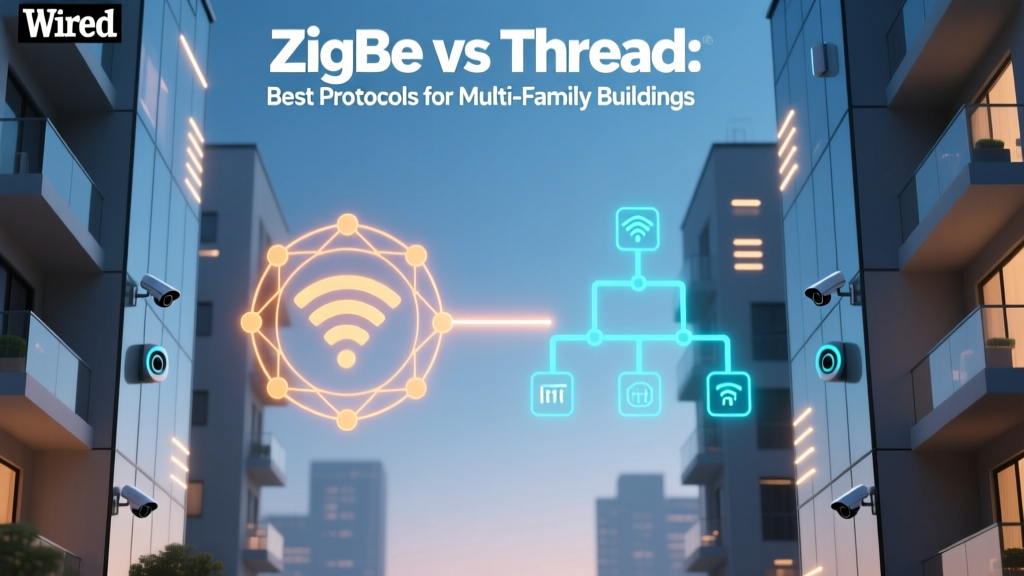
The Shift to Smart Multi-Family and Commercial Buildings
The integration of smart home technology into Multi-Dwelling Units (MDUs) and commercial real estate is no longer a luxury amenity; it is a fundamental expectation for modern tenants and a critical operational tool for property managers. Unlike single-family homes, multi-family and commercial buildings present a unique matrix of challenges. Property managers must balance high-density device deployments, severe radio frequency (RF) interference, strict tenant privacy requirements, and the need for centralized management via Property Management Systems (PMS) like Yardi or RealPage.
Choosing the right wireless protocol is the most critical decision in designing a smart building network. A protocol that works flawlessly in a 2,500-square-foot suburban home may fail catastrophically in a 300-unit concrete high-rise. In this comprehensive guide, we evaluate the leading wireless protocols—Zigbee 3.0, Thread (with Matter), Wi-Fi 6, and Wi-Fi HaLow—specifically through the lens of multi-family and commercial building deployments.
The RF Congestion Challenge in High-Density MDUs
Before diving into specific protocols, it is vital to understand the physical environment of an MDU. Modern commercial and multi-family buildings are often constructed with reinforced concrete, steel framing, and low-emissivity (Low-E) glass, all of which severely attenuate wireless signals. Furthermore, a single apartment floor with 20 units might contain over 100 individual Wi-Fi routers, hundreds of Bluetooth devices, and countless microwaves and cordless phones.
This creates a highly congested 2.4 GHz spectrum. When a property manager attempts to deploy smart leak detectors, HVAC thermostats, and smart locks across 300 units using a protocol susceptible to interference, the result is often dropped connections, delayed access control, and a flood of maintenance tickets. Therefore, the ideal MDU protocol must offer robust mesh networking, frequency agility, and low power consumption to ensure years of reliable operation without frequent battery replacements.
Zigbee 3.0: The Proven Workhorse for MDU Sub-Networks
Zigbee 3.0 has long been the backbone of professional smart home and light commercial installations. Operating on the IEEE 802.15.4 standard in the 2.4 GHz band, Zigbee utilizes a mesh network topology. In an MDU environment, this means that every mains-powered device (like a smart plug or an in-wall light switch) acts as a router, extending the network's range and reliability throughout a single unit.
Advantages for Multi-Family Deployments
- Device Density and Mesh Routing: A single Zigbee network can theoretically support up to 65,000 nodes. In practice, a dedicated commercial-grade Zigbee gateway per apartment unit can easily manage 50 to 100 devices with self-healing mesh routing that bypasses physical obstructions like concrete walls.
- Low Power Consumption: Battery-operated devices like smart locks (e.g., Yale Assure Lock 2) and leak sensors can run for 12 to 24 months on standard batteries, drastically reducing maintenance costs for property managers.
- Security via Install Codes: Zigbee 3.0 mandates the use of randomized Install Codes for device pairing, ensuring that a tenant's smart lock cannot be hijacked by a neighbor's rogue gateway.
Limitations in Commercial Spaces
The primary drawback of Zigbee in MDUs is its reliance on the crowded 2.4 GHz spectrum. While Zigbee uses Direct Sequence Spread Spectrum (DSSS) and frequency agility to avoid crowded Wi-Fi channels, severe congestion in high-density buildings can still cause latency. Furthermore, Zigbee requires a dedicated hub per unit to bridge the local mesh network to the building's central IP network, adding to the per-unit hardware cost.
Thread and Matter: The Future of IP-Based Building Management
Thread represents a paradigm shift in building automation. Like Zigbee, Thread is built on the IEEE 802.15.4 MAC layer, offering the same low-power, mesh-networking benefits. However, Thread is fundamentally an IPv6 protocol utilizing 6LoWPAN. This means every Thread device has its own IP address, eliminating the need for complex proprietary translation gateways and allowing seamless integration with enterprise IT networks.
When paired with Matter, the application layer standard developed by the Connectivity Standards Alliance (CSA), Thread becomes a powerhouse for MDUs. Matter standardizes device control, meaning a property manager can deploy a Nanoleaf Essentials bulb, an Ecobee thermostat, and a Schlage smart lock, and control them all through a single, unified API without worrying about fragmented cloud ecosystems.
Thread Border Routers in MDUs
Instead of a dedicated hub, Thread relies on Border Routers to connect the 802.15.4 mesh to the building's Wi-Fi or Ethernet network. In a multi-family setting, property managers can install a single enterprise-grade Thread Border Router in a central hallway or utilize existing smart speakers (like the Apple HomePod Mini or Amazon Echo) inside the units to act as localized Border Routers. According to the CSA Thread specifications, Thread meshes are highly resilient and can dynamically reroute data if a specific node fails or is removed.
Wi-Fi 6 and Wi-Fi HaLow: Leveraging and Upgrading IT Infrastructure
Standard Wi-Fi (802.11ac/ax) is ubiquitous, but it is notoriously power-hungry and struggles with massive IoT device density. Connecting 30 smart sensors per apartment to the building's primary Wi-Fi network will quickly exhaust the router's DHCP table and airtime, leading to network crashes. However, two Wi-Fi variants are changing the commercial landscape.
Wi-Fi 6 (802.11ax) Target Wake Time (TWT)
Wi-Fi 6 introduces Target Wake Time, a feature that allows IoT devices to negotiate exactly when and how often they will wake up to transmit data. This significantly reduces battery drain and frees up airtime for high-bandwidth tenant devices like laptops and streaming boxes. For commercial buildings providing managed Wi-Fi as a service (WaaS), Wi-Fi 6 is essential for handling basic smart thermostats and plugs.
Wi-Fi HaLow (802.11ah)
For large commercial campuses, parking garages, and sprawling multi-family complexes, Wi-Fi HaLow is a game-changer. Operating in the sub-1 GHz spectrum (typically 900 MHz), HaLow penetrates concrete and steel far better than 2.4 GHz signals and offers a range of up to 1 kilometer. It is ideal for outdoor common areas, smart irrigation systems, perimeter security cameras, and centralized utility metering, though the consumer device ecosystem for HaLow is still in its infancy.
Protocol Comparison for Commercial Real Estate
The following table summarizes how these protocols stack up when deployed in high-density, multi-family, and commercial environments.
| Protocol | Frequency Band | Power Profile | MDU Network Topology | Best MDU Use Case |
|---|---|---|---|---|
| Zigbee 3.0 | 2.4 GHz | Ultra-Low | Local Mesh + Dedicated Hub | In-unit leak sensors, smart locks, HVAC |
| Thread (Matter) | 2.4 GHz | Ultra-Low | IPv6 Mesh + Border Router | Unified lighting, smart blinds, tenant apps |
| Wi-Fi 6 (TWT) | 2.4 / 5 / 6 GHz | Medium | Star (via WAPs) | High-bandwidth thermostats, video intercoms |
| Wi-Fi HaLow | Sub-1 GHz | Low | Star (Long Range) | Outdoor lighting, utility meters, parking gates |
Visualizing Protocol Performance in High-Density Environments
To help property managers and system integrators make informed decisions, we have scored these protocols based on their suitability for high-density MDU environments. Factors include interference resistance, power efficiency, setup cost, and scalability.
Protocol Suitability Scores for High-Density MDUs
As the data illustrates, Thread (paired with Matter) edges out Zigbee due to its native IP addressing, which drastically simplifies enterprise cloud integration and API management for property management software. Wi-Fi 6 scores lowest for pure IoT density due to airtime congestion, while Wi-Fi HaLow shows immense promise for exterior and campus-wide commercial applications.
Network Architecture and Security Best Practices
Deploying smart devices in an MDU requires strict adherence to cybersecurity frameworks. According to the NIST Cybersecurity for IoT Program, building operators must ensure that IoT devices do not become entry points for malicious actors to access the building's core IT infrastructure or tenant personal data.
VLAN Segmentation
Never place smart building devices on the same Virtual Local Area Network (VLAN) as tenant Wi-Fi or the property management office's secure servers. System integrators should configure managed switches to place all Zigbee gateways, Thread Border Routers, and IP cameras onto a dedicated, isolated IoT VLAN. This ensures that if a smart bulb is compromised, the attacker cannot pivot to the building's access control servers.
Matter's Multi-Admin Feature
One of the most powerful features of the Matter protocol for MDUs is Multi-Admin. This allows a smart lock to be simultaneously paired to the property manager's commercial access control system (for automated key revocation upon lease termination) and the tenant's personal smartphone (for daily use). When the tenant moves out, the property manager can revoke the tenant's admin rights without resetting the hardware or disrupting the building's master network.
Cost Analysis and ROI for Property Managers
The financial viability of smart MDU deployments hinges on the balance between Capital Expenditure (CapEx) and Operating Expenditure (OpEx).
- Hardware Costs (CapEx): A standard Zigbee or Thread smart package per unit (including a smart lock, thermostat, leak detector, and gateway/border router) typically ranges from $350 to $600. Wi-Fi HaLow infrastructure requires specialized access points, costing upwards of $1,000 per AP, but one AP can cover massive commercial areas like parking structures.
- Maintenance Savings (OpEx): Early detection of water leaks via Zigbee/Thread sensors can prevent catastrophic water damage, saving tens of thousands of dollars per incident. Furthermore, smart thermostats in vacant units can be locked to eco-modes, reducing building-wide HVAC costs by 15% to 20%.
- Rent Premiums: Industry data consistently shows that Class A and Class B multi-family properties with integrated smart home packages can command a 3% to 5% premium on monthly rent, yielding a full ROI on the hardware within 18 to 24 months.
Conclusion
Designing a smart network for multi-family and commercial buildings requires moving beyond consumer-grade assumptions. While Wi-Fi remains essential for tenant broadband, the building's operational IoT layer is best served by dedicated mesh protocols. Zigbee 3.0 remains a highly reliable, cost-effective choice for localized in-unit deployments. However, the combination of Thread and Matter represents the future of commercial real estate technology, offering native IP integration, robust security, and the multi-admin capabilities necessary for seamless property management. By prioritizing network segmentation, leveraging low-power mesh topologies, and selecting enterprise-grade hardware, building owners can create resilient smart environments that enhance tenant satisfaction and drive long-term operational efficiency.