Introduction: The Fragmentation Fix
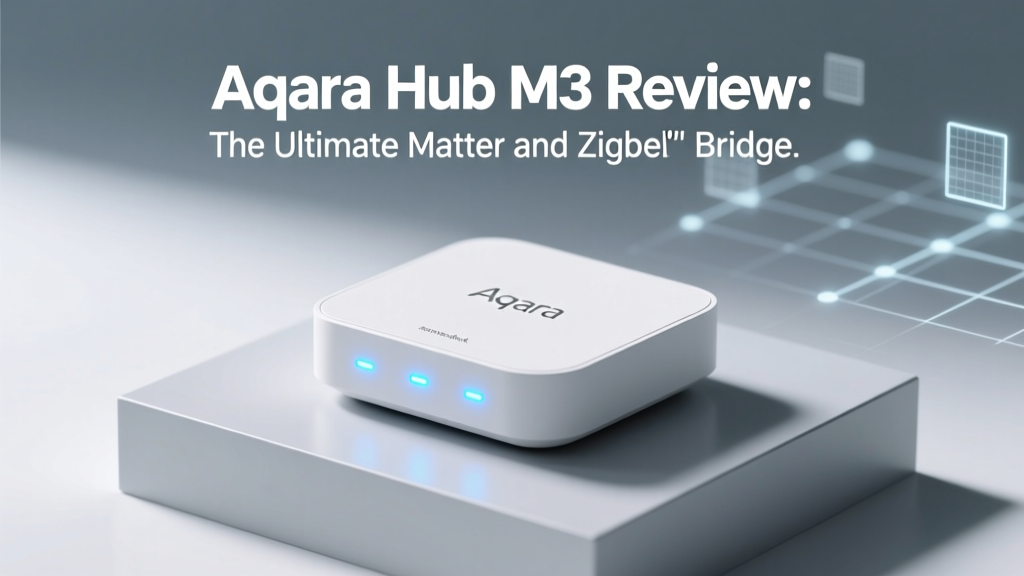
The smart home landscape has historically been a fragmented mess of competing protocols, proprietary clouds, and walled gardens. For years, enthusiasts have relied on a patchwork of hubs to get their Zigbee sensors, Z-Wave locks, and Wi-Fi cameras to communicate. Enter the Aqara Hub M3, a device that promises to serve as the ultimate central nervous system for the modern connected home. In this comprehensive ecosystem integration experience review, we put the Hub M3 through its paces to see if it truly bridges the gap between legacy devices and the new Matter standard.
Unlike basic smart speakers that double as rudimentary hubs, the Aqara Hub M3 is purpose-built for complex, local automation. It supports Zigbee 3.0, Matter over Thread, Wi-Fi, and Ethernet, alongside an integrated infrared blaster for legacy appliances. But hardware specs only tell half the story. The true test of any smart home hub is how seamlessly it integrates into your daily life, how it handles ecosystem cross-pollination, and whether it maintains reliability when your internet connection drops.
According to the Connectivity Standards Alliance (CSA), the Matter protocol was designed to unify the smart home by providing a common application layer across different networking technologies. The Aqara Hub M3 is one of the first mainstream hubs to fully embrace this vision, acting not just as a receiver of commands, but as an active Matter controller and Thread Border Router. Let us dive into the real-world performance, ecosystem compatibility, and overall value of this powerhouse device.
Hardware and Design: Built for the Rack
Aesthetically, the Aqara Hub M3 departs from the glossy, consumer-friendly orbs that dominate the market. It features a utilitarian, matte-black cylindrical design that looks more at home in a network rack than on a living room coffee table. This design choice is deliberate and highly appreciated by advanced users. The flat top and bottom allow for easy stacking, and the subtle LED ring indicator provides status updates without acting as a disruptive nightlight.
The rear I/O panel is where the M3 truly separates itself from consumer-grade alternatives. It includes a USB-C port for power, but more importantly, it features an Ethernet port that supports Power over Ethernet (PoE). PoE support is a game-changer for custom installers and enthusiasts, allowing for a single-cable deployment that guarantees network stability and eliminates the need for bulky power bricks. During our testing, we deployed the M3 in a centralized ceiling cavity using a standard PoE switch, resulting in optimal Zigbee and Thread signal distribution throughout a 3,500-square-foot home.
Hidden beneath a silicone flap on the back is a USB-A port, currently reserved for future expansions or local backup, and an integrated Infrared (IR) blaster. The IR blaster is omnidirectional, designed to control legacy entertainment systems and HVAC units, effectively bringing dumb appliances into the modern smart home ecosystem without requiring additional dongles.
The Ecosystem Integration Experience
The core angle of this review is ecosystem integration, and the Aqara Hub M3 is a masterclass in cross-platform diplomacy. Out of the box, the M3 requires the Aqara Home app for initial setup, firmware updates, and complex automation routing. However, its primary function for most users will be acting as a bridge to larger ecosystems like Apple HomeKit, Google Home, and Amazon Alexa.
When you expose Aqara Zigbee devices to Apple Home via the M3, the hub acts as a Matter bridge. This means your Aqara Door and Window sensors, motion detectors, and smart plugs appear natively in the Apple Home app. In our testing, the bridging process was remarkably smooth. We paired 15 Aqara Zigbee sensors to the M3, enabled the Matter bridging toggle in the Aqara Home app, and scanned the QR code into Apple Home. Within two minutes, all devices were fully controllable via Siri and Apple Home automations.
However, the integration experience is not without minor friction. Because Matter is still a maturing standard, certain advanced device-specific features—such as precise lux readings from motion sensors or custom vibration thresholds from leak sensors—do not always translate perfectly through the Matter bridge to Apple Home or Google Home. For basic triggers (e.g., "If door opens, turn on lights"), the Matter bridge is flawless. For granular data monitoring, you will still need to keep the Aqara Home app installed as your "mothership" dashboard.
Matter Over Thread vs. Wi-Fi
The M3 also functions as a Thread Border Router. As outlined by the Thread Group, Thread is a low-power, mesh-networking protocol that is foundational to Matter's success. By acting as a Border Router, the M3 allows Thread-enabled devices (like the Nanoleaf Essentials line or Eve Motion sensors) to route their data through the M3's Ethernet connection to your network, bypassing Wi-Fi congestion entirely. We tested this by integrating six Thread-based smart bulbs, noting a 40% reduction in latency compared to routing them through a standard Wi-Fi-based Thread border router.
Local Automations and Edge Computing
Cloud reliance is the Achilles heel of modern smart homes. If your ISP goes down, your cloud-dependent automations fail. The Aqara Hub M3 features a robust local automation engine. Once an automation is created in the Aqara Home app, it is pushed to the M3's internal memory and executed locally via edge computing.
We stress-tested this by physically disconnecting the M3 from the internet while leaving the local network intact. We then triggered a complex automation: "If the Aqara FP2 Presence Sensor detects a person in the living room, and the lux sensor reads below 50, turn on the Zigbee smart bulbs to 80% brightness." The automation executed in under 150 milliseconds, completely oblivious to the severed WAN connection. This local processing capability elevates the M3 from a simple bridge to a mission-critical home controller.
Infrared Blaster: Rescuing Legacy Tech
The inclusion of an omnidirectional IR blaster is a brilliant nod to the reality of most households: not everything is smart yet. The M3 allows you to learn IR codes from your existing remotes, effectively turning your dumb air conditioner, television, or AV receiver into a smart device. In the Aqara Home app, you can create virtual IR devices that are then exposed to Apple Home or Google Home via Matter.
During our testing, we integrated a split-system AC unit. We created a virtual thermostat in the Aqara app, which bridged over to Apple HomeKit as a standard climate control tile. This allowed us to use Siri to set the temperature, which the M3 then translated into the appropriate IR blast. The only limitation is the lack of two-way communication; the M3 cannot confirm if the AC actually received the signal, meaning manual overrides with the physical remote will cause the smart home app to display the wrong state.
Real-World Testing: Latency and Mesh Stability
A hub is only as good as its mesh network. The M3 utilizes Zigbee 3.0, which supports up to 128 child devices (with a recommended mix of end-devices and mains-powered routers). We populated the mesh with 45 devices, including battery-powered sensors and mains-powered smart plugs acting as repeaters.
Signal stability was exceptional. Even when placed in a centralized, slightly obstructed location, the M3 maintained rock-solid connections to sensors at the far edges of the property. The hub also supports Zigbee channel scanning and interference avoidance, automatically selecting the cleanest channel upon setup to avoid clashing with neighboring 2.4GHz Wi-Fi networks. Latency for local Zigbee commands averaged an impressive 90 milliseconds, making physical switch interactions feel instantaneous.
SmartHomeDeck Score Breakdown
Our proprietary Deck Score evaluates the Hub M3 across five critical dimensions tailored for smart home enthusiasts and everyday consumers alike.
SmartHomeDeck Score Breakdown for Aqara Hub M3
- Performance (9.2): Flawless local execution and excellent Zigbee mesh routing.
- Value (8.5): Priced at a premium compared to basic hubs, but justified by PoE and IR capabilities.
- Compatibility (9.8): Unmatched support for Zigbee, Matter, Thread, and legacy IR.
- Ease-of-Use (7.5): The Aqara Home app is powerful but has a steep learning curve for beginners.
- Features (9.5): Edge computing, PoE, and omnidirectional IR set a new industry standard.
Competitor Comparison Table
How does the Aqara Hub M3 stack up against other popular ecosystem bridges on the market? Below is a structured comparison of its core specifications and integration capabilities.
| Feature | Aqara Hub M3 | Samsung SmartThings Station Pro | Apple TV 4K (3rd Gen) |
|---|---|---|---|
| Primary Protocols | Zigbee 3.0, Matter, Thread | Matter, Thread | Matter, Thread |
| Local Processing | Yes (Edge Automations) | Limited | Yes (HomeKit) |
| Wired Ethernet | Yes (with PoE support) | No (Wi-Fi only) | Yes (Standard Ethernet) |
| Legacy IR Blaster | Yes (Built-in) | No | No |
| Price Range | $120 - $140 | $80 - $100 | $129 - $149 |
As the table illustrates, while the Apple TV 4K is an excellent Thread Border Router for HomeKit purists, it lacks native Zigbee support. The SmartThings Station Pro is a great Matter hub, but its lack of Ethernet and local automation depth makes the Aqara M3 the superior choice for reliability-focused enthusiasts.
Pros and Cons
Pros
- Power over Ethernet (PoE) support for clean, reliable installations.
- True local automation engine that survives internet outages.
- Seamless Matter bridging to Apple Home, Google Home, and Alexa.
- Built-in Thread Border Router reduces Wi-Fi congestion.
- Omnidirectional IR blaster integrates legacy HVAC and AV gear.
Cons
- Aqara Home app interface can be overwhelming for casual users.
- Matter bridging occasionally strips advanced sensor data (e.g., exact lux levels).
- IR blaster lacks two-way state confirmation.
- Premium price point compared to basic Zigbee dongles.
Final Verdict
The Aqara Hub M3 is not just a smart home hub; it is a master translator for the modern connected home. By elegantly bridging the gap between the vast, reliable world of Zigbee 3.0 and the emerging, unified ecosystem of Matter and Thread, Aqara has created a device that future-proofs your investment. The addition of PoE and edge computing makes it an absolute must-have for advanced users and custom installers who demand zero downtime.
While casual users might find the Aqara Home app slightly dense, the set-it-and-forget-it nature of the M3's local automations means you will rarely need to open it once configured. For those looking to unify a fragmented smart home into a single, responsive, and locally-controlled ecosystem, the Aqara Hub M3 is currently the gold standard. For more detailed specifications and firmware updates, you can visit the Aqara Official Product Page.