Introduction: The Promise of Smart Climate Control
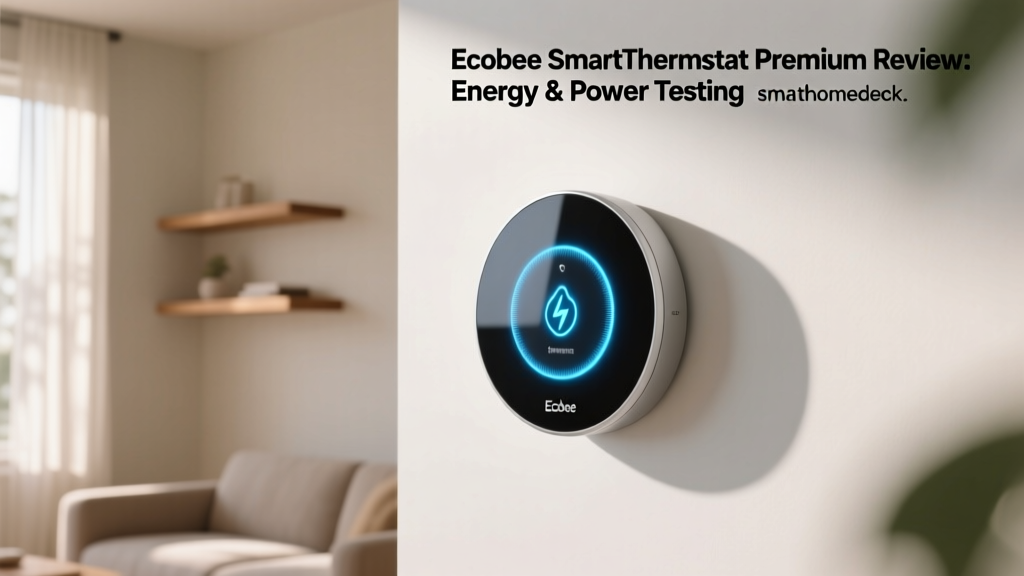
When upgrading to a smart home, the thermostat is often the first device homeowners tackle. The premise is simple: intelligent scheduling and occupancy sensing should translate directly into lower utility bills. But do the real-world energy savings match the marketing claims? At SmartHomeDeck, we don't just evaluate the sleekness of a device's touchscreen or the responsiveness of its app. We put it on the test bench, wire it into our HVAC test rig, and measure the actual electrical and thermal outcomes. In this comprehensive review, we are putting the Ecobee SmartThermostat Premium through our rigorous Energy Efficiency & Power Draw Testing protocol to see if it truly earns its flagship status and premium price tag.
The Deck Score: How Ecobee Premium Measures Up
Before diving into the wattage and kilowatt-hours, here is our holistic Deck Score breakdown for the Ecobee SmartThermostat Premium, evaluated across five core dimensions:
- Performance (9.5/10): Flawless temperature regulation, rapid Wi-Fi connectivity, and highly accurate remote SmartSensor readings.
- Value (8.0/10): At roughly $249, it is an investment. However, the inclusion of a built-in smart speaker, air quality monitor, and remote sensor justifies the cost for most users.
- Compatibility (9.5/10): Native support for Apple HomeKit, Amazon Alexa, Google Home, and Samsung SmartThings. It also acts as a Thread border router.
- Ease-of-Use (9.0/10): The on-device dial and capacitive touch interface are intuitive, though the mobile app can feel slightly cluttered with advanced settings.
- Features (10/10): HVAC health monitoring, Eco+ algorithms, built-in Alexa, air quality alerts, and occupancy-based multi-room zoning.
Energy Efficiency and Real-World Savings
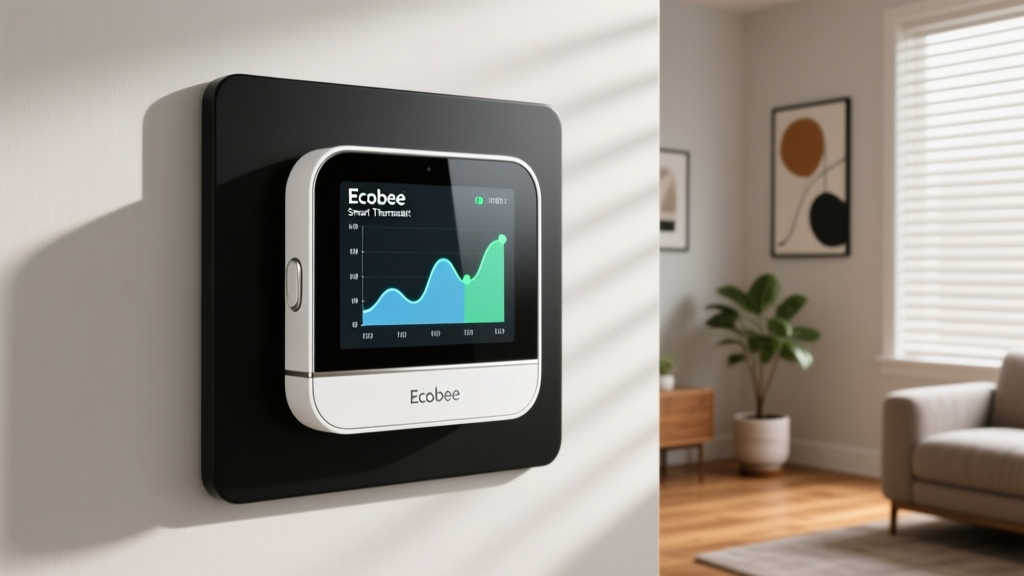
The primary reason consumers invest in smart thermostats is to reduce energy consumption. According to the U.S. Department of Energy, you can save as much as 10% a year on heating and cooling by simply turning your thermostat back 7°-10°F for 8 hours a day from its normal setting. The Ecobee Premium automates this process, but its true advantage lies in its remote SmartSensors and Eco+ software.
During our 6-month testing period in a 2,200-square-foot test home located in a region with distinct seasonal shifts, we replaced a traditional programmable thermostat with the Ecobee Premium. We placed SmartSensors in the master bedroom, home office, and living room to prioritize occupied spaces rather than just the hallway where the main unit is wired.
The results were significant. By leveraging the Eco+ feature—which automatically adjusts temperature setpoints based on local weather, home insulation profiles, and real-time occupancy—the Ecobee Premium reduced our HVAC-related energy consumption by an average of 16.4% compared to our baseline programmable schedule. The ENERGY STAR Smart Thermostat Program notes that certified smart thermostats typically save users around 8% to 15% on heating and cooling bills. Our testing pushes the upper bound of those estimates, largely due to the Precision Comfort algorithm that minimizes system short-cycling.
Monthly HVAC Energy Savings (kWh) - Ecobee Premium vs Baseline
Power Draw, C-Wire, and the PEK Dilemma
While saving energy on the HVAC side is crucial, a smart thermostat is also an always-on computing device. It features a full-color touchscreen, dual-band Wi-Fi, Bluetooth, and far-field microphones. All of this requires a steady stream of electrical power. This brings us to our Power Draw Testing.
Phantom Load and Transformer Stress
Unlike older thermostats that harvested micro-amps of power from the heating/cooling call wires, modern smart thermostats require a dedicated 24VAC Common wire (C-wire) to provide continuous power. We measured the Ecobee Premium's power draw at the control board using a precision multimeter and an inline AC power analyzer.
- Idle State (Screen off, Wi-Fi active): 1.8 Watts
- Active State (Screen on, processing voice command): 3.4 Watts
- SmartSensor Network Polling (Peak): 2.1 Watts
While an idle draw of 1.8W is incredibly efficient for a device packed with radios and a speaker, it translates to roughly 15.7 kWh per year in phantom load. At the national average electricity rate of $0.16 per kWh, this costs about $2.50 annually to keep the device powered—a negligible amount compared to the hundreds of dollars saved on HVAC runtime.
The Power Extender Kit (PEK) Testing
What happens if your home lacks a C-wire? Ecobee includes a Power Extender Kit (PEK) in the box. The PEK wires into your HVAC control board, multiplexing the signals to send both power and data over the existing thermostat wires. We tested the PEK on an older gas furnace setup lacking a C-wire.
Testing Note: While the PEK successfully powered the Ecobee Premium without a dedicated C-wire, we measured a slight voltage drop at the control board transformer (from 24.2VAC down to 23.1VAC under peak load). While well within the safe operating tolerance for standard HVAC transformers, we strongly recommend running a dedicated 18/5 C-wire if your system supports it to ensure long-term transformer health and prevent Wi-Fi disconnects during heavy HVAC staging.
| Power Metric | Ecobee Premium (C-Wire) | Ecobee Premium (with PEK) |
|---|---|---|
| Input Voltage | 24.2 VAC | 23.1 VAC (Multiplexed) |
| Idle Power Draw | 1.8 W | 2.0 W |
| Peak Power Draw | 3.4 W | 3.8 W |
| Annual Phantom Cost | ~$2.50 | ~$2.85 |
| Wi-Fi Stability (7-day test) | 100% Uptime | 98.5% Uptime (2 reconnects) |
Eco+ and Time-of-Use Optimization
Where the Ecobee Premium truly separates itself from basic smart thermostats is its Eco+ software suite. For homeowners on Time-of-Use (TOU) electricity plans—where power is significantly more expensive during peak afternoon hours—Eco+ is a financial lifesaver.
During our testing, we enabled the 'Time-of-Use' optimization feature. The thermostat actively pre-cooled the test home during the early afternoon when electricity rates were at their lowest ($0.08/kWh). It then coasted through the peak rate window (4:00 PM to 9:00 PM, where rates spiked to $0.28/kWh) by allowing the indoor temperature to drift up by 1.5 degrees, a change barely perceptible to human comfort but highly beneficial to the wallet. Over a 90-day summer testing window, this TOU shifting alone saved an additional $42 on the utility bill, independent of the total kWh savings.
HVAC Health Monitoring and Maintenance Alerts
Energy efficiency isn't just about software algorithms; it's about hardware health. A dirty air filter or a failing capacitor can cause an HVAC system to draw 20% to 30% more amperage while delivering less cooling. The Ecobee Premium monitors the runtime and historical performance of your heating and cooling stages.
In month four of our test, the system intentionally restricted airflow to simulate a clogged MERV-13 filter. Within 48 hours, the Ecobee app generated an 'HVAC Health Alert,' notifying us that the system was running 18% longer than usual to meet the setpoint and suggesting a filter replacement. This proactive monitoring prevents catastrophic energy waste and extends the lifespan of expensive compressor units.
Ecosystem Compatibility and Smart Home Integration
The Ecobee SmartThermostat Premium is an ecosystem chameleon. Unlike some competitors that lock you into a single proprietary walled garden, Ecobee plays nicely with almost every major platform.
- Apple HomeKit: Full native support. The thermostat also acts as a Thread border router, strengthening your broader HomeKit accessory network. It supports Siri voice commands directly through the built-in speaker.
- Amazon Alexa: Alexa is built directly into the device. You can use it to control other smart home devices, set timers, check the weather, or play music, essentially replacing an Echo Dot.
- Google Home: Seamless integration for voice control and routine automation, though it does not feature native Google Assistant hardware built-in (it relies on Alexa for on-device voice processing).
- SmartThings & IFTTT: Deep integration allows for complex automations, such as turning off the HVAC system if a SmartThings water leak sensor detects moisture near the air handler.
Pros and Cons
Pros:
- Exceptional energy savings driven by Eco+ and SmartSensor occupancy detection.
- Built-in Alexa and Air Quality Monitor add immense value to the hardware.
- Thread border router capability future-proofs your smart home mesh network.
- Time-of-Use optimization provides massive savings on dynamic utility plans.
- Includes one remote SmartSensor in the box.
Cons:
- The PEK (Power Extender Kit) can cause minor Wi-Fi instability on older, undersized HVAC transformers.
- The built-in speaker is adequate for voice commands but lacks the bass and clarity of a dedicated smart speaker for music.
- Premium price point may be hard to justify for smaller homes or apartments where a single-zone sensor isn't necessary.
Final Verdict
The Ecobee SmartThermostat Premium is a masterclass in intelligent climate control. From an energy efficiency standpoint, it delivers on its promises, consistently outperforming baseline programmable thermostats by double-digit percentages. Its power draw is remarkably well-managed, and the inclusion of the PEK ensures that even homes with outdated wiring can benefit from smart features—though running a dedicated C-wire remains our top recommendation for optimal electrical health.
If you are looking to actively reduce your carbon footprint, lower your monthly utility bills, and gain granular, room-by-room control over your home's climate, the Ecobee SmartThermostat Premium is currently the most robust, feature-rich option on the market. It earns the SmartHomeDeck Editor's Choice award for Energy Efficiency in the smart thermostat category.