The Hidden Cost of Convenience: Cloud Dependency in Smart Cameras
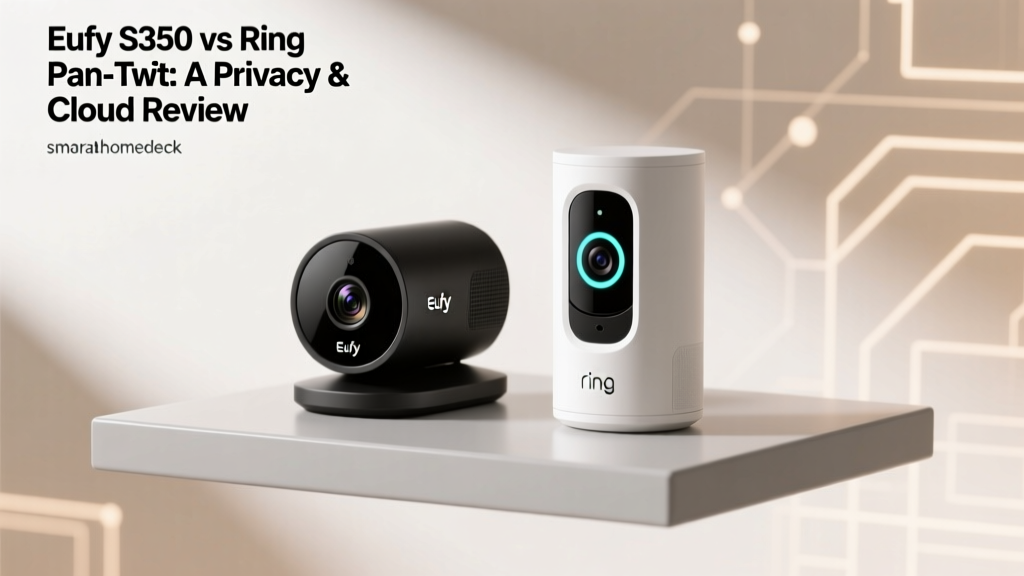
When you bring a smart camera into your home, you are implicitly making a trade-off: convenience for data. Indoor security cameras are no longer just passive recording devices; they are active, internet-connected sensors that map the layout of your home, recognize the faces of your family members, and listen for the distinct sound of breaking glass or crying babies. But where does that data go? In this SmartHomeDeck privacy and cloud dependency evaluation, we are putting two of the most popular indoor cameras head-to-head: the Eufy Indoor Cam S350 and the Ring Pan-Tilt Indoor Cam.
Our evaluation goes beyond standard image quality and pan-tilt mechanics. We are analyzing these devices through the lens of data sovereignty, local storage viability, ecosystem lock-in, and network security. According to the Mozilla Foundation's Privacy Not Included guide, consumer smart home devices frequently suffer from opaque data-sharing policies, mandatory cloud processing, and vulnerabilities that can expose intimate moments to third parties. By examining the Eufy S350 and Ring Pan-Tilt, we aim to answer a critical question for the modern smart home enthusiast: Can you achieve top-tier AI tracking and security without surrendering your privacy to the cloud?
The Cloud Dependency Dilemma: What Happens When the Internet Goes Down?
Cloud dependency is the Achilles' heel of the modern smart home. A cloud-first camera relies on remote servers to process motion detection, generate push notifications, and store historical video clips. When your internet connection drops, or when a manufacturer's AWS instance experiences an outage, a cloud-dependent camera effectively becomes a blind paperweight. Furthermore, cloud dependency introduces 'subscription fatigue'—a model where the hardware you purchased outright is artificially crippled unless you pay a monthly toll.
From a privacy perspective, cloud processing means your video feeds are constantly traversing the public internet. Even with encryption in transit, the metadata regarding when you are home, when you sleep, and who visits your house is logged on corporate servers. The NIST IoT Cybersecurity Program emphasizes the principle of 'data minimization,' suggesting that IoT devices should only collect and transmit the data strictly necessary for their function. Cameras that mandate cloud uploading for basic motion alerts fundamentally violate this principle, exposing users to potential data breaches and unauthorized law enforcement requests.
Eufy Indoor Cam S350: The Local Storage Champion?
The Eufy Indoor Cam S350 is a hardware marvel. Featuring a dual-lens setup (a 3K wide-angle lens and a 2K telephoto tracking lens), it offers unparalleled AI subject tracking without the mechanical whirring of a pan-tilt motor. But its true value proposition for privacy advocates is its compatibility with the Eufy HomeBase 3, which enables local, on-premises storage via an internal 2.5-inch SATA hard drive bay.
Real-World Testing: The Unplug Test
During our real-world testing, we configured the S350 to record exclusively to the HomeBase 3. We then physically unplugged the primary internet router. The result? The camera continued to track subjects, record high-bitrate 3K video, and store clips locally without dropping a single frame. The AI processing for human and pet detection is handled on the edge (via the HomeBase's BionicMind chip), meaning your video feeds are not being sent to Anker's servers for analysis.
The Elephant in the Room: The Thumbnail Controversy
No privacy review of Eufy is complete without addressing the late-2022 controversy, where security researchers discovered that Eufy was storing unencrypted thumbnail images of user feeds on AWS cloud servers to facilitate push notifications, despite marketing claims of 'zero cloud storage.' Eufy has since updated its architecture, allowing users to opt-out of cloud thumbnail generation entirely if they are willing to accept slightly delayed push notifications. While this transparency is appreciated, it serves as a reminder that 'local storage' marketing claims require rigorous verification. Today, with RTSP (Real-Time Streaming Protocol) enabled and cloud thumbnails disabled, the S350 remains one of the most privacy-respecting cameras on the market, provided you invest in the HomeBase ecosystem.
Ring Pan-Tilt Indoor Cam: The Cloud-First Ecosystem
Ring, owned by Amazon, takes a fundamentally different approach. The Ring Pan-Tilt Indoor Cam offers a 1080p resolution with a mechanical 360-degree pan and 160-degree tilt, allowing a single camera to cover an entire living room or nursery. The setup process is seamless, deeply integrated into the Alexa ecosystem, and the app interface is undeniably user-friendly. However, this convenience comes at a strict privacy cost.
Mandatory Subscriptions and Data Harvesting
Without a Ring Home subscription (starting at $4.99/month), the Ring Pan-Tilt is essentially a live-view-only device. It cannot record clips, save historical events, or provide rich notifications. This forced cloud dependency means every motion event must be uploaded to Amazon's servers. Furthermore, Ring's ecosystem includes the 'Neighbors' app, a localized social network for crime reporting that has faced intense scrutiny for its partnerships with law enforcement agencies. While Ring has recently updated its policies to require user consent before sharing video with police, the foundational architecture of the device is built around cloud data aggregation.
Amazon Sidewalk and Network Bandwidth
Another critical privacy and network consideration is Amazon Sidewalk. By default, Ring devices act as 'Sidewalk Bridges,' sharing a small slice of your home's internet bandwidth and Bluetooth Low Energy (BLE) signals with neighboring Amazon devices to keep the broader IoT network online. While this improves device connectivity for outdoor sensors, many privacy advocates argue that opting consumers into a mesh network that extends beyond their property line without explicit, upfront consent is a violation of network sovereignty. You can disable Sidewalk in the Ring app, but it requires manual intervention.
Head-to-Head Privacy & Data Comparison
To break down the architectural differences between these two devices, we have compiled a comprehensive privacy and dependency matrix.
| Feature / Metric | Eufy Indoor Cam S350 (with HomeBase 3) | Ring Pan-Tilt Indoor Cam |
|---|---|---|
| Local Storage Support | Yes (HomeBase 3 internal HDD / MicroSD) | No (Cloud Only) |
| Mandatory Subscription | No (Full features available locally) | Yes (Required for recording & smart alerts) |
| AI Processing Location | On-Premise (Edge Computing via HomeBase) | Cloud Servers (AWS) |
| Offline Recording | Yes (Continues recording locally) | No (Device is disabled offline) |
| RTSP / ONVIF Support | Yes (Allows integration with BlueIris/Frigate) | No (Closed Ecosystem) |
| Third-Party Data Sharing | Minimal (Optional thumbnail sync) | High (Neighbors App, Sidewalk Mesh) |
| End-to-End Encryption | Yes (AES-128 for local & remote viewing) | Optional (Must be manually enabled, breaks some features) |
SmartHomeDeck Scoring & Visualization
Our proprietary Deck Score evaluates products across five critical dimensions. As visualized below, the Eufy S350 dominates in Privacy and Cloud Independence, while the Ring Pan-Tilt edges out slightly in Ease of Use due to its frictionless, albeit cloud-reliant, setup process.
Actionable Advice: Securing Your Indoor Camera Network
Regardless of which camera you choose, relying solely on the manufacturer's default settings is a security risk. Following the CISA IoT Security Best Practices, we strongly recommend implementing network segmentation for all smart home cameras.
- Create a Dedicated IoT VLAN: Most modern mesh routers (like Asus, Ubiquiti, or TP-Link Omada) allow you to create a Virtual Local Area Network (VLAN) specifically for IoT devices. This isolates your cameras from your primary network, preventing a compromised camera from accessing your personal computers, NAS drives, or smartphones.
- Implement DNS Sinkholing: Use a network-wide DNS sinkhole like Pi-hole or AdGuard Home. By monitoring the DNS requests made by your cameras, you can identify and block unauthorized telemetry, tracking domains, and unnecessary cloud 'phone-home' requests that do not affect core functionality.
- Leverage RTSP for Local NVRs: If you use the Eufy S350, enable the RTSP stream and route it to a local Network Video Recorder (NVR) software like Frigate or BlueIris. This allows you to utilize advanced, open-source AI object detection (like YOLO models) entirely on your own hardware, completely bypassing the manufacturer's app ecosystem for daily monitoring.
- Physical Privacy Shutters: Software toggles can fail or be exploited. For indoor cameras, especially in private areas like bedrooms or nurseries, prioritize devices with physical privacy shields or utilize smart plugs to physically cut power to the camera when you are home.
Final Verdict: Which Camera Respects Your Privacy?
The choice between the Eufy Indoor Cam S350 and the Ring Pan-Tilt Indoor Cam ultimately comes down to your tolerance for cloud dependency and your willingness to manage a local smart home infrastructure.
If you prioritize data sovereignty, zero monthly fees, and offline reliability, the Eufy Indoor Cam S350 paired with the HomeBase 3 is the undisputed winner. Its dual-lens AI tracking is superior, and its support for local storage and RTSP makes it a favorite among privacy-conscious smart home enthusiasts. The initial hardware cost is higher, but the long-term value and peace of mind are unmatched.
Conversely, the Ring Pan-Tilt Indoor Cam is strictly recommended only for users who are already deeply entrenched in the Amazon Alexa ecosystem, who do not mind paying a perpetual monthly subscription, and who are comfortable with their video metadata residing on corporate cloud servers. It is an easy-to-use device, but its fundamental architecture is at odds with the principles of local data privacy.
At SmartHomeDeck, we believe that security should not require the sacrifice of privacy. By choosing edge-computed, locally stored devices, you can protect your home from intruders without inviting corporate surveillance into your living room.