Introduction to Matter and Energy Monitoring
The smart home landscape has undergone a massive paradigm shift with the introduction of the Matter protocol. No longer are consumers locked into proprietary ecosystems or forced to juggle half a dozen different apps just to turn on their living room lamps. Matter promises universal compatibility, local control, and enhanced security. But beyond simple on/off switching, one of the most practical applications of smart plugs is energy monitoring. As utility rates continue to climb globally, understanding your household's energy consumption is no longer just an environmentalist's pursuit; it is a financial necessity.
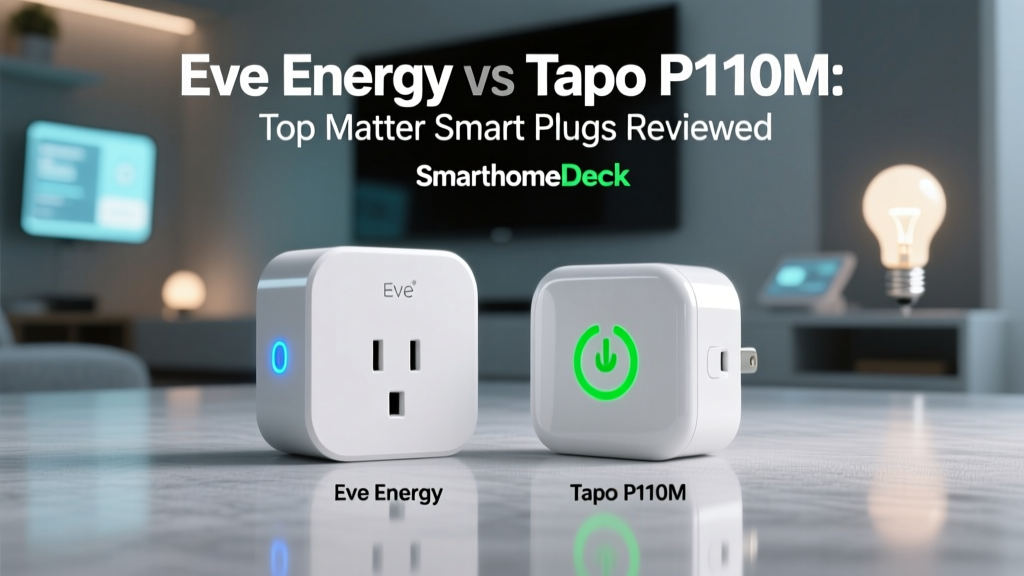
According to the U.S. Department of Energy, 'vampire power' or standby power can account for up to 10% of a household's total electricity usage. Devices left in standby mode—ranging from gaming consoles to coffee makers with digital clocks—silently drain your wallet. To combat this, energy-monitoring smart plugs have become essential tools for the modern smart home. In this comprehensive review, we put two of the most highly anticipated Matter-compatible smart plugs to the test: the premium Eve Energy (Matter Edition) and the budget-friendly TP-Link Tapo P110M.
Our testing methodology involves rigorous real-world usage, measuring standby power detection thresholds, evaluating the accuracy of high-load tracking, and assessing the seamless integration of Matter across Apple Home, Google Home, and Amazon Alexa ecosystems. Whether you are a data nerd looking to export CSV files of your refrigerator's compressor cycles or a casual user wanting to shut off your entertainment center at midnight, this review will help you decide which smart plug deserves a spot on your wall.
The Matter Protocol: Why It Changes Everything
Before diving into the hardware, it is crucial to understand why Matter is the defining feature of these plugs. The Connectivity Standards Alliance (CSA) developed Matter to be an open-source, royalty-free connectivity protocol. Unlike older Zigbee or Z-Wave devices that required proprietary hubs, or Wi-Fi plugs that clogged up your router and relied heavily on cloud servers, Matter operates locally. This means faster response times, continued functionality during internet outages, and native integration into your smartphone's built-in smart home app.
Furthermore, the National Institute of Standards and Technology (NIST) has long advocated for standardized smart grid and home energy management interoperability. Matter aligns perfectly with these goals by allowing energy data to be queried locally by different controllers without routing sensitive usage data through third-party cloud servers. Both the Eve Energy and Tapo P110M leverage this, though they take different underlying network approaches: Eve utilizes Thread (a low-power mesh network), while Tapo relies on Wi-Fi.
Eve Energy (Matter Edition): The Premium Thread Powerhouse
Design and Build Quality
Eve has long been synonymous with premium Apple HomeKit accessories, and their transition to Matter has not diluted their build quality. The Eve Energy Matter Edition features a sleek, glossy white polycarbonate shell with a subtle LED ring that indicates power status. Its compact, circular design is intentionally engineered to avoid blocking adjacent outlets on standard duplex wall receptacles—a common frustration with bulkier smart plugs. The physical button on the side offers a satisfying, tactile click, allowing for manual override without the use of a smartphone.
Energy Tracking Accuracy and Software
Where Eve truly shines is in its granular energy tracking. During our testing with a Kill A Watt baseline meter, the Eve Energy proved exceptionally accurate, tracking loads within a 1-2% margin of error. More impressively, its standby power detection threshold is incredibly low. It successfully registered the 0.5-watt standby draw of a modern LED television, a feat many cheaper plugs fail to accomplish. The Eve app provides beautiful, interactive graphs showing daily, weekly, and monthly consumption, and even projects annual costs based on your local utility rates. Furthermore, Eve allows users to export this data to CSV, a massive plus for home automation enthusiasts who want to pipe data into Home Assistant or Grafana dashboards.
Ecosystem and Matter Performance
Because Eve utilizes Thread, it requires a Thread Border Router (such as an Apple TV 4K, HomePod Mini, or Nest Hub) to communicate with your network. Once paired via the Matter QR code, the plug appears natively in Apple Home, Google Home, and Alexa. In Apple Home, the energy data is presented beautifully, and you can create automations based on power draw (e.g., 'Turn off the plug if power drops below 2 watts for 5 minutes'). However, Thread's reliance on a robust mesh network means that if your border router is too far away, you may experience pairing delays or latency.
TP-Link Tapo P110M: The Budget Wi-Fi Champion
Design and Build Quality
The Tapo P110M takes a more utilitarian approach. It is slightly bulkier than the Eve, featuring a matte white finish and a more pronounced rectangular shape. While it generally does not block the second socket on a standard US wall plate, it might feel cramped on tight power strips. The build quality is solid, though it lacks the premium heft of the Eve. A small LED indicator on the front can be toggled off via the app, which is a thoughtful addition for bedroom or home theater use where ambient light pollution is a concern.
Energy Tracking Accuracy and Software
Despite costing nearly half the price of the Eve, the Tapo P110M's energy monitoring is remarkably competent. It accurately tracked high-draw appliances like a 1500W space heater and a 1200W microwave without overheating or dropping the connection. However, its low-end sensitivity is not quite as refined as Eve's; it struggled to consistently register standby loads below 1.2 watts. The Tapo app is feature-rich, offering real-time power draw, historical usage charts, and cost calculations. Unfortunately, TP-Link does not currently offer a native CSV export feature within the Tapo app, which may deter advanced data hoarders.
Ecosystem and Matter Performance
The P110M connects via standard 2.4GHz Wi-Fi. This means it does not require a Thread Border Router, making it easier to set up for users who do not own a modern smart speaker or hub. The Matter pairing process was swift, taking under 45 seconds to appear in our Google Home environment. Because it relies on Wi-Fi, it does consume a local IP address and adds to your router's client list, which is worth considering if you are deploying dozens of plugs and have a budget ISP router.
Head-to-Head Specifications Comparison
| Feature | Eve Energy (Matter) | Tapo P110M |
|---|---|---|
| Protocol | Thread / Matter | Wi-Fi / Matter |
| Max Load | 15A / 1800W | 15A / 1800W |
| Energy Monitoring | Yes (High Precision) | Yes (Standard Precision) |
| Min Detectable Load | ~0.5 Watts | ~1.2 Watts |
| Data Export | CSV Supported | App Only |
| Hub Required | Thread Border Router | No (Wi-Fi Router) |
| Approximate Price | $40 - $50 | $15 - $20 |
Real-World Testing: Vampire Power Detection
To visualize the difference in low-end sensitivity between these two plugs, we conducted a 'Vampire Power' test. We plugged in a desktop computer in sleep mode and a smart TV on standby. We then compared the readings from the Eve Energy, the Tapo P110M, and a dedicated Kill A Watt meter (our baseline). The ability to detect sub-1-watt draws is critical for identifying devices that are wasting electricity while seemingly turned off.
As the chart illustrates, the Eve Energy's Thread-based sensor array is highly sensitive, closely trailing the dedicated baseline meter. This makes it the superior choice for auditing home offices and entertainment centers where multiple devices draw fractional watts in standby. The Tapo P110M, while slightly less sensitive at the extreme low end, is more than adequate for tracking the active cycles of washing machines, refrigerators, and space heaters.
Deck Score Breakdown
At SmartHomeDeck, we evaluate products across five core dimensions to provide a holistic view of their value and performance.
Eve Energy (Matter Edition) Deck Score: 8.8/10
- Performance (9.5/10): Flawless relay switching, highly accurate energy tracking, and excellent thermal management under max load.
- Value (7.0/10): The premium price tag is a barrier for users looking to outfit an entire home with energy monitors.
- Compatibility (9.0/10): Matter over Thread ensures future-proofing, provided you have a robust Thread mesh network.
- Ease-of-Use (8.5/10): Pairing is seamless if your border router is nearby; otherwise, Thread commissioning can occasionally time out.
- Features (9.5/10): CSV exports, beautiful native app graphs, and deep automation triggers based on wattage thresholds.
TP-Link Tapo P110M Deck Score: 8.4/10
- Performance (8.5/10): Reliable Wi-Fi connection and accurate high-load tracking, though it misses micro-standby draws.
- Value (9.5/10): Unbeatable price-to-performance ratio. You can buy three Tapo plugs for the price of one Eve.
- Compatibility (8.0/10): Matter over Wi-Fi is universally supported, but heavy Wi-Fi smart homes may experience network congestion.
- Ease-of-Use (9.0/10): Tapo's onboarding process is incredibly fast and user-friendly, requiring no specialized hubs.
- Features (7.5/10): Great app interface, but the lack of native data export limits its utility for advanced data analysts.
Final Verdict: Which Should You Buy?
The choice between the Eve Energy and the Tapo P110M ultimately comes down to your budget, your existing network infrastructure, and how deeply you care about granular data. If you are an Apple HomeKit power user, a Home Assistant tinkerer, or someone obsessed with tracking the exact standby wattage of your electronics to eliminate vampire power, the Eve Energy is worth the premium. Its Thread connectivity ensures a responsive, low-latency experience that doesn't burden your Wi-Fi router, and its data export capabilities are unmatched in the consumer space.
On the other hand, if your primary goal is to monitor the heavy energy consumption of appliances like washing machines, dehumidifiers, or space heaters, and you want to keep costs low, the TP-Link Tapo P110M is the undisputed champion. It delivers 90% of the functionality for a fraction of the price, and its Wi-Fi connectivity means you can deploy it anywhere without worrying about Thread mesh coverage. Both plugs represent the bright, interoperable future of the Matter ecosystem, proving that you no longer have to sacrifice your preferred voice assistant or smartphone ecosystem to gain control over your home's energy footprint.