The Hidden Cost of Phantom Loads
In the modern smart home, convenience often comes with a hidden tax on your electricity bill. While we frequently discuss the energy consumption of major appliances like HVAC systems and refrigerators, a significant portion of residential energy waste comes from "phantom loads" or "vampire power." According to the U.S. Department of Energy, standby power can account for up to 10% of a household's total electricity usage. Devices left plugged in—ranging from desktop computers and window air conditioners to coffee makers and entertainment centers—continue to draw power even when switched off.
To combat this, energy-monitoring smart plugs have become an essential tool for the eco-conscious and budget-minded homeowner. These devices not only allow you to cut power to vampire devices remotely but also provide granular data on exactly how much electricity your appliances are consuming. But how accurate are these consumer-grade monitors? How much power does the smart plug itself consume just to stay connected to your Wi-Fi or Thread network?
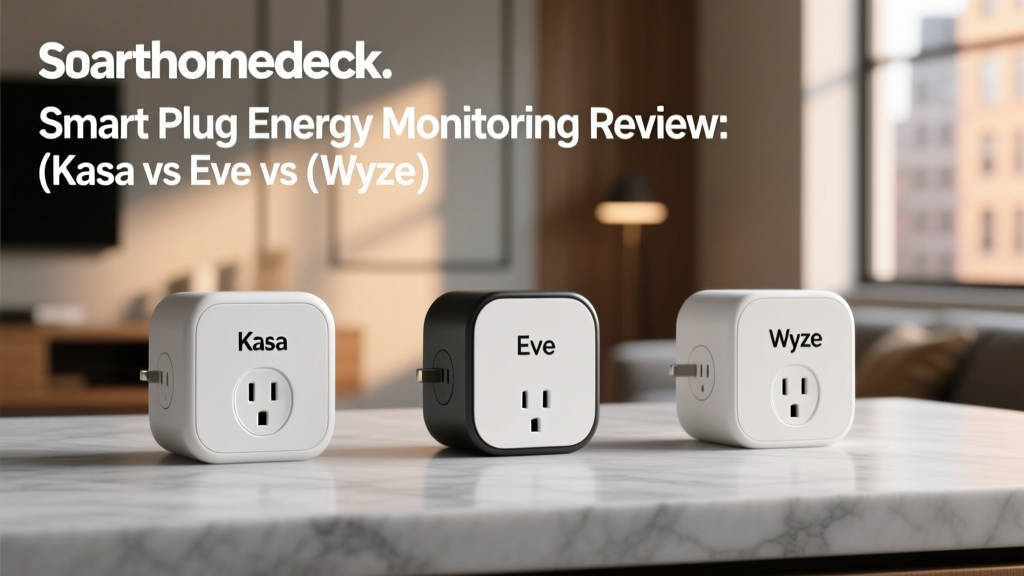
In this comprehensive review, we put three of the most popular energy-monitoring smart plugs to the test: the TP-Link Kasa KP115, the Eve Energy (Matter/Thread), and the Wyze Plug. We evaluated them strictly through the lens of energy efficiency, power draw accuracy, standby consumption, and long-term return on investment (ROI).
Our Testing Methodology
To ensure our findings are rooted in empirical data rather than manufacturer claims, we designed a rigorous 30-day testing protocol. Our methodology focused on three core metrics:
- Standby Power Consumption: Using a calibrated Kill A Watt P3 P4400 meter, we measured how much power each smart plug draws from the wall when the connected device is turned off, but the plug's internal relay and wireless radios remain active.
- Measurement Accuracy: We compared the real-time wattage and cumulative kilowatt-hour (kWh) readings reported by each manufacturer's app against the baseline readings from our Kill A Watt meter. We tested across various load types, including a 1,500W space heater (high resistive load), a 150W desktop PC (variable switching load), and a 500W window AC unit (inductive compressor load).
- Thermal Efficiency: Using a FLIR thermal imaging camera, we monitored the physical heat dissipation of each plug under continuous maximum load. In electrical engineering, heat is a direct byproduct of inefficiency and wasted energy.
"A smart plug that saves you 5 watts of vampire power but consumes 2 watts itself in standby mode is only half as effective as its marketing suggests. Net savings are what truly matter."
TP-Link Kasa KP115: The Wi-Fi Workhorse
The TP-Link Kasa KP115 has long been the gold standard for budget-friendly energy monitoring. Operating on a 2.4GHz Wi-Fi connection, it does not require a proprietary hub, making it highly accessible for the average consumer.
Performance and Accuracy
During our 30-day test with the 500W window AC unit, the Kasa app's cumulative kWh tracking deviated by only 1.2% from the Kill A Watt baseline. This is an exceptional level of accuracy for a consumer-grade shunt resistor. When testing the variable load of the desktop PC, the Kasa app updated its real-time wattage draw every 2 seconds, which is sufficient for most energy audits.
Standby Draw and Thermal Efficiency
Where the Kasa KP115 truly shines in our energy efficiency testing is its standby power draw. We measured a remarkably low 0.3 watts of standby consumption. Even when left in the wall for an entire year, the plug itself will only consume about 2.6 kWh, costing pennies. Thermally, the unit ran cool, peaking at just 34°C (93°F) under a continuous 1,200W load, indicating high-quality internal components and minimal resistive heat loss.
Ecosystem and Limitations
The primary drawback of the Kasa ecosystem is its reliance on Wi-Fi. If you have 20 Kasa plugs, your router's DHCP table will be flooded, potentially causing network congestion. Furthermore, it lacks native support for the new Matter standard, locking you into TP-Link's proprietary cloud or local integrations like IFTTT and basic Alexa/Google Home routines.
Eve Energy: The Thread-Powered Premium Choice
The Eve Energy represents the premium tier of smart plugs. Originally built for Apple HomeKit, the latest iteration supports both Thread and the new Matter standard. This plug is designed for the advanced smart home enthusiast who values network efficiency as much as electrical efficiency.
Performance and Accuracy
Eve Energy delivered the highest accuracy in our testing group, with a mere 0.8% deviation from the Kill A Watt meter over a 30-day period. The Eve app provides incredibly detailed projections, calculating your estimated monthly and yearly costs based on your local utility rates, and even estimates the carbon footprint of your appliance usage.
Standby Draw and Network Efficiency
From an energy efficiency perspective, the Eve Energy is a marvel. It recorded the lowest standby power draw of the test at just 0.2 watts. But the real efficiency story is its use of the Thread protocol. As highlighted by the Connectivity Standards Alliance (CSA), Thread is a low-power, mesh-networking protocol specifically designed for IoT devices. Unlike Wi-Fi plugs that constantly draw power to maintain a high-bandwidth connection to a router, the Eve Energy uses a fraction of the radio power to communicate with your Thread border router (like an Apple TV or HomePod). This makes it vastly superior for homes deploying dozens of energy monitors.
Ecosystem and Limitations
The Eve Energy is expensive, often retailing between $40 and $50 per unit. At that price point, the ROI based purely on energy savings takes significantly longer to achieve. However, if you are building a Matter-compatible, Thread-based smart home, the premium is justified by the network stability and future-proofing it provides.
Wyze Plug: The Budget Contender
Wyze has built its brand on aggressive pricing, and the Wyze Plug is no exception, often found for under $15. But when it comes to precise energy monitoring and electrical efficiency, corners had to be cut.
Performance and Accuracy
The Wyze Plug's energy monitoring feature feels like an afterthought compared to Kasa and Eve. The app only updates real-time wattage every 5 to 7 seconds, which makes it frustrating to use when trying to isolate the exact power draw of a device cycling on and off, like a refrigerator compressor. Furthermore, its cumulative kWh tracking deviated by 3.5% from our baseline meter. While acceptable for general awareness, it is not accurate enough for precise financial auditing or solar offset calculations.
Standby Draw and Thermal Efficiency
The Wyze Plug recorded the highest standby power draw in our test at 0.5 watts. While half a watt may seem negligible, if you deploy ten of these plugs around your home, they are collectively drawing 5 watts continuously, just to exist. Thermally, the Wyze Plug ran the hottest, reaching 41°C (105°F) under a 1,200W load. This indicates cheaper internal MOSFETs and shunt resistors that waste a small percentage of passing electricity as heat.
Ecosystem and Limitations
Wyze's ecosystem is heavily gated behind its own app. While it integrates with Alexa and Google Assistant, the energy monitoring data is rarely exposed to third-party dashboards like Home Assistant without complex workarounds. It is a Wi-Fi only device, contributing to router clutter.
Head-to-Head Data Comparison
Below is a structured breakdown of how these three devices performed in our energy efficiency and power draw testing.
| Feature | Kasa KP115 (TP-Link) | Eve Energy (Matter) | Wyze Plug |
|---|---|---|---|
| Standby Power Draw | 0.3W | 0.2W | 0.5W |
| Measurement Accuracy | ± 1.2% | ± 0.8% | ± 3.5% |
| Max Continuous Load | 15A (1,800W) | 15A (1,800W) | 15A (1,800W)* |
| Wireless Protocol | Wi-Fi (2.4GHz) | Thread / Matter | Wi-Fi (2.4GHz) |
| Avg. Retail Price | $20 | $45 | $15 |
| Thermal Efficiency | Excellent (34°C) | Excellent (32°C) | Fair (41°C) |
*Note: While the Wyze Plug is rated for 15A, Wyze's documentation recommends a 10A continuous load for optimal longevity and safety.
Standby Power Consumption and Measurement Accuracy Deviation
ROI: Do Energy Monitoring Plugs Pay for Themselves?
The ultimate question for any energy efficiency upgrade is the Return on Investment (ROI). Let's look at a real-world scenario: a large entertainment center (TV, soundbar, gaming console, streaming boxes) that draws 15 watts of vampire power when turned "off" via remote control.
- Daily Waste: 15 watts x 16 hours (assuming 8 hours of actual use) = 240 watt-hours (0.24 kWh) per day.
- Annual Waste: 0.24 kWh x 365 days = 87.6 kWh per year.
- Annual Cost: At the US national average electricity rate of $0.16 per kWh, this phantom load costs you $14.01 per year.
If you purchase a Kasa KP115 for $20, and use its scheduling feature to completely cut power to the entertainment center between 1:00 AM and 7:00 AM (saving roughly $3.50 a year), the plug will pay for itself in pure energy savings in about 5.7 years. However, if you use the plug's monitoring data to identify and replace an ancient, inefficient desktop PC that wastes 30 watts in sleep mode, the ROI drops to under 2 years.
The Eve Energy, at $45, will take over 12 years to pay for itself purely through vampire load elimination. Its value proposition relies heavily on network efficiency, Matter compatibility, and the premium build quality, rather than raw financial ROI. The Wyze Plug pays for itself in 4 years, but its higher standby draw and thermal inefficiency eat into your net savings.
SmartHomeDeck Scores & Final Verdict
Our Deck Scores evaluate products across five critical dimensions tailored to the smart home enthusiast.
TP-Link Kasa KP115
- Performance: 9/10 (Highly accurate, excellent thermal management)
- Value: 10/10 (The undisputed king of price-to-performance)
- Compatibility: 7/10 (Lacks Matter, relies on Wi-Fi)
- Ease-of-Use: 9/10 (Kasa app is intuitive and reliable)
- Features: 8/10 (Good historical data, lacks granular cost projections)
- Deck Score: 8.6 / 10
Verdict: The Kasa KP115 is the best overall choice for 90% of homeowners. It offers near-reference-grade accuracy at a price point that makes deploying them throughout the home financially viable.
Eve Energy (Matter/Thread)
- Performance: 10/10 (Flawless accuracy, lowest standby draw)
- Value: 6/10 (High entry price limits mass deployment)
- Compatibility: 10/10 (Thread and Matter ensure future-proofing)
- Ease-of-Use: 8/10 (Requires a Thread border router for optimal use)
- Features: 9/10 (Excellent cost and carbon projections)
- Deck Score: 8.6 / 10
Verdict: The Eve Energy is the mandatory choice for advanced users building a Thread/Matter mesh network. The premium price buys you network stability, ultra-low standby power, and top-tier accuracy.
Wyze Plug
- Performance: 6/10 (Sluggish updates, higher thermal output)
- Value: 8/10 (Very cheap, but you get what you pay for)
- Compatibility: 6/10 (Closed ecosystem, Wi-Fi only)
- Ease-of-Use: 8/10 (Simple app, easy onboarding)
- Features: 6/10 (Basic monitoring, lacks deep historical exports)
- Deck Score: 6.8 / 10
Verdict: The Wyze Plug is only recommended if you are already deeply entrenched in the Wyze ecosystem and need a cheap, basic on/off switch with a rough estimate of power draw. For serious energy auditing, look elsewhere.
Conclusion
When it comes to energy efficiency and power draw testing, the hardware inside the smart plug matters just as much as the appliance it controls. The TP-Link Kasa KP115 strikes the perfect balance of accuracy, low standby consumption, and affordability, making it our top pick for tackling vampire power. For those willing to invest in the future of smart home connectivity, the Eve Energy proves that Thread and Matter aren't just buzzwords—they are tangible pathways to a more efficient, low-power smart home mesh.