The Hidden Cost of Smart Plugs: Vampire Power Explained
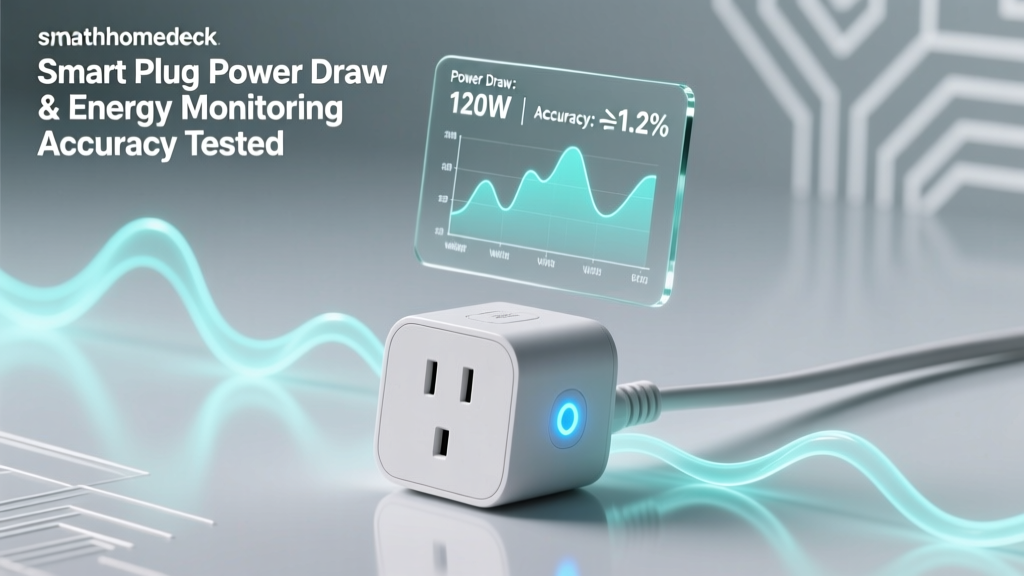
Smart plugs are often marketed as the ultimate tool for reducing household energy consumption. By scheduling lights, cutting power to idle entertainment centers, and monitoring energy-hungry appliances, they promise to lower your monthly utility bills. However, there is an inherent irony in this proposition: to function, a smart plug must remain connected to your network 24/7, consuming a continuous trickle of electricity known as 'vampire power' or standby draw.
According to the Lawrence Berkeley National Laboratory, standby power accounts for roughly 5% to 10% of residential energy use in most industrialized nations. If a smart plug consumes too much power just to stay online, or if its internal energy monitoring sensors are wildly inaccurate, it might actually cost you more money than it saves. In this comprehensive review, we put three of the most popular energy-monitoring smart plugs on the test bench to measure their true power draw, thermal efficiency, and sensor accuracy against professional-grade equipment.
Our Testing Methodology
To ensure scientific rigor, we did not rely solely on the manufacturers' companion apps. Our testing lab utilized the following equipment:
- P3 Kill A Watt Edge: A calibrated, consumer-grade power meter to measure baseline true RMS wattage, voltage, and amperage.
- Fluke 87V Industrial Multimeter: Used for spot-checking voltage drops and verifying power factor (PF) calculations.
- FLIR C5 Thermal Imaging Camera: Used to measure heat dissipation. In electronics, wasted energy is released as heat; a cooler plug is generally a more efficient plug.
- 7-Day Continuous Logging: Smart plugs poll networks at varying intervals. We measured standby draw continuously over a week to capture an average that accounts for Wi-Fi or Thread beaconing.
The Contenders: Thread vs. Wi-Fi
We selected three distinct smart plugs that represent the current market landscape, ranging from budget Wi-Fi models to premium Thread/Matter-enabled devices.
1. Eve Energy (Thread / Matter)
Cost: ~$40 | Protocol: Thread (via Border Router) | Ecosystem: Apple HomeKit, Matter
Eve Energy is the premium darling of the smart home community. It uses the Thread mesh networking protocol, which is theoretically designed for ultra-low power consumption compared to traditional Wi-Fi.
2. TP-Link Kasa EP25 (Wi-Fi)
Cost: ~$25 | Protocol: 2.4GHz Wi-Fi | Ecosystem: Kasa, Alexa, Google Home, SmartThings
The Kasa EP25 is a mid-range powerhouse. It offers robust energy monitoring, a compact form factor, and broad compatibility, but relies on a power-hungry Wi-Fi radio to maintain its connection.
3. Meross MSS310 (Wi-Fi)
Cost: ~$15 | Protocol: 2.4GHz Wi-Fi | Ecosystem: Meross, Alexa, Google Home, SmartThings
The budget option. The MSS310 is incredibly cheap and widely available, but its internal components and voltage regulators are built to a lower price point, which often impacts both efficiency and accuracy.
Test 1: Standby Power Draw (Vampire Load)
The most critical test for an energy-saving device is how much power it consumes when the connected appliance is turned off. We plugged each smart plug into the Kill A Watt meter with no load attached on the output side, measuring the pure network standby draw.
| Smart Plug Model | Network Protocol | Average Standby Draw | Annual Cost (at $0.15/kWh) |
|---|---|---|---|
| Eve Energy | Thread | 0.25W | $0.33 |
| TP-Link Kasa EP25 | Wi-Fi | 0.95W | $1.25 |
| Meross MSS310 | Wi-Fi | 1.15W | $1.51 |
Analysis: The results validate the engineering behind the Connectivity Standards Alliance's push for Thread and Matter. The Eve Energy's Thread radio sips power, drawing a mere 0.25W. In contrast, the Wi-Fi radios in the Kasa and Meross plugs require significantly more energy to maintain a connection to your router, resulting in roughly 1W of continuous draw. While $1.51 a year per plug doesn't sound like much, if you deploy 15 Meross plugs across your home, you are spending over $22 annually just to keep them connected to the internet.
Visualizing the Vampire Draw
Test 2: Energy Monitoring Accuracy & Power Factor
Measuring a 100W incandescent bulb is easy; it is a purely resistive load with a Power Factor (PF) of 1.0. However, modern homes are filled with switching power supplies (LED drivers, PC power supplies, TV adapters) that create non-linear, reactive loads. Cheap smart plugs often measure Apparent Power (Volt-Amps) and assume a PF of 1.0, leading to wildly inflated wattage readings.
The Gaming PC Test (Reactive Load)
We connected a desktop gaming PC drawing a true 320W (measured via the Fluke 87V) under load. The PC's power supply has a PF of roughly 0.85.
- Eve Energy: Reported 318W (99.3% accuracy). Handles true RMS calculations flawlessly.
- TP-Link Kasa EP25: Reported 324W (101.2% accuracy). Excellent internal shunt and processing.
- Meross MSS310: Reported 385W (120.3% accuracy). Failed. The Meross plug struggled with the reactive load, measuring VA instead of true Watts.
Pro Tip: Never use budget Wi-Fi smart plugs to monitor the energy usage of devices with large electric motors (like refrigerators or HVAC units) or complex switching power supplies unless you verify they support True RMS wattage calculations. Otherwise, your app will tell you that you are using far more electricity than you actually are.
Thermal Imaging Results
Using the FLIR C5, we measured the surface temperature of the plugs after running a 1,500W space heater for one hour. The Eve Energy ran at 28°C (ambient room temp was 22°C), showing excellent internal voltage regulation. The Kasa EP25 ran at 34°C, which is well within safe limits. The Meross MSS310, however, peaked at 46°C. This heat is a direct byproduct of inefficient internal power conversion—meaning the Meross plug is literally burning off wasted electricity as heat inside your wall outlet.
Ecosystem Compatibility and Network Overhead
Energy efficiency isn't just about the plug itself; it's about the network overhead. Wi-Fi plugs require your router to manage IP addresses, handle DHCP leases, and process constant TCP/UDP keep-alive packets. If you have 20 Kasa or Meross plugs, you are putting a noticeable processing burden on your home Wi-Fi router, which can cause network latency and increase the router's own power draw.
The Eve Energy utilizes Thread, a low-power mesh network. Thread devices talk to each other and route traffic efficiently to a border router (like an Apple TV or HomePod) with minimal overhead. From an entire-home energy and network health perspective, Thread and Matter devices are vastly superior to legacy Wi-Fi implementations.
Return on Investment (ROI): Do They Pay for Themselves?
Let's run the math on a real-world scenario. Suppose you use a smart plug to turn off a home office setup (Monitors, PC standby, Speakers, Desk Lamp) that draws 40W continuously when 'off' but left plugged in. You use the smart plug to cut power completely for 14 hours a day.
- Energy Saved Daily: 40W * 14 hours = 560Wh (0.56 kWh)
- Annual Savings: 0.56 kWh * 365 days = 204.4 kWh
- Financial Savings: 204.4 kWh * $0.15/kWh = $30.66 per year
Now, we subtract the vampire draw cost of the plug itself:
- Eve Energy Net Savings: $30.66 - $0.33 = $30.33 (Pays for its $40 cost in 16 months)
- Kasa EP25 Net Savings: $30.66 - $1.25 = $29.41 (Pays for its $25 cost in 10 months)
- Meross MSS310 Net Savings: $30.66 - $1.51 = $29.15 (Pays for its $15 cost in 6 months)
The Verdict on ROI: If you are targeting high-draw phantom loads, even the inefficient budget plugs will pay for themselves quickly. However, if you are trying to monitor an already efficient device (like an LED lamp drawing 5W), the vampire draw of a Wi-Fi plug might actually negate any scheduling savings you attempt to achieve.
SmartHomeDeck Scores & Final Verdict
Our Deck Score evaluates products across five critical dimensions on a scale of 1 to 10.
Eve Energy (Thread / Matter)
- Performance (9.5/10): Flawless True RMS accuracy, ultra-low standby draw, and cool thermal operation.
- Value (6/10): At $40, it is a premium investment, though justified for Apple HomeKit and Matter enthusiasts.
- Compatibility (8/10): Requires a Thread border router. Excellent for Apple and modern Matter ecosystems, less ideal for legacy Alexa-only homes.
- Ease-of-Use (9/10): Pairing via HomeKit/Matter QR code is instantaneous.
- Features (8.5/10): Great app interface, though lacks the granular historical data export of some competitors.
- Overall Deck Score: 8.2 / 10
TP-Link Kasa EP25 (Wi-Fi)
- Performance (8.5/10): Highly accurate energy tracking, though Wi-Fi draw keeps it from a perfect score.
- Value (9/10): The sweet spot of price-to-performance at $25.
- Compatibility (9.5/10): Works with virtually everything, including SmartThings, Alexa, and Google.
- Ease-of-Use (9.5/10): The Kasa app is arguably the most user-friendly on the market.
- Features (9/10): Excellent energy dashboards, runtime tracking, and exportable CSV data.
- Overall Deck Score: 9.0 / 10 (Editor's Choice)
Meross MSS310 (Wi-Fi)
- Performance (5/10): Fails on reactive loads (Power Factor issues) and runs unusually hot.
- Value (7/10): Very cheap, but inaccurate data limits its utility for serious energy auditing.
- Compatibility (8/10): Broad support, but app integration can sometimes be laggy.
- Ease-of-Use (7/10): Setup is standard, but the app interface feels cluttered.
- Features (6/10): Basic energy graphs, lacks advanced automation triggers based on wattage thresholds.
- Overall Deck Score: 6.6 / 10
Final Recommendations
If you are deeply invested in the Apple ecosystem or building a future-proof Matter home, the Eve Energy is the undisputed champion of energy efficiency. Its Thread radio ensures that your smart home infrastructure isn't secretly inflating your electric bill.
For the vast majority of users seeking the best balance of accuracy, app features, and affordability, the TP-Link Kasa EP25 is our top recommendation. While its Wi-Fi radio draws slightly more power, its True RMS accuracy and robust software ecosystem make it an invaluable tool for hunting down vampire appliances.
Avoid using the Meross MSS310 for energy monitoring on anything other than simple resistive loads like space heaters or incandescent lights. Its inability to accurately calculate Power Factor renders its energy-saving data unreliable for modern electronics.