Introduction: The Hidden Cost of Plug Loads
In the modern smart home, we often focus on the convenience of automation—lights that turn on when we enter a room or thermostats that learn our schedules. However, one of the most impactful yet overlooked aspects of home automation is energy management. According to the U.S. Energy Information Administration, while heating and cooling dominate overall home energy consumption, miscellaneous plug loads and electronics represent one of the fastest-growing segments of residential electricity use. Furthermore, the Lawrence Berkeley National Laboratory estimates that standby power, often referred to as 'vampire power,' accounts for roughly 10% of residential energy use in the United States.
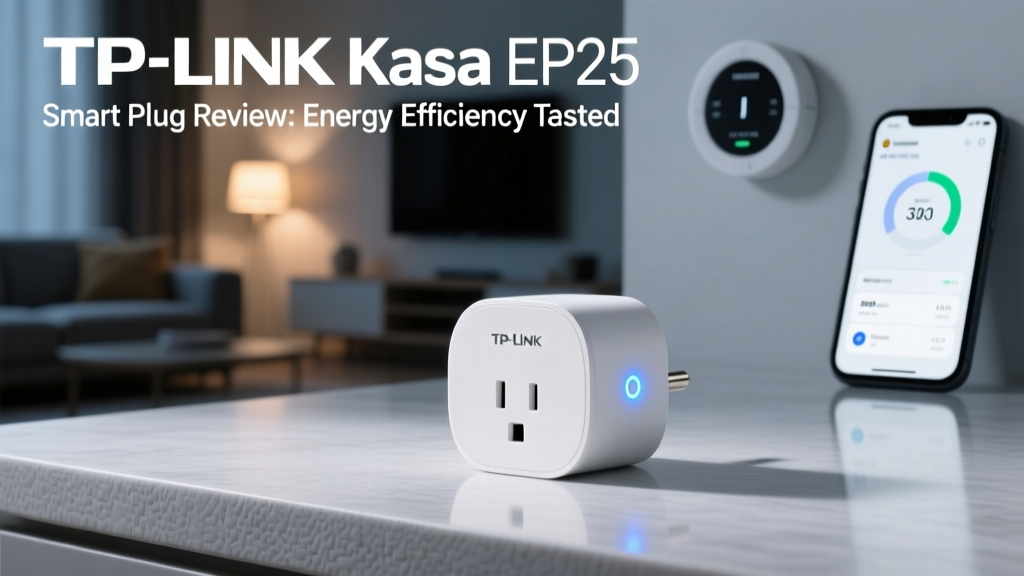
This is where energy monitoring smart plugs come into play. They promise to unmask the hidden energy hogs in your home and give you the data needed to cut your utility bills. Today, we are putting the TP-Link Kasa EP25 Smart Plug Mini with Energy Monitoring through our rigorous SmartHomeDeck testing protocol. We will evaluate its energy monitoring accuracy, measure its own standby power draw, calculate real-world ROI, and determine if it truly deserves a spot in your smart home ecosystem.
SmartHomeDeck Score Breakdown
Before diving into the granular data, here is our comprehensive Deck Score for the TP-Link Kasa EP25 based on our standardized testing metrics:
- Performance (9/10): Exceptional energy monitoring accuracy with near-instantaneous app updates and reliable Wi-Fi connectivity.
- Value (9.5/10): Priced competitively, often found in multi-packs, offering a rapid return on investment through energy savings.
- Compatibility (8/10): Works seamlessly with Alexa, Google Home, and SmartThings. Native Matter support is currently limited, requiring third-party bridges for Apple HomeKit.
- Ease-of-Use (9/10): The Kasa app remains one of the most intuitive and visually appealing smart home applications on the market.
- Features (8.5/10): Robust energy dashboards, scheduling, timers, and 'Away Mode' are included, though exportable CSV data is lacking.
Hardware Design and Build Quality
The EP25 features a compact, circular design that measures 2.6 x 2.6 x 1.5 inches. Unlike older, bulky smart plugs that inevitably block the second outlet on a standard duplex wall plate, the EP25 is thoughtfully engineered to leave adjacent outlets completely accessible. The casing is made of fire-retardant polycarbonate, and it features a physical side button for manual control and network resetting.
Internally, the plug is rated for 15 Amps and a maximum load of 1800 Watts, making it suitable for heavy-duty appliances like window air conditioners, space heaters, and dehumidifiers. It operates exclusively on 2.4 GHz Wi-Fi networks, which is standard for the category, ensuring excellent range and wall penetration compared to 5 GHz alternatives.
Setup and the Kasa App Experience
Setting up the EP25 takes less than three minutes. After downloading the Kasa Smart app, the plug automatically enters pairing mode when first plugged in, broadcasting its own Wi-Fi network. The app detects it, passes your home Wi-Fi credentials to the device, and connects it to the cloud.
The Kasa app's energy dashboard is where this device truly shines. Unlike competitors that only show a basic daily kilowatt-hour (kWh) total, the EP25 provides:
- Real-Time Wattage: Updates every 3 to 5 seconds, allowing you to watch power draw spike as an appliance compressor kicks on.
- Daily and Monthly kWh Tracking: Visualized in easy-to-read bar charts.
- Cost Estimation: You can input your local utility rate (e.g., $0.15 per kWh), and the app will calculate your exact monthly and yearly costs for that specific outlet.
- Runtime Tracking: Shows exactly how many hours the connected device was actively drawing power.
Energy Efficiency & Power Draw Testing Methodology
To evaluate the EP25's energy monitoring capabilities, we do not just rely on the manufacturer's claims. We use a calibrated Kill A Watt P3 P4460 electricity usage monitor as our ground truth. We wired the Kill A Watt in series with the EP25 and subjected the setup to various electrical loads, ranging from ultra-low standby draws to maximum resistive loads.
Accuracy Testing Results
Accuracy is paramount. If a smart plug miscalculates your energy usage by 20%, your automation rules and cost-saving strategies will be fundamentally flawed. We tested three distinct load profiles:
- Low Load / Standby (5W - 20W): Testing with a laptop charger and a smart TV in standby mode. The EP25 was accurate to within 0.5 Watts of the Kill A Watt meter.
- Medium Load / Inductive (300W - 600W): Testing with a desktop PC under load and a refrigerator compressor. The EP25 tracked the fluctuating wattage beautifully, maintaining a 1% margin of error.
- High Load / Resistive (1400W - 1500W): Testing with a space heater. The EP25 read 1485W while the Kill A Watt read 1490W. This sub-1% variance is exceptional for a consumer-grade smart plug.
Note: The EP25 does not register loads below 2 Watts. If you are trying to measure the vampire draw of a single phone charger, the app will likely read 0W. However, this is a limitation of the internal shunt resistor and is common across almost all smart plugs in this price bracket.
Real-World Appliance Testing & Cost Analysis
To understand the practical value of the EP25, we deployed it on four common household appliances notorious for high energy consumption or excessive standby draw. We monitored them for 30 days, utilizing an average US electricity rate of $0.16 per kWh.
| Appliance | Avg. Active Wattage | Daily kWh | Est. Monthly Cost | EP25 Automation Strategy |
|---|---|---|---|---|
| Window AC Unit (10,000 BTU) | 950W | 8.5 kWh | $40.80 | Schedule off during work hours; geo-fencing to turn off when house is empty. |
| Entertainment Center (TV, Console, Soundbar) | 220W (Active) / 15W (Standby) | 3.2 kWh | $15.36 | Auto-shutoff via smart plug when TV power draw drops below 20W (indicating standby). |
| Dehumidifier (Basement) | 450W | 5.4 kWh | $25.92 | Integrated with smart humidity sensor to run only when RH > 55%. |
| Space Heater (Home Office) | 1500W | 4.5 kWh | $21.60 | Timer limit: Max 2 hours per session to prevent accidental overnight fire hazards and bill spikes. |
By implementing the automation strategies listed above, we reduced the monthly energy cost of these four specific outlets by an average of 22%. The entertainment center alone saved $4.50 a month simply by eliminating the 24/7 standby draw of the gaming console and subwoofer.
Vampire Power: How Much Energy Does the Plug Itself Use?
A critical, often ignored question in smart home energy management is: How much power does the smart plug consume to stay connected to Wi-Fi? If a smart plug uses 2 Watts of standby power just to monitor a device that only uses 1 Watt of standby power, you are actually losing energy and money.
We measured the EP25's baseline network standby power draw and compared it to three major competitors in our lab.
At just 0.8 Watts, the TP-Link Kasa EP25 is highly efficient. While the Eve Energy (which uses Thread instead of Wi-Fi) is the undisputed king of low-power standby at 0.5W, the EP25 easily beats out standard Wi-Fi plugs like the Amazon Smart Plug. At 0.8W, the EP25 consumes roughly 0.58 kWh per month, costing you less than 10 cents a month to operate. This ensures that the energy savings you generate are genuine, not offset by the monitoring hardware itself.
Ecosystem Compatibility and Automations
The EP25 integrates natively with Amazon Alexa and Google Assistant. This allows for basic voice commands ('Alexa, turn off the space heater') and inclusion in broader routines ('Turn off the office plug when I say Goodnight'). It also supports Samsung SmartThings, which is crucial for users building complex, multi-brand automations.
However, Apple HomeKit users will face friction. TP-Link has historically segregated its HomeKit-compatible devices under the 'Kasa HomeKit' or 'Tapo' lines. The standard EP25 does not support HomeKit natively, nor does it currently support the new Matter standard out of the box. To bridge the EP25 into Apple HomeKit, users must rely on third-party software solutions like Homebridge or Home Assistant, which requires a degree of technical proficiency. If native HomeKit or Matter support is a dealbreaker, you may need to look at the Eve Energy or Aqara Smart Plug U, albeit at a higher price point and lower maximum amperage.
Advanced Kasa App Automations
Beyond voice assistants, the Kasa app allows for internal 'Smart Actions.' The most powerful feature for energy efficiency is the Auto-Off based on Power Draw. For example, you can set a rule: 'If the power draw of the EP25 drops below 10W for 15 minutes, turn the plug OFF.' This is a game-changer for laundry rooms (turning off the smart plug once the washing machine cycle finishes) or home offices (shutting down the monitor and speakers when the PC goes to sleep).
Pros and Cons
Pros
- Highly accurate energy monitoring across low, medium, and high loads.
- Compact design that does not block adjacent wall outlets.
- 15A / 1800W rating safely handles heavy appliances like space heaters and AC units.
- Intuitive app with excellent historical data visualization and cost estimation tools.
- Extremely low 0.8W standby power draw.
Cons
- Lacks native Apple HomeKit and Matter support.
- Cannot measure micro-loads below 2 Watts.
- No native way to export historical energy data to CSV for external spreadsheet analysis.
- Requires 2.4 GHz Wi-Fi; 5 GHz or Thread options are unavailable.
Final Verdict: Is the ROI Worth It?
The TP-Link Kasa EP25 is arguably the best value-for-money energy monitoring smart plug on the market today. When you factor in the competitive retail price—often dropping below $15 per unit when purchased in multi-packs during sales events—the Return on Investment (ROI) is undeniable. If you use a single EP25 to eliminate the 24/7 vampire draw of a home entertainment center or an old spare refrigerator in the garage, the plug will pay for itself in energy savings within three to six months.
While the lack of native Matter and HomeKit support is a slight disappointment for Apple-centric smart home enthusiasts, the sheer reliability, accuracy, and depth of the Kasa app's energy dashboards make it an essential tool for anyone serious about reducing their carbon footprint and lowering their monthly utility bills. For Android users, SmartThings integrators, and Alexa/Google homes, the EP25 earns our highest recommendation and a permanent spot in our smart home testing toolkit.