The Smart Home Ecosystem Wars: Flagship Hubs Compared
The modern smart home is no longer a collection of disjointed gadgets responding to isolated voice commands. Today, it is a cohesive, automated ecosystem reliant on central nervous systems: flagship smart speakers. As the ecosystem wars rage on between Amazon Alexa, Google Home, and Apple HomeKit, the choice of your primary smart speaker hub dictates not only the audio quality of your living space but the boundaries of your device interoperability, privacy, and automation capabilities. For smart home enthusiasts and casual users alike, selecting the right flagship device is the most critical decision in building a connected home.
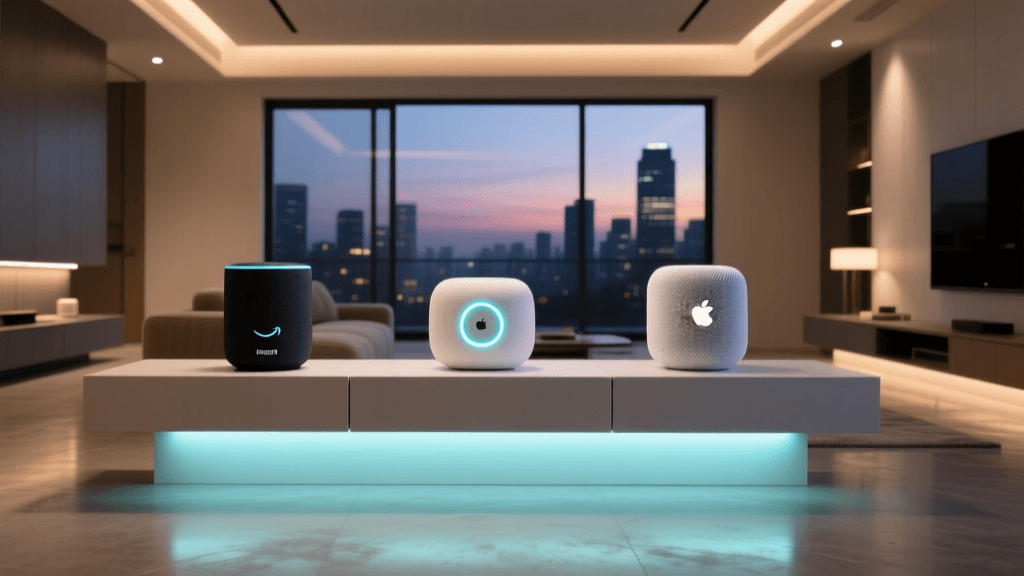
In this comprehensive showdown, we pit the heavyweights against one another: the Amazon Echo Studio, the Google Nest Audio, and the Apple HomePod (2nd Generation). We will dissect their acoustic engineering, smart home hub protocols, ecosystem lock-in factors, and privacy architectures to help you determine which flagship smart speaker deserves the centerpiece position in your home.
Amazon Echo Studio: The Alexa Powerhouse
The Amazon Echo Studio is the undisputed heavyweight champion of the Alexa ecosystem, designed for users who demand high-fidelity audio alongside aggressive smart home integration. Priced around $199, the Studio is not just a speaker; it is a fully-fledged smart home hub equipped with a built-in Zigbee radio and Matter controller. This means you can connect compatible smart locks, lights, and sensors directly to the speaker without needing a third-party bridge or hub, significantly reducing network clutter and latency.
From an audio perspective, the Echo Studio boasts a five-speaker array, including a 3.0-inch neodymium woofer, three 2.0-inch midrange drivers, and a 1.0-inch tweeter. It supports Dolby Atmos and Sony 360 Reality Audio, utilizing spatial audio processing to create a room-filling, three-dimensional soundstage. The built-in room adaptation technology continuously analyzes the acoustics of your space and fine-tunes the audio output to ensure optimal sound quality, regardless of where you place it.
Alexa’s ecosystem remains the most expansive in the market, with over 100,000 third-party skills and compatibility with virtually every major smart home brand. The Echo Studio serves as the perfect anchor for complex Alexa Routines, allowing you to trigger multi-step automations based on voice, time, or sensor data. However, the sheer volume of Alexa-compatible devices can sometimes lead to a fragmented user experience, requiring careful curation of your connected device list to maintain reliable voice control.
Google Nest Audio: The Brainy Assistant
Google’s Nest Audio takes a fundamentally different approach, prioritizing artificial intelligence, natural language processing, and seamless integration with Google’s vast suite of web services. Priced at an accessible $99, the Nest Audio is a more budget-friendly flagship contender, though it makes specific compromises in local hub capabilities. Unlike the Echo Studio, the Nest Audio lacks a built-in Zigbee or Thread radio. While it supports Matter over Wi-Fi, users looking to build a robust local smart home network will still need a dedicated Nest Hub or Thread border router to manage low-power devices efficiently.
Acoustically, the Nest Audio is a marvel of machine learning. It features a 75mm woofer and a 19mm tweeter, encased in a rigid, fabric-wrapped shell designed to minimize distortion. Google utilizes ambient EQ and media EQ to automatically adjust the sound profile based on the type of content you are playing and the ambient noise in the room. While it may not reach the sheer decibel levels or spatial immersion of the Echo Studio, the Nest Audio delivers a remarkably balanced, warm sound profile that excels in vocal clarity and podcast reproduction.
The true strength of the Nest Audio lies in Google Assistant. It is widely regarded as the most conversational and context-aware voice assistant available. If your smart home routine involves heavy reliance on web searches, calendar management, Google Workspace integration, and multi-step conversational queries, the Nest Audio is unparalleled. Furthermore, its integration with Nest cameras and doorbells provides a cohesive security ecosystem, though it heavily incentivizes you to remain within the Google hardware umbrella for the best experience.
Apple HomePod (2nd Gen): The HomeKit Citadel
Apple’s HomePod (2nd Generation) is a fortress of privacy, premium acoustics, and seamless ecosystem integration, designed exclusively for those entrenched in the Apple universe. Priced at a premium $299, the HomePod is a masterclass in computational audio and local smart home processing. It serves as a vital HomeKit and Matter hub, featuring a built-in Thread border router that allows low-power Matter devices to communicate locally without relying on the cloud. As detailed in Apple's official HomeKit documentation, the HomePod acts as a secure home hub, enabling remote access and advanced automations while keeping data encrypted and localized.
The audio engineering in the second-generation HomePod is nothing short of spectacular. It features a custom-engineered high-excursion woofer and five horn-loaded tweeters, all powered by the S7 chip. The room-sensing technology uses the internal microphones to detect sound reflections off nearby walls and surfaces, dynamically adjusting the audio beamforming to deliver an immersive, spatial audio experience that rivals high-end dedicated sound systems. The inclusion of the U1 (Ultrawideband) chip allows for magical handoff capabilities; simply bringing your iPhone close to the top of the speaker transfers the audio seamlessly.
However, the HomePod’s brilliance is gated by its ecosystem. Siri, while vastly improved in its smart home control capabilities, still lags behind Alexa and Google Assistant in general knowledge queries and third-party integrations. The HomePod is best suited for users who prioritize HomeKit Secure Video, local automations, and an ad-free, privacy-first experience over the ability to ask their speaker obscure trivia questions.
Head-to-Head Specifications Table
To understand the hardware and protocol differences at a glance, review the comprehensive specification breakdown below:
| Feature | Amazon Echo Studio | Google Nest Audio | Apple HomePod (2nd Gen) |
|---|---|---|---|
| Price (MSRP) | $199.99 | $99.99 | $299.00 |
| Audio Drivers | 1x Woofer, 3x Midrange, 1x Tweeter | 75mm Woofer, 19mm Tweeter | 1x High-Excursion Woofer, 5x Tweeters |
| Hub Protocols | Wi-Fi, Bluetooth, Zigbee, Matter | Wi-Fi, Bluetooth, Matter (via Wi-Fi) | Wi-Fi, Bluetooth, Thread, Matter |
| Voice Assistant | Amazon Alexa | Google Assistant | Apple Siri |
| Spatial Audio | Yes (Dolby Atmos / 360 Reality) | No (Stereo Pairing Only) | Yes (Dolby Atmos / Spatial Audio) |
| Room Calibration | Automatic Room Adaptation | Ambient EQ & Media EQ | Real-time Room Sensing |
| Local Processing | Limited (Sidewalk/Zigbee) | Minimal | Extensive (Siri & HomeKit) |
Visualizing the Ecosystem Scorecard
How do these flagship devices compare across critical smart home and audio metrics? The radar chart below illustrates the relative strengths of each ecosystem based on audio fidelity, assistant intelligence, integration depth, privacy, and overall value.
Flagship Smart Speaker Ecosystem Scorecard
The Great Unifier: How Matter Changes the Game
Historically, choosing a smart speaker meant locking yourself into a proprietary ecosystem. If you bought an Echo, you bought Alexa-compatible bulbs. If you bought a HomePod, you bought HomeKit-certified plugs. Today, the Matter protocol is dismantling these walled gardens. According to the Connectivity Standards Alliance, Matter is designed to unify the fragmented smart home landscape by providing a common, IP-based connectivity layer that operates locally over Wi-Fi, Ethernet, and Thread.
Both the Echo Studio and the HomePod are exceptionally positioned for the Matter revolution. The Echo Studio’s inclusion of a Zigbee hub ensures backward compatibility with older devices while its Matter controller bridges new Thread and Wi-Fi devices into the Alexa app. The HomePod’s Thread border router makes it an ideal gateway for low-latency, low-power Matter sensors and switches, ensuring that your automations trigger instantly even if your internet connection drops.
The Nest Audio, while supporting Matter over Wi-Fi, lacks the local Thread radio found in the smaller Nest Hub. This means that to fully utilize Thread-based Matter devices in a Google Home ecosystem, you will likely need to purchase additional Thread border routers, slightly diminishing the Nest Audio's standalone value as a central hub. As the Google Store specifications for Nest Audio highlight, the device is optimized for high-quality audio and Assistant interactions, deferring heavy local mesh-networking duties to other Nest hardware.
Audio Engineering and Spatial Sound
When evaluating these devices strictly as audio equipment, the competition is fierce, but the philosophies differ. The Amazon Echo Studio is engineered for raw power and cinematic immersion. Its support for Dolby Atmos makes it a viable, albeit compact, alternative to a traditional soundbar for small to medium-sized living rooms. The upward-firing speaker creates a genuine sense of height, bouncing sound off the ceiling to envelop the listener.
The Apple HomePod (2nd Gen) focuses on precision and computational audio. Rather than relying on physical upward-firing drivers, Apple uses advanced beamforming algorithms and its five tweeters to bounce audio off walls, creating a phantom center channel and a wide stereo image. The result is a remarkably clean, audiophile-friendly sound signature that excels in instrument separation and vocal clarity. Furthermore, the ability to pair two HomePods in a stereo configuration with an Apple TV 4K creates a home theater audio experience that neither the Echo Studio nor the Nest Audio can currently match.
The Google Nest Audio, while the most modest of the three in terms of driver count, punches well above its weight class. Google’s machine learning models dynamically adjust the equalizer based on the room's ambient noise and the media type. If you are listening to a podcast, it boosts vocal frequencies; if you are playing bass-heavy music, it engages the woofer more aggressively. It lacks spatial audio, but for multi-room background music, it is incredibly reliable and pleasant.
Privacy, Security, and Local Processing
Privacy remains the most divisive battleground in the ecosystem wars. Apple has built its entire smart home strategy around the premise that your home is a private sanctuary. The HomePod processes many Siri requests on-device using the S7 chip, and HomeKit Secure Video encrypts camera footage end-to-end, storing it in your iCloud account where not even Apple can view it. For privacy-conscious consumers, the HomePod is the only logical choice.
Conversely, Amazon and Google rely heavily on cloud processing to fuel their assistants' vast knowledge bases and third-party integrations. While both companies have implemented local processing for basic smart home commands (like turning on a light) to reduce latency, complex queries, routines, and general knowledge questions are routed through their respective cloud servers. Both ecosystems offer robust privacy controls, including physical microphone mute buttons and the ability to auto-delete voice recordings, but the fundamental business models of Amazon and Google are inherently tied to data utilization in ways that Apple's hardware-centric model is not.
Final Verdict: Which Ecosystem Wins?
The ultimate winner of the flagship smart speaker showdown depends entirely on your existing hardware, your privacy tolerance, and your automation goals.
Choose the Amazon Echo Studio if:
- You want the most versatile smart home hub with built-in Zigbee and Matter support.
- You prioritize loud, immersive, spatial audio for music and casual home theater use.
- You rely on complex, multi-step Alexa Routines and want access to the largest library of third-party skills.
Choose the Google Nest Audio if:
- You value natural language processing, conversational context, and deep integration with Google Workspace and Android.
- You are building a multi-room audio setup on a budget and want excellent value for money.
- Your smart home relies primarily on Wi-Fi-based devices and cloud-controlled routines rather than local mesh networks.
Choose the Apple HomePod (2nd Gen) if:
- You are deeply embedded in the Apple ecosystem and use iPhones, iPads, and Apple TVs daily.
- Privacy, end-to-end encryption, and local processing are your top priorities.
- You want a Thread border router for Matter devices and appreciate audiophile-grade computational audio and seamless Ultrawideband handoff.
In the ongoing ecosystem wars, there is no single victor—only the platform that best aligns with your digital lifestyle. By understanding the hub capabilities, audio profiles, and privacy architectures of these flagship devices, you can confidently anchor your smart home in the ecosystem that serves you best.